
The holiness of Ratzinger: discreet and without fanfare
Benedict XVI's crystal-clear faith, reports of graces, and a personal relationship that continues beyond death. Is he a saint? Haste is the enemy of the halo, says the secretary mons. Georg Gänswein, who is now the apostolic nuncio to the Baltic States. Testimony on the third anniversary of his death.

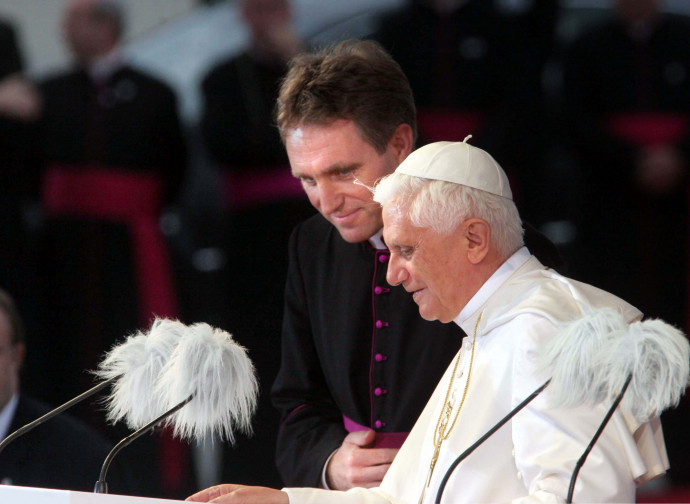
Three years ago, the enthusiastic pilgrimage to bid a final farewell to Benedict XVI, who died on 31 December 2022, prevailed over the harsh temperatures of early January, but above all it prevailed over a certain 'narrative' about the German Pope: he was indeed shy and reserved, but he was anything but cold and distant. It was evident that day at his funeral, that he had not been forgotten at all, even though almost a decade had passed since his resignation from the throne of Peter. From that crowd arose the sensus fidelium who 'detected' the scent of sainthood, perhaps hoping for the rapid beatification that he himself had permitted for his great predecessor, Wojtyla. However, it seems there is no need to rush in the case of Ratzinger, because what has emerged since then is 'a holiness without fanfare, as gentle and discreet as his personality', as testified by Monsignor Georg Gänswein, the current apostolic nuncio to Lithuania, Estonia and Latvia, and former secretary to Benedict XVI before, during and after his pontificate, in an interview with the Daily Compass.
Regarding the possible beatification of Pope Benedict, Your Excellency has said that we should leave it to the Church, which takes a long time except in rare and justified cases such as St John Paul II. Does holiness not follow the rhythms of today's 'civilisation of haste'?
Speaking of a 'civilisation of haste' in relation to holiness is a contradiction in terms. Worse still, haste is a fierce enemy of holiness. Therefore, let us allow time, not haste, to work so that the dominant criterion is the emergence of true holiness, not worldly popularity. The fama sanctitatis must mature and ultimately reveal the sanctitas of life.
Did you also notice this reputation for holiness in the homage paid to Benedict XVI by the crowd, despite him having lived hidden from the world for almost ten years?
Anyone who opened their eyes, ears, and heart could clearly perceive the sensus fidelium on that occasion three years ago. In the meantime, a quiet and discreet holiness is emerging, much like his personality.
Have you received any testimonies of graces attributed to his intercession?
Several reports have emerged so far. These include letters testifying to healings through Benedict XVI's intercession, writings speaking of particular graces received following prayers to Pope Benedict, and various types of thanksgiving for prayers answered in times of serious personal difficulty.
How has your relationship with Pope Benedict changed now that it takes place not in daily life, but in the communion of saints?
The relationship itself has not changed, but the nature of the relationship has. His physical presence has been replaced by a 'metaphysical' presence. I feel close to him every day when I pray for his help or read his homilies and study his writings. It is a strong and rewarding relationship.
Joseph Ratzinger certainly did not think of himself as a saint, but he took the call to holiness seriously. What was holiness to him?
For him, holiness was the highest and most radical realisation of the goal of life. Becoming a saint means taking the Lord's call seriously. The ways to achieve this are varied and innumerable.
Cardinal Ratzinger stated that 'the true apology of the Christian faith [...] is, on the one hand, the saints and, on the other, the beauty that faith has generated'. This is reminiscent of Florensky's comparison between 'good deeds' and 'beautiful deeds'. So, can we speak of an 'aesthetic' dimension of holiness?
We must speak of an aesthetic dimension of holiness, provided that we do not confuse 'aesthetics' with 'cosmetics'. Faith creates an external garment, or aesthetic, that is the fruit of an inner life nourished by truth and love.
This implies much more than mere intellectual depth.
While it is entirely justified to speak of Joseph Ratzinger/Benedict XVI as an intellectual, we must not confine him to this definition. It is an important aspect, but only a partial one — it is not the 'whole' Ratzinger. Before his intellectualism, we must recognise his profound and clear faith, as well as his human qualities, such as goodness, gentleness, and sincerity.
