
The bones of Saint Francis proclaim that God has redeemed the flesh
There is a common thread linking the disputes surrounding the body of the ‘Poverello’ with the veneration of his mortal remains in Assisi today. Christianity is not spiritualism; the Word can also be seen and touched in the material traces left by a holy life.


‘You are not handsome, you are not learned, you are not noble; so why should the whole world follow you?’
To Brother Masseo da Marignano's all too frank question, St Francis of Assisi replied that God ‘has found no creature more vile on earth, and therefore he has chosen me to confound the nobility, greatness, strength, beauty and wisdom of the world, so that it may be known that every virtue and every good thing comes from him, and not from creatures’. In the exchange recorded in the Fioretti, alongside the saint's humility, the contrast emerges between the charm that Francis exerted and continues to exert, and his appearance, which, at least at first glance, could hardly have been impressive. 'The person was despicable, the face without beauty' is the merciless portrait painted by Thomas of Split, a view shared by other sources. However, Brother Masseo told him this to his face.
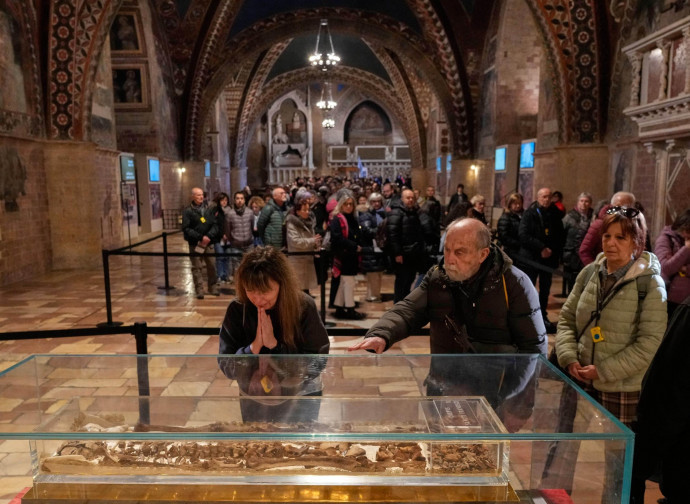
'You are not a handsome man...' we would be tempted to say eight centuries later, standing before what remains of his body. Judging by the increase in bookings, it would seem that 'the whole world is coming' to see Francis's mortal remains, which are being displayed for veneration in the Lower Basilica of Assisi for the first time in a public exhibition open from Sunday 22 February to 22 March, marking the eighth centenary of his death. 'And all this, some might say, just to see a pile of bones.' True! But it is equally true that that pile of bones represents an experience of Christian life that, for eight centuries, has fascinated people of all backgrounds and geographical locations,’ comments Monsignor Felice Accrocca on Vatican News, the bishop-elect of Assisi (he will take possession of the Umbrian diocese on 25 March). He is also a historian and teacher and the author of numerous studies on Franciscanism.
Perennially in poor health, whether due to his natural constitution, his imprisonment as a young man during the war between Perugia and Assisi, or a combination of illness and penance later in life, Francis in his later years had to ask forgiveness from his 'brother body', to which he had subjected himself to extreme hardships (including 'brother fire' for a painful and useless cauterisation procedure). As is well known, not even the Lord had spared him anything, imprinting his own wounds on Francis's body. Francis was the first person in history to be stigmatised and, along with the wounds, he also received nails whose heads were visible in the palms of his hands and on the backs of his feet, while the tips protruded from the opposite side, as Tommaso da Celano writes in the Vita prima. He also mentions the 'large scar' on Francis's right side 'pierced as if by a spear', which 'often bled, soaking his tunic and underwear with that sacred blood'.
Yet his physique, mediocre at best and often considered ugly and neglected, was a relic even while he was alive. Even before his death, his body was already a contested body, as the title of Monsignor Accrocca's essay suggests: A Contested Body, The Last Days of Francis of Assisi, Ed. Porziuncola, Assisi, 2025), recounts how the people of Assisi deployed military forces to ensure that Francis died in the city, so that no one else could take possession of his mortal remains — least of all their eternal enemies from Perugia! In the last six months, when the sick man risked dying in Siena or Bagnara, his return to Assisi was met with unanimous jubilation, as "all the people hoped that the saint of God would end his days within the walls of his city", as Tommaso da Celano recounts. But even there, they did not leave him in peace, escorting him to the bishop's palace and distrusting even the friars, until he was taken to die at the Porziuncola. Monsignor Accrocca observes that only one person could have made this final decision: Francis himself. Even as a dying man, he knew how to command respect.
The second part of the story of the 'disputed body' begins on the evening of 3 October 1226, when Francis fell asleep in the Lord. He was not buried at the Porziuncola, as it was too exposed to the risk of theft by the people of Perugia, who, as Giordano da Giano informs us, wanted to steal the body because of the wonders God had worked through Francis. Instead, he was buried "near the walls of Assisi, in the church of St George" (where the basilica dedicated to St Clare now stands). This was a temporary burial, as he would have remained an 'ordinary' patron saint if he had been buried in the cathedral. That sacred body needed a special reliquary: the great basilica, construction of which began in 1228, the year of the 'lightning' canonisation of the ‘Poverello’. He was laid to rest there in 1230. This final burial took place in great secrecy. The friars and even the papal legates were sent away so that no one would know the exact location. This remained unknown until excavations were carried out in 1818 under the leadership of Father Giuseppe De Bonis. Almost six centuries of inaccessibility fuelled legends about the body's state of preservation, with some claiming to have seen it as incorrupt and beautiful, either lying down or standing up, while others claimed it had even been resurrected.
This is a unique story even by the standards of the 'hungry' Middle Ages for relics, and it would be reductive to dismiss it as pure superstition or profane civic pride.
Setting aside the excesses and even thefts, there is a common thread linking the 13th-century Assisians' anxiety that Francis should remain in the city even (and especially!) after his death, and the pilgrimage that today leads 21st-century believers to venerate his bones. This common thread is incarnation; without it, we risk misinterpreting Franciscanism and Christianity itself. If God created our flesh and even assumed it, the mortal remains of a saint convey the mirabilia Dei — the marvellous deeds of God (Psalm 98:1). They are not merely the shells of 'pure' souls, but flesh and bones 'contaminated' by holiness and destined for resurrection at the end of time.
The Creator is not repulsed by the matter that he himself created and sanctified. In fact, it is a disembodied spirituality that is unwelcome, one that can ultimately be pieced together at will, reducing the Gospel to an anthology of good feelings or a manual for social reform. The woman with the haemorrhage desired healing, and obtained it! – by touching the hem of Christ's cloak. This is not unlike the way in which, over the centuries, people have approached the relics of saints, seeing in them a 'hem' not only of the cloak, but of Christ himself. Christianity is also, if you will pardon the expression, a visual and tactile faith. It proclaims 'what was from the beginning, what we have heard, what we have seen with our eyes, what we have looked upon and touched with our hands, concerning the Word of life' (1 Jn 1:1). This Word of life even becomes food in the Sacrament of the Eucharist, allowing itself to be seen and touched in the material traces left by a holy life.
