
Christians in the Middle East are the first victims of the war
The spiral of violence in the Middle East is driving Christians in Palestine into exile and forcing them to abandon their homeland. In Lebanon, they are marginalised; in Iran, they are persecuted; and in Syria, they are treated as geopolitical pawns. The war is not only redefining the geopolitical borders of the Middle East, but also its religious geography. This is to the detriment of Christians and demonstrates Western hypocrisy.


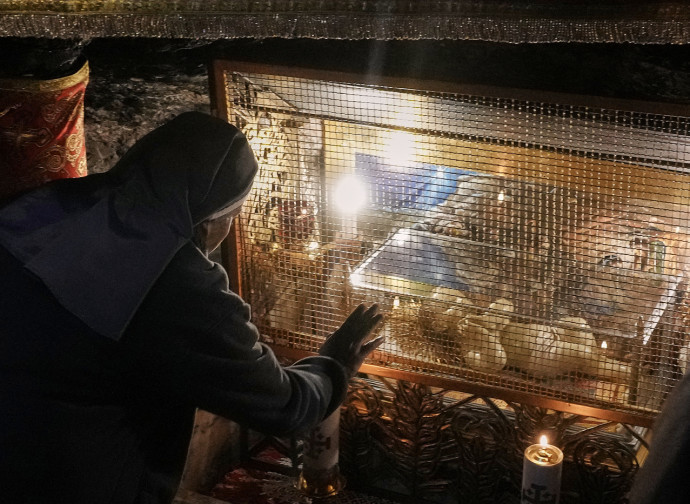
Our hearts are deeply sorrowful to learn that many Christian faithful in Palestine, affected by the war, have been scattered or forced to abandon their homes. It is 15 April 1949. In the encyclical Redemptoris Nostri Cruciatus, the then Pope Pius XII describes the tragedy of Palestinian Christians with this sentiment. It remains relevant today, as the ongoing spiral of violence continues to force Palestinian Christians into exile. In the places where Christianity was born, there is a risk that the Christian presence will dwindle inexorably. This is not a marginal issue, even if it is treated as such. Rather, it is a reality that contradicts many comforting narratives. It is not a mass exodus, but rather the inevitable consequence of wars, political crises, religious radicalisation, and international indifference.
"Christians here are not guests." The Latin Patriarch of Jerusalem, Pierbattista Pizzaballa, has been emphasising this point for some time. He says it without diplomacy. Without mincing his words. Christians are part of the history of this land. They always have been. This raises the question that many prefer to avoid: how much longer can the Christian community in Palestine survive? There is a truth that is often forgotten in Europe. Christians in the Middle East did not originate from the West. They are the descendants of some of the region's oldest peoples. They have been rooted here for centuries. Yet today, their numbers are dwindling.
The war sweeping across the Middle East, with Israel at the centre of an ever-widening conflict involving Gaza, Hezbollah-controlled Lebanon, Iran and Syria, is not just a military conflict. It is not just about ideology or geopolitics. It is also a slow hollowing out. It is a process that has been going on for years. Silent. Steady. It is demographic even before it is political. Entire historic communities are leaving the region. Some are leaving out of fear. Others out of weariness. Some simply because they no longer see a future. The result is plain for all to see: The Middle East is losing pieces of its history. Among all the region's ancient minorities, Christians are perhaps the most vulnerable. They are the hardest to ignore.
In the Holy Land, the situation is becoming increasingly paradoxical. In places visited by millions of pilgrims every year from all over the world, local Christian communities are becoming increasingly irrelevant. In Bethlehem, Jerusalem and many cities in the West Bank, the number of Christians is dwindling due to emigration. During the final months of these absurd wars, Pizzaballa himself put it in very direct terms: “The biggest problem is not just the violence. It is the lack of a future.' When a community ceases to imagine its future in a place, it will abandon that place sooner or later.
Yet Palestinian Christians have historically played an important role in local society, being educated and urbanised and often occupying key positions in cultural and political life.
Today, their primary role is as custodians of the holy sites and liturgical traditions. They are a symbolic presence rather than a community with real influence. For its part, Israel often claims to protect religious minorities within its own state. It is true that Israeli citizens of the Christian faith enjoy civil liberties that are unknown in many other countries in the region, except Jordan. However, this does not negate the growing tension: the radicalisation of the conflict and the rise of ultra-nationalist factions are making coexistence increasingly difficult there, too. The settlers are out of control and free to act against the Palestinians, safe in the knowledge that they will never be punished. It is undeniable that all this is happening.
While the Holy Land represents the demographic decline of Middle Eastern Christianity, Lebanon serves as its political laboratory. Or rather, its historical battlefield. For decades, the Land of the Cedars was the only Arab country where Christians were not only a minority, but also one of the pillars of the state. The presidency of the republic is entrusted to a Maronite Christian, the political system is built on a delicate confessional balance and Lebanese culture still bears the deep marks of this presence. However, the economic crisis that has devastated the country, the rise of Hezbollah, and the ongoing conflict with Israel have drastically reduced the political space available to Christian forces. In other words, Lebanese Christians are no longer the backbone of the system; they are just one player trying not to be swept aside.
In Iran, the situation has dramatically worsened in recent days due to the ongoing conflict. The government has seized the opportunity to intensify arrests and persecution, including against converts from Islam. Arrests and prison sentences have increased, whilst official propaganda portrays Christians as an internal threat and labels them as 'Zionists' or foreign agents. Those who possess a Bible or are baptised are handed down sentences. Many are fleeing towards the Armenian border, while the community of converts continues to grow, albeit in hiding. The 'dark hour' for Iranian Christians is unfolding amidst repression, war, and the necessity to hide their faith.
The civil war in Syria has turned Christians into geopolitical pawns. For years, the Damascus regime elevated them to symbolise its authoritarian narrative, presenting the state as the sole bulwark against jihadist chaos. Rather than being protagonists, Christians were living proof of the protection afforded to minorities, who were often tolerated out of necessity or fear as jihadists conquered entire regions. The message was clear: without this power, the survival of minorities would be at risk. However, this protection has also turned out to be a form of political captivity.
In the Middle East, families are selling their homes. Young people are emigrating. The churches remain, but the neighbourhoods are emptying. This is a slow but radical transformation. Within a century, Christianity in these places has gone from being a widespread and deeply rooted presence to being reduced to an array of increasingly insignificant minorities. Patriarch Pizzaballa often emphasises a point that is difficult for Europe to grasp: the presence of Christians is not just a religious matter, but a political and cultural one too. ‘If Christians disappear,’ he warns, ‘an essential part of this land’s identity will also disappear.’
Here, the hypocrisy of the West becomes apparent. The self-righteous West often speaks of Christians in the Middle East as a cultural heritage to be protected.
They are mentioned in speeches but forgotten when decisions are made. Cities such as Jerusalem, Bethlehem, Antioch and Damascus, where the original faith took root, could become places visited by pilgrims yet inhabited almost exclusively by non-Christian communities.
The new war is not only redefining the geopolitical borders of the Middle East, it is also redrawing its religious geography. To the detriment of Christians.
