

Syrian Catholics – Pope helps to remove the patriarch
The first effects of the motu proprio Mutua Concordia on the Eastern Churches can be seen in the standoff between Ignace Youssif III Younan and his bishops. Thanks to the powers granted by Leo XIV, the bishops have convened a synod to remove Younan from office. The ‘disgraced’ patriarch has retaliated by convening another synod — a move that is unlikely to save him from deposition.

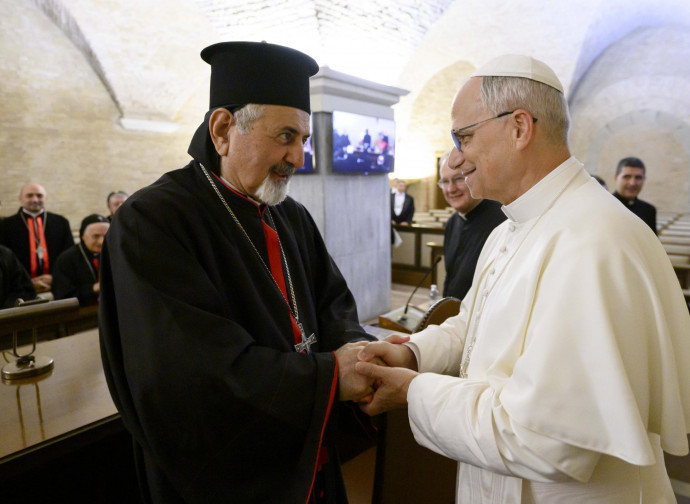
It took just two weeks for the motu proprio Mutua Concordia to provoke reactions. As we have explained, the Pope’s action primarily concerns the Syriac Catholic Patriarchate of Antioch, based in Lebanon. A power struggle has been raging within it for some time between Patriarch Ignace Youssif III Younan (pictured with Leo XIV in the LaPresse photograph) and the synod of bishops. The Holy See is an interested observer, as evidenced by the publication of the papal document introducing the possibility of removing an Eastern patriarch by a two-thirds majority.
Following the Vatican’s intervention, the Syriac Catholic bombshell did not take long to explode: we can reveal that, on Friday 4 September, the bishop with the longest service since his episcopal ordination invoked the new provision of the Code of Canon Law of the Eastern Churches to convene the synod. This power has been granted to him by Leo XIV 'should the patriarch fail to fulfil his obligations'. The majority of bishops intend to use this power to remove the now discredited Younan. While the vote will be secret, the outcome seems a foregone conclusion. At least, however, the patriarch will have the chance to defend himself before the synod. It will then be up to the Pope to confirm or reject the removal. While the bishops' move comes as no surprise — they have been urging the patriarch to convene the synod for three years without success — the Dicastery for the Oriental Churches has been left stunned by the reaction of the 'discredited' patriarch.
According to Vatican sources, Younan sent out a notice convening the synod just a few hours after the senior bishop's letter was dispatched. The two notices differ in the date of the meeting: the senior bishop indicated the end of September, while the patriarch set the date for November. In short, it is as though Younan wishes to gain more time on top of that 'wrested' from the Pope through his request for an extension, which was granted only partially. Above all, he appears determined not to recognise the legal innovations introduced by Leo XIII in Mutua Concordia, which give the majority of bishops at a synod the power to remove their patriarch in extraordinary circumstances. This power already has its roots in the history of the Eastern Churches, so it is not an entirely unprecedented concession. In Rome, Younan's actions are seen as a desperate move, as the other bishops now have the legal means to remove him from office after years of confrontational conflict.
The other Eastern Catholic patriarchs are watching with interest to see how the new provisions of the Codex Canonum Ecclesiarum Orientalium will be applied for the first time, and they may be beginning to think that it is not wise to tie their own fate to that of Younan. The Holy See has formed a clear view of the situation, as demonstrated by the introduction of Mutua Concordia.
The outlook is now uncertain. Will there be two synods within a few months? With the exception of the Roman synod in 2025, none have been held for three years. What will the patriarch do in September? Will he seek reconciliation with the bishops who have sidelined him? This would enable him to continue managing the Church's affairs at the synod he has convened for November. However, would the bishops trust a change of course now that the conflict has reached this point? Following the entry into force of Mutua Concordia, it cannot be ruled out that a new patriarch might be elected to lead the Syriac Catholic Church of Antioch.
