
Social media on trial: the strategy to nail Zuckerberg & Co.
Almost eight hours of questioning for the founder of Facebook, as part of the lawsuit filed against Instagram and other giants such as Google. Protected for years by Section 230, Big Tech companies now have to defend themselves against the new strategy of the plaintiffs' lawyers: the accusation of deliberately designing social media to create addiction in minors.


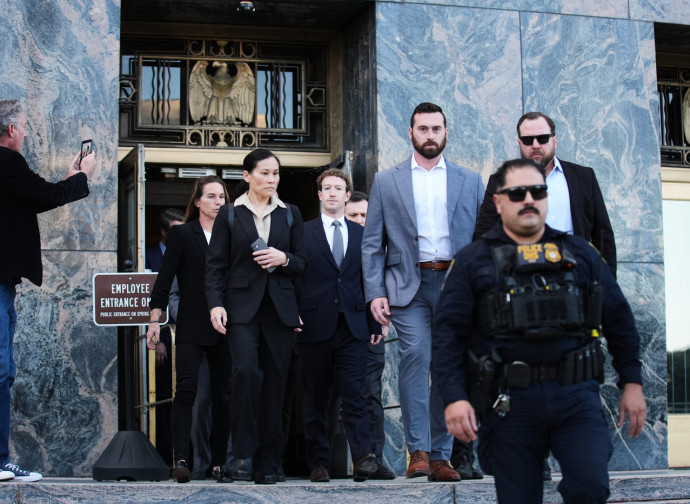
On 18 February, Mark Zuckerberg testified for nearly eight hours before a Los Angeles jury in the first civil lawsuit in history against the founder of Meta, who was called to answer under oath to allegations that he deliberately designed Instagram as a product that is addictive to minors.
The K.G.M. v. Meta Platforms trial, which began with opening statements on 9 February, is a test case that will determine the fate of more than 2,300 pending lawsuits across the United States, involving hundreds of families and school districts. If Meta and Google lose, the financial and regulatory consequences would be devastating and run into the billions.
After being called as a hostile witness by Texas lawyer Mark Lanier, Zuckerberg appeared “combative” and “irritated” according to reporters present. He repeatedly repeated phrases such as “you are misrepresenting what I am saying” and “that is not what I mean at all”. A particular moment came when Lanier questioned him about his expertise in assessing the damage caused by social media. The lawyer asked if Zuckerberg had a degree in epidemiology or statistical science — disciplines that study how to determine whether a product causes harmful effects on the population. The Meta CEO's response was blunt: “I don't have a degree in anything”. The statement is correct, as Zuckerberg dropped out of Harvard in 2004 to found Facebook, but it still provoked more than a few nervous laughs in the courtroom. The prosecution's intent was to emphasise that, despite Meta having internal research demonstrating the harm to minors, Zuckerberg did not have the expertise to evaluate it himself, but chose to ignore the results when they were not favourable to the company.
The most significant part of the deposition concerned some internal Meta documents, such as a 2015 email in which Zuckerberg set a goal of increasing the “time spent” by users on Instagram by 12% in three years, or an internal report that predicted that the average time spent on Instagram per user would increase from 40 minutes in 2023 to 46 minutes in 2026. Again, Zuckerberg backtracked, admitting that he did not know how his instructions had been translated into official company goals.
The discussion about children under 13 was particularly relevant. An internal document from 2015 estimated that 4 million children under the age of 13 were already using Instagram in the United States, and that around 30% of children between the ages of 10 and 12 were on the platform. This was a figure that should have alarmed Facebook's top management at the time. A 2018 document stated: “If we want to win big with teenagers, we need to get them in as pre-teens”. An internal 2020 study showed that 11-year-olds were four times more likely to return to Meta apps than older users. Instagram did not start asking for date of birth during registration until late 2019.
The most dramatic moment in the courtroom came when lawyer Lanier had six lawyers unfold a 10-metre-wide collage of hundreds of selfies that a girl, the plaintiff Kaley, had posted on Instagram as a minor, asking Zuckerberg if that account had ever been investigated. The Meta CEO did not respond directly.
Among the most damaging evidence for the defence was Project MYST (Meta and Youth Social Emotional Trends), an internal study conducted in collaboration with the University of Chicago on a thousand teenagers and their parents. According to the study, parental controls and family supervision have “little association with children's levels of attention to their own social media use”. In simple terms: they are essentially ineffective. Furthermore, it appears that minors who had experienced traumatic events (referring to alcoholic parents, sexual abuse, school trauma) showed an even lower ability to moderate their presence on social media, making them even more vulnerable to addiction.
The results of Project MYST were never published and no warning was communicated to parents or teenagers. Other internal documents presented at the trial include communications in which a Meta employee describes Instagram as “a drug” and employees as “drug dealers”. Internal documents from Google, the other defendant, compared YouTube to a casino and explicitly stated that “the goal is viewer addiction”.
The plaintiff is Kaley, a 20-year-old Californian identified by the initials K.G.M., who has already become the symbol of this trial. She started using YouTube at age 6 and Instagram at age 9. Before finishing primary school, she had posted over 284 videos on YouTube and used Instagram for several hours a day, with a documented peak of over 16 hours. K.G.M. blames her addiction to social media for depression, anxiety, body dysmorphia, suicidal thoughts, bullying and sextortion. Her mother had tried to block her access with third-party software and by taking away her phone, without success.
The plaintiffs' approach represents a legal revolution in the way Big Tech can be sued. Traditionally, social media platforms have been protected by Section 230 of the Communications Decency Act of 1996, a federal law that states that Internet service providers cannot be held liable for content posted by users. In practice, Facebook cannot be sued for an offensive post written by a user, just as the postal service is not liable for the content of the letters it delivers. However, this law has provided virtually total protection for social media platforms, making them immune to lawsuits for decades. Whenever someone has tried to sue Facebook, YouTube or Twitter for damages arising from content on the platforms, the courts have dismissed the cases citing Section 230.
But lawyer Lanier has taken a different approach: he is not suing Meta for user-generated content, but for the design of the platform itself. The lawsuit argues that Instagram is a “defective product” under product liability law, the same legal theory used against car manufacturers when they produce cars with faulty brakes, or against drug manufacturers when a drug causes undeclared side effects. This is why the court documents are so full of statements that focus not so much on the fact that social media is addictive, but on the fact that the company deliberately designed a platform to generate addiction (with endless notifications, video autoplay, recommendation algorithms designed to maximise usage time, and addictive “like” mechanisms). The issue is the intentionality of Meta's design.
If this legal theory were accepted by the jury, Meta would be held accountable for how Instagram itself is designed. It is as if a company produced cigarettes with specific additives to increase addiction: the problem is not tobacco itself (which exists in nature), but the additives intentionally added. The internal documents presented at the trial — the goals of increasing “time spent”, studies on the neurological mechanisms of addiction, awareness of the effects on vulnerable minors — serve to demonstrate that Meta knew the product was “defective” and chose to market it anyway. This is the proof of “malice” needed to overcome standard legal defences.
The K.G.M. trial will last about six weeks. The 12-person jury will have to reach an agreement of at least 9 out of 12. The stakes go far beyond this single case: federal pilot trials for school districts are set for summer 2026, and those for attorneys general for late summer. Meta said it could face ‘material financial losses’ this year.
Legal analyst Josh Golin summed it up after the testimony: ‘All Mark Zuckerberg achieved today was to prove once again that he cannot be trusted, especially when it comes to the safety of children.’ UCLA law professor Melodi Dinçer added, ‘A trial like this will reveal the gap between what companies say publicly and what happens behind the scenes.’
An eloquent side note: Judge Kuhl threatened to hold anyone who used Meta's AI-powered Ray-Ban glasses to record the testimony in contempt of court. Some members of Zuckerberg's security detail were photographed wearing the product at the courthouse entrance. The technology even challenges the rules of the courtroom where it is on trial: a perhaps unintended metaphor for the ruthlessness that forty-two attorneys general, thousands of families and now a Californian jury are asking to judge.
