

Rome-Écône, halt ordinations to continue dialogue
Following his meeting with Cardinal Fernández, the Superior General of the Society of Saint Pius X returns home with a proposal for theological discussion and a request not to ordain new bishops without papal mandate. This is the first step to take (or rather not to take) at the crossroads between schism and the gradual restoration of full communion.


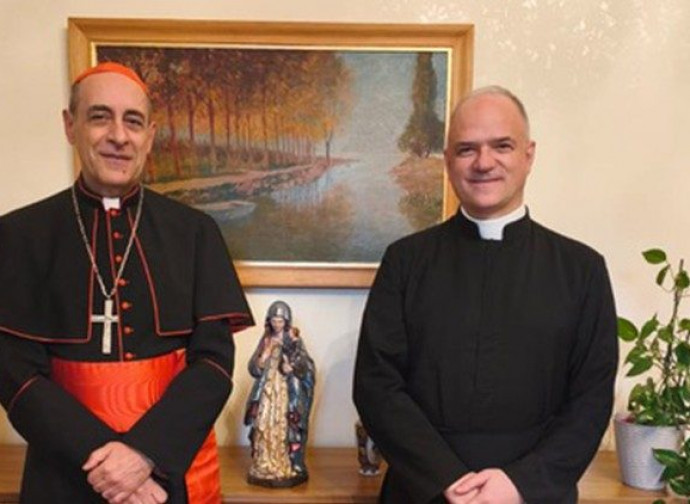
The Holy See opens up again to the Priestly Society of St. Pius X with an interim proposal for a structured dialogue on certain doctrinal points with “the aim of highlighting, in the topics discussed, the minimum necessary for full communion with the Catholic Church and, consequently, to outline a canonical statute for the Society, together with other aspects to be further explored.”
This is the heart of the statement from the Dicastery for the Doctrine of the Faith on yesterday's meeting, 12 February, between the Prefect, Cardinal Víctor Manuel Fernández, and the Superior General of the FSSPX, Fr. Davide Pagliarani, who was asked, as a precondition for proceeding with this dialogue, "that the Fraternity suspend the decision on the announced episcopal ordinations". Fr. Pagliarani will bring this proposal to the Council of the Society, which will decide whether to confirm the date of 1 July or to accept the proposal of the Dicastery, which is not intended to approve the status quo of the FSSPX, as hoped for by Fr. Pagliarani, but to give the Lefebvrians a canonical configuration that re-establishes their juridical ties with the Church.
Among the topics that may be discussed, the communiqué mentions “the difference between an act of faith and ‘religious assent of the mind and will’,” “the different degrees of adherence required by the various texts of the Second Vatican Council,” and other topics that the FSSPX had proposed in a letter dated 17 January 2019. There is no explicit mention of the topic of liturgy.
During the meeting, the Holy See reiterated “that the ordination of bishops without the mandate of the Holy Father […] would imply a decisive rupture of ecclesial communion (schism) with grave consequences for the Fraternity as a whole.” The communiqué refers in this regard to both the Apostolic Letter Ecclesia Dei, in which John Paul II condemned the schismatic act committed by Archbishop Marcel Lefebvre and Archbishop Antonio de Castro Mayer on 30 June 1988, and the Explanatory Note of the Pontifical Council for Legislative Texts, presided over at the time (1996) by Cardinal Julián Herranz, which specified “that there is never a need to ordain bishops against the will of the Roman Pontiff, Head of the College of Bishops. This would in fact mean the possibility of ‘serving’ the Church by attacking its unity in matters connected with the very foundations of this unity.”
An important article by Father de Blignières illustrated the doctrinal reasons underlying the impossibility of ordaining bishops against the will of the Pope, with the aim of guaranteeing total juridical autonomy from the hierarchy of the Catholic Church. However, articles continue to circulate on the internet claiming that such an ordination would not constitute a schism.
Some rely on the historical fact that the mandatum of the Pontiff has not always been necessary for episcopal ordinations and that the current canonical discipline is the result of a rather recent centralisation, which has led to the act of consecrating bishops without a mandate being punished with the maximum penalty (excommunication), whereas even in the previous Code (1917), it was punished with the lesser penalty of suspension a divinis. So why persecute the FSSPX?
There is no doubt that in many ecclesiastical regions for centuries a formal mandate from the Apostolic See was not necessary. Bishops could be chosen by cathedral chapters, the local episcopate or local synods, as is still the case today in the Eastern Catholic Churches. But these were elective procedures agreed with the Holy See, to which the acts had to be transmitted and which always had the right to confirm or veto the candidate. It was never permitted to consecrate bishops against the will of the Pope, for the simple fact that he is, by divine right, the sole Head of the Episcopal College, who has the power to accept or exclude a bishop from the College.
There is also a macroscopic and decisive aspect that is not understood by those who use these historical precedents to justify the announced consecrations on 1 July. Whether they were cathedral chapters, bishops or local synods, they were still legitimate members of the hierarchy, who had received the authority from the Holy See to consecrate a candidate who legally belonged to the Church and who would exercise his episcopate in the same legal communion. Now, however, neither the FSSPX bishops who will consecrate nor the candidates who will be consecrated belong juridically to the Church and will, in fact, be ordained with the specific purpose of exercising their ministry outside this juridical communion.
For this reason, it is completely erroneous and misleading to refer to the various historical and present methods of choosing bishops as precedents that would justify the consecrations announced by the FSSPX (such as those already performed in 1988 and 1991), because in the latter case we have the consecration of bishops: 1. against the will of the Pope (and not simply without mandatum), 2. by bishops who have no jurisdiction in the Church 3. to exercise a ministry that openly claims to be completely independent of juridical communion with the Catholic hierarchy.
As for the change in sanctions, a clarification is needed. The sin of schism is ‘translated’ on the juridical level as a canonical crime, which corresponds to sanctions that belong to ecclesiastical law, not divine law. This entails the possibility, and sometimes the opportunity, to modify these sanctions. In practice, the consecration of a bishop against the will of the Pope, with the aim of perpetuating a ministry independent of the hierarchy, is always a schism, whatever the penalty provided for by law.
Another group of arguments appeals to canons 1323-1324, which set out the circumstances that make a person who commits a canonical crime not liable to punishment or require mitigation of the penalty. In particular, reference is made to point 4 of canon 1323 (fifth of canon 1324), which requires exemption from punishment or a mitigated penalty for those who have violated the law or precept “compelled by grave fear, even if only relative, or by necessity or grave inconvenience, unless, however, the act was intrinsically evil or harmful to souls”. . The FSSPX would be driven by necessity and therefore the sanction of excommunication for a bishop who consecrates other bishops without a mandate would be anything but ‘automatic’.
Now, the point lies precisely in the final clause. Ordaining bishops against the will of the Pope, with the aim of establishing a totally independent ministry, constitutes a schism, which is an intrinsically evil act and causes grave harm to souls, who are thus drawn outside the visible communion with the Church. Necessity may compel a bishop to ordain other bishops without the Pope's mandate, as has happened in countries where the Church is and has been persecuted, but he cannot do so against the will of the pontiff and even less so to establish an “episcopate” that is legally autonomous from the Catholic hierarchy. Whenever bishops were consecrated without papal mandate in countries under the Soviet regime, due to the need to maintain the local hierarchy decimated by arrests and executions, avoiding the risk of being “intercepted” by the totalitarian power, neither the consecrating bishops nor those consecrated intended to establish an episcopate legally autonomous from the Catholic hierarchy. This is the great and serious underlying problem of the FSSPX.

Freedom outside the Church — the Lefebvrians real goal
Approve the announced episcopal ordinations, but without granting them any canonical status. Don Pagliarani's request to the Pope shows that it is not Rome that refuses to regularise the Society of Saint Pius X, but rather the latter that claims to save souls outside the Mystical Body of Christ.
A second breakaway will see five new Lefebvrian bishops ordained
Episcopal ordinations without a papal mandate, as in 1988. On 1 July, the Society of Saint Pius X will repeat Archbishop Lefebvre's gesture, this time ordaining an additional bishop.The Holy See has expressed its willingness to continue dialogue in order to avoid a new rupture.
Lefebvrians: excommunication lifted but schism stands
Monsignor Lefebvre's episcopal appointments are illegitimate in all respects. The excommunication lifted by Benedict XVI was aimed at paving the way for reconciliation, but does not cancel the schism. In the same way it was for the Orthodox.
Frustrated by Rome, following the Lefebvrians is not the solution
Many faithful now attend the chapels of the St Pius X Priestly Fraternity, much like castaways in search of dry land, due to the serious crisis being experienced in the Church. But this is a mistake and stems from the confusion surrounding the real status of the Lefebvrians. The Daily Compass explains where the problems lie in a series of four instalments.