

Roche's unread text at consistory supports restrictions on ancient rite
The cardinal's report supports the restrictions on the ancient rite in the name of unity and even misquotes St Pius V. This and much more was spared the sacred college when the liturgy was removed from the proceedings. Providentially.


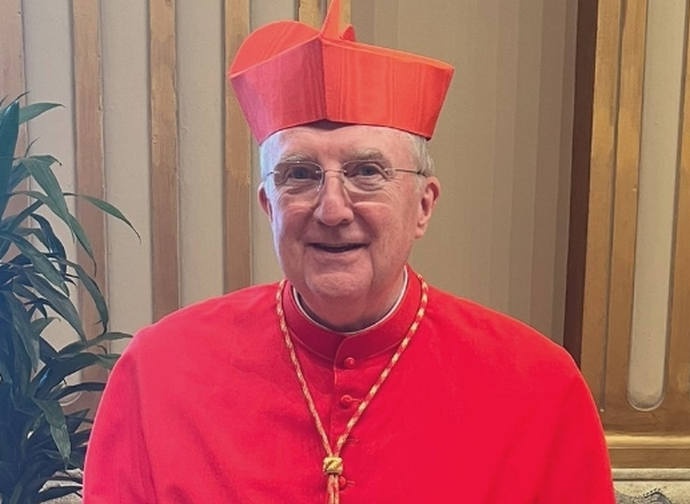
Of the many events that occur and often upset us, we do not always understand the reasons. Sometimes, however, we do. For example, consider the recent consistory, which was supposed to discuss four points (evangelisation, synodality, the Roman Curia and liturgy), but instead only the first two were retained, to the detriment of the liturgy.
Had things turned out differently, we would have witnessed the unfortunate spectacle of the Prefect of the Congregation for Divine Worship and the Discipline of the Sacraments, Cardinal Arthur Roche, delivering his speech. The content of his report in English and Italian was made public by Diane Montagna on her website, and it clearly shows the bias of the speech to anyone who is even vaguely familiar with the issue of liturgical reform, from Sacrosanctum Concilium to Traditionis Custodes.

Essentially, His Eminence emphasises the importance of the unity of the Roman rite, which was so dear to St Pius V and which is ultimately undermined by those who desire greater freedom to use liturgical books prior to the reform. Thus, 'the use of the liturgical books that the council wanted to reform was, from St John Paul II to Francis, a concession that in no way provided for its promotion'. Roche then explains, quoting Benedict XVI, that tradition is not the transmission of dead things, but a living river that connects us to our origins. He reminds us that, according to Sacrosanctum Concilium, the preservation of tradition and legitimate progress are not mutually exclusive. The Council explains that this balance was achieved by the reform, which was developed on the basis of 'careful theological, historical and pastoral investigation' (SC 23).
Let us start with this final quotation, which is rather curious because it uses a document from before the liturgical reform was implemented to guarantee the appropriateness of the subsequent reform. The problem is that SC did indeed call for such accuracy, but it does not confirm that things were done as hoped because the document came before the reform. In fact, it is enough to read on in the same paragraph to realise that the reform did not follow the Council's criteria at all. The Council Fathers had in fact recommended not introducing innovations unless they were truly and certainly useful to the Church, on the proviso that the new forms should spring organically from the existing ones. Can Roche claim that the demolition and re-establishment of the offertory rites followed this twofold criterion? Or that the almost complete replacement of the pericopes of the Lectionary, the rewriting of 90% of the prayers, the alteration of the liturgical calendar's temporal cycle and the almost total replacement of the Rituale Romanum and the Pontificale Romanum observed it? Evidently not. This is why the cardinal, who referred to §23 of SC twice in a few lines, was careful not to include this quotation.
By doing so, he demonstrates his complete lack of understanding of the reasons that lead hundreds of thousands of faithful, in ever-increasing numbers, who habitually attend and continue to attend the reformed liturgy, to seek out the ancient rite. Without ever having read SC, these faithful people testify that some reforms have betrayed the organic nature of liturgical development. This has robbed them of priceless treasures that were taken away unnecessarily. Instead, reforms have imposed "inventions" that spring from a supposed academic erudition which is often unfounded (think of the idea of facing "towards the people").
Certainly not from organic development.
Roche's partisan selectivity is further evident in his reference to Benedict XVI. He quotes a General Audience (26 April 2006) on the meaning of tradition but omits the key document on the liturgy of Benedict XVI's pontificate: Summorum Pontificum, together with the accompanying letter to bishops. In these documents, His Eminence would have found two important principles contradicting his stance. Firstly, while the unity of the Roman Rite is certainly important, the 'internal reconciliation within the Church' that Pope Ratzinger hoped for and worked towards is equally important. This has been clearly undermined by Traditionis custodes. Secondly, the ancient Roman rite is not simply something to be tolerated — he writes that it should be neither conceded nor promoted — but a sacred heritage to be preserved and esteemed: "What was sacred for previous generations remains sacred and great for us too, and cannot suddenly be completely forbidden or even judged harmful. It is good for all of us to preserve the riches that have grown in the faith and prayer of the Church, and to give them their rightful place.'
But what about the reference to Quo primum? This bull has been misused in several ways: on the one hand, it is used to discredit any subsequent reforms and the legitimacy of the new missal on the basis of St Pius V's instruction not to add, subtract or change anything in the 1570 missal; on the other hand, as Roche does, it is used to justify the 'iron fist' approach to avoid fragmentation within the Roman rite. In both cases, this is a misrepresentation. While it is true that no pontiff can bind his successors to his own liturgical norms, it is equally true that no pontiff has the authority to overturn liturgical tradition.
Examining the reforms introduced by St. Pius V reveals that his intention was not to create a new missal by substantially rewriting parts of the ordinary, the proper, the lectionary and the antiphonary, but rather to purify liturgical celebrations from the arbitrary additions introduced in recent times. For instance, the Kyrie and the Gloria in excelsis were purged of numerous tropes that had been added to the text and made it unwieldy; sequences, which had come to be used for every feast and liturgical commemoration, were reduced (perhaps too drastically); rites performed in different ways were standardised; and the calendar of saints was scaled down so as not to overwhelm the temporal cycle of the liturgical year, which remained virtually untouched. Minimal changes were also made to the lectionary, prayers, and antiphons.
These few notes allow us to understand that the unity sought by St Pius V in his reform was not achieved by returning to a supposed 'liturgy of the origins' that existed only in the scholarship of a few academics and which trampled on centuries of organic development. Rather, it was achieved by purifying texts and rites that had emerged more recently and were not universally accepted, or liturgical rites that could not demonstrate a tradition of at least two centuries. Cardinal Roche should therefore exercise extreme caution in invoking St Pius V because, based on these principles, it would be the new missal that would encounter serious difficulties, not the old one.
The speech that Cardinal Roche was due to deliver at the consistory is evidence of a worrying trend in the Roman Curia. Like his colleague at the head of the Congregation for the Doctrine of the Faith, he cherry-picks texts from the Magisterium to suit his own agenda, carefully omitting anything that might be inconvenient.
“Honest is he who changes his mind to agree with the truth. Dishonest is he who changes the truth to agree with his mind,' says an ancient proverb. This could be a useful criterion for the Curia reform to be discussed at the upcoming consistory.
