
Nicaragua: Persecution of the Church Intensifies
A new wave of repression by the Ortega-Murillo regime against the Catholic Church. Priests forced to submit their weekly schedules, send the texts of their sermons to the authorities, and are photographed daily in church by the police.


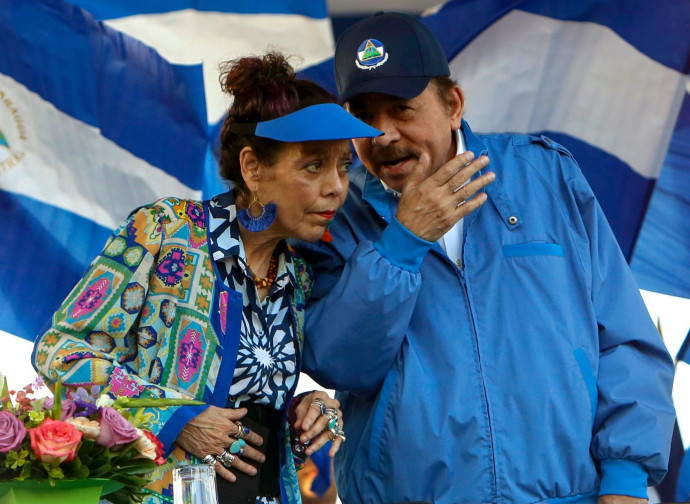
Martha Patricia Molina Montenegro, a Nicaraguan lawyer in exile, is now considered one of the most authoritative voices on the persecution of the Church under the regime of Daniel Ortega and his wife, Rosario Murillo. Described by a Costa Rican priest as 'the second most powerful witch in the world', Molina Montenegro has been monitoring and denouncing violations against the Catholic clergy since 2019. She reports a new escalation of repression and systematic persecution by the Sandinista government. "Agents go to churches every day to photograph and record the faithful during Mass and internal clergy meetings," Molina stated, denouncing a surveillance system that extends across the entire country and is applied indiscriminately. “Even among bishops considered close to the government.”
Molina collects data and testimonies with great precision and clarity, enriching the report Nicaragua, una Iglesia perseguida (Nicaragua, a Persecuted Church), now in its seventh edition, which has become an international benchmark on the repression of religious freedom in the Central American country. The latest version of the dossier was presented to Pope Leo XIV on the occasion of the Jubilee of Migrants. The report documents 1,010 incidents ranging from assaults on the clergy and restrictions on religious life to attacks on places of worship between April 2018 and July 2025. It describes the ongoing persecution that has now reached its peak, with limited freedom of worship and obstructed religious activities, as well as the forced exile of priests and nuns. ‘The organisation of patron saint festivals, processions and liturgical celebrations has come under the control of public institutions, and not even priests’ meetings escape police scrutiny,’ Molina writes in a post. He has also recently denounced the fact that, during the last Holy Week, the Sandinista dictatorship imposed further restrictions on religious events, blocking 6,135 processions. Celebrations are often permitted only within church walls, under the control of the authorities, while public processions remain banned or severely restricted. Consequently, 28,904 restrictions on religious life have been documented since 2019, including banned or restricted processions and acts of popular devotion.
Priests must submit their weekly schedules to the authorities and apply for permits for any activity taking place outside the place of worship, however minor. This is taking place against a backdrop of increasing surveillance, reinforced by the Consejo del Poder Ciudadano (a network for the regime’s political control), the police, and some 80,000 paramilitaries recruited at the start of 2025 and deployed for social and religious control and repression.
Furthermore, in several parishes, priests are required to send the full text or a summary of their intended homily to the police in advance. Priests and bishops are constantly followed by plain-clothes officers or drones, while their mobile phones are often subject to arbitrary checks. One priest anonymously described the situation in the country to ACI Prensa, one of the leading Spanish-language Catholic news agencies: “Every Sunday, the police turn up to photograph me. He must report to the authorities every time he leaves the parish and attends a liturgical celebration. If he addresses a social issue during a homily, he risks two things: prison or exile.' The priest described the mechanisms through which the Sandinista government controls, monitors and restricts the activities of the Catholic Church in the country, stating that the population has become accustomed to the situation and no longer speaks out. The atmosphere seems calm, but the restrictions remain constant because there is no freedom”. Regarding the control exercised over priests and bishops, he explained: 'Every time there are liturgical services, we must report the type of celebration and the location. We must report every time we leave the parish boundaries and state how long we will be away. The police also come to photograph me every Sunday. This is to verify that we are indeed where we have declared ourselves to be. The superiors ask the officers for proof of the visits carried out; this is how they maintain control.'
New restrictions also include the criminalisation of religious acts: praying in public or carrying devotional objects, such as rosaries, across borders is regarded by immigration authorities as suspicious or potentially criminal behaviour. Molina speaks of a 'silent siege': fewer high-profile arrests than in the past, but constant police surveillance to intimidate priests and the faithful who are accused of opposing 'Orteguism', the only permitted form of worship.
