New consistory: the topics change, but the synod tables remain the same
Four sessions over two days, culminating in the Mass of Saints Peter and Paul, feature on the agenda of the Sacred College, which will meet from 26 to 29 June. Alongside the mission and the ‘novelty’ of Magnifica humanitas, synodality continues to dominate the organisation of working groups, with the risk that dissenting voices may be silenced.


The Vatican Press Office has announced the timetable for the now imminent second extraordinary consistory convened by Leo XIV: the Sacred College will convene on Friday 26 and Saturday 27 June for two days of proceedings divided into four sessions, concluding with Mass on Monday 29 in honour of Saints Peter and Paul. As was already evident in the letter sent on 3 June by Cardinal Dean Giovanni Battista Re, the liturgy and Praedicate Evangelium remain pending, having been ‘put on hold’ at the first consistory in January. ‘The Church’s raison d’être is not for the cardinals, nor for the bishops, nor for the clergy. Its raison d’être is to proclaim the Gospel. And so these two themes: the Synod and synodality, as an expression of the quest to be a missionary Church in today’s world, and Evangelii Gaudium, proclaiming the kerygma, the Gospel with Christ at its centre’, the Pope had explained on the evening of 7 January. ‘The other themes must not be lost’, he added, but merely postponed to a later date which has not yet arrived.
Since then, the publication of Magnifica humanitas has further changed the landscape, making Leo XIV’s first encyclical the starting point for the cardinals’ discussions and, in particular, for the second and third sessions. What had particularly captured the media’s attention was the invitation contained in the Dean’s letter, with direct reference to Magnifica humanitas, to ‘ask ourselves how we might reaffirm today “the rejection of the theory of the “just war”, too often invoked to justify any war” (no. 192) and on what concrete ways might help peoples and Christian communities to safeguard and build peace’.
In the packed agenda (partly previewed on 16 June, along with the Information Note, on the blog Messainlatino.it), the discussion on the ‘just war’ is not explicitly mentioned, but it is likely to be addressed in the context of conflicts, tensions and peace, which are at the heart of the second session devoted to The Culture of Power and the Civilisation of Love, introduced by Cardinal Victor Manuel Fernández and further explored through questions such as: ‘How do the tensions, divisions and conflicts affecting the world today impact the lives of our Churches and our peoples?’ and ‘What language, attitudes and practices can help to foster reconciliation, coexistence and peace?’. The first session, on the other hand, will have a more missionary focus (In what kind of world are we called to proclaim the Gospel?), introduced by a biblical meditation by Cardinal Grzegorz Ryś, Archbishop of Kraków, whilst the third session, centred on Building for the Common Good: the Construction Sites of Our Time, will be introduced by Cardinal Stephen Brislin, Archbishop of Johannesburg.
Finally, the fourth session will focus on The path to implementing the Synod and will, of course, be opened by Cardinal Mario Grech, Secretary General of the Synod of Bishops.
Synodality and mission therefore continue to take centre stage alongside the ‘novelty’ of Magnifica humanitas, and the logistics are also synodal with 20 working groups, divided as follows, according to the Information Note: ‘9 groups of Ordinary Cardinal Electors (including Nuncios and Cardinal Electors who have completed their service as Ordinaries)’, in practice from the ‘territory’, including emeritus cardinals provided they are under 80 years of age, and ‘11 groups of Cardinal Electors from the Roman Curia and Non-Elector Cardinals’. In January, it was only the former who were to report to the assembly, as the Pope himself explained: ‘since it is easier for me to seek advice from those who work in the Curia and live in Rome, the groups that will report will be the nine from the local Churches’. How things will proceed in June is not entirely clear, judging by the cryptic wording of the Note: ‘The groups of Ordinary Cardinals will present their report in the Plenary Hall (a maximum of three minutes per group). During the proceedings, there will also be an opportunity for each of the other groups to present their report once, again for three minutes.’ As if to say: the former will speak, but (perhaps) the latter will too.
The only certainty is the three-minute limit, and contributions at the tables will also be strictly timed: following a ten-minute introductory statement, three minutes each in the first round of personal contributions, and then a further two minutes each during the subsequent shared discussion in the groups. Three minutes will also be allocated for the open discussions on Saturday afternoon with the Holy Father before the conclusion (further open discussions are scheduled for Friday evening and Saturday at midday, but in those cases they will be limited to the session’s theme).
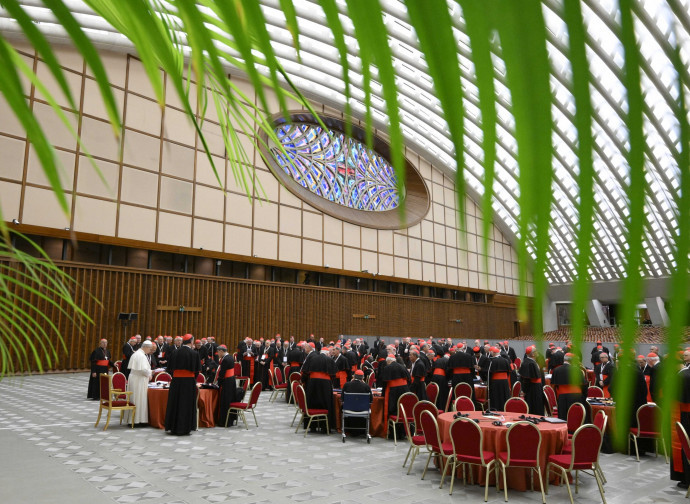
The other certainty is the synodal tables, which are being applied for the second time to the Sacred College, but which appear to have been ‘transferred’ to the January consistory currently being prepared. In fact, the first consistory was initially scheduled to take place in the usual manner, in the Synod Hall (i.e. in plenary session), according to the letter sent on 7 November 2025 by Cardinal Dean Giovanni Battista Re, published by Diane Montagna, together with the programme received by the cardinals two days before the consistory, on 5 January, which was instead structured around the famous “working groups” in the much larger Paul VI Hall. This change of venue, which had been introduced for synodal assemblies from October 2023 onwards, was described at the time by Settimana News as follows: the Paul VI Hall “is large enough to accommodate all participants, whereas the new Synod Hall would barely have been able to hold the Members, let alone the Experts. But above all, the Paul VI Hall can be arranged with tables at which groups of around ten people can sit, speeding up the transition between plenary sessions and group work and, above all, facilitating the flow of conversation in the Spirit’.
A methodology that ‘is described as a way of managing decision-making processes and building consensus’ in the Instrumentum laboris of the 2023 Synod . With the not-so-remote risk that the less aligned voices will be heard only by those ‘dining companions’ seated at the same table. And it is again the Instrumentum laboris that explains how it works: ‘Once again, everyone takes the floor: not to react to or counter what they have heard, reaffirming their own position, but to express what touched them most deeply whilst listening and what they feel most strongly called upon to respond to.’ Consensus is guaranteed; any dissent, somewhat less so.
