

'Mary Co-Redemptrix': all that's wrong in the Vatican Note
The Daily Compass publishes the document by the Theological Commission of the International Marian Association, which clarifies the correct doctrine concerning the titles 'Mary Co-Redemptrix' and 'Mediatrix of all graces'. This document responds to the 'Note Mater Populi Fidelis' by the Congregation for the Doctrine of the Faith, which caused confusion and disorientation among the faithful.
- RESPONSE TO MATER POPULI FIDELIS BY THE INTERNATIONAL MARIAN ASSOCIATION


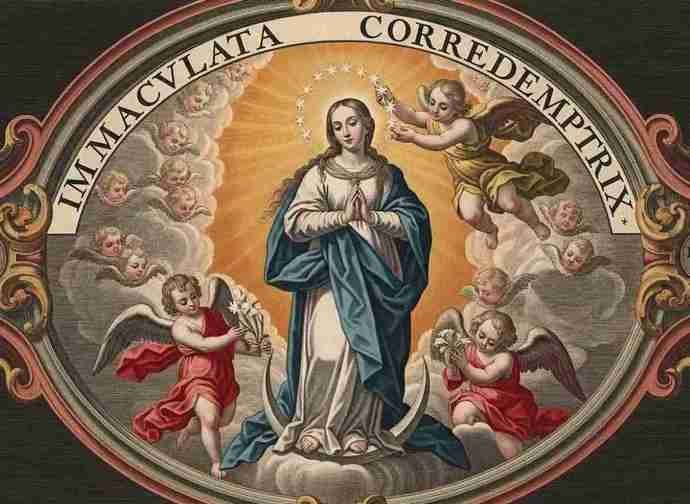
The universal law of the Church recognises that every member of the faithful has the right — which can sometimes be considered a duty — to 'to manifest to the sacred pastors their opinion on matters which pertain to the good of the Church and to make their opinion known to the rest of the Christian faithful, without prejudice to the integrity of faith and morals, with reverence toward their pastors, and attentive to common advantage and the dignity of persons' (Code of Canon Law, can. 212 §3).
In light of the disorientation and confusion caused by the Note Mater Populi Fidelis (MPF) among many of the faithful, the Theological Commission of the International Marian Association (IMA), comprising around forty theologians and bishops, has decided to publish a document outlining the key criticisms of the Doctrinal Note of the Congregation for the Doctrine of the Faith (CDF).
The document dedicates forty paragraphs to summarising the development of the correct doctrine underlying the titles of Co-Redemptrix and Mediatrix of All Graces in a clear and comprehensive manner. This development is unfortunately absent from the Doctrinal Note, even though its stated purpose was to address this issue. The result is that the MPF communicated reservations about the two Marian titles in question and failed to present and preserve the teaching that has developed over the centuries and been repeatedly taught in the ordinary magisterium of popes over the last three hundred years. This contravenes the hermeneutic of continuity so strongly recommended by Benedict XVI, to which the IMA document explicitly refers (cf. §9).
The first section (§ 4–18) is devoted to the Marian title of Co-Redemptrix. In §13, the document recalls that note 32 of MPF refers to two theological currents: one maximalist, which affirms Mary's close, direct and immediate cooperation in the Redemption; and one minimalist. However, it is precisely the teaching of various popes, and therefore the ordinary magisterium of the church, that falls within the maximalist line. It is not simply a matter of two theological currents debating amongst themselves, but rather an ordinary magisterium that has reiterated and deepened its teaching by explaining Mary's cooperation in the redemption as immediate and christological. Similarly, it is inaccurate for the DDF to state that 'Some popes have used the title ‘Co-redemptrix’ without elaborating on the meaning' (§18). Once again, Pius XI and John Paul II very clearly explain Mary's role as Co-Redemptrix in terms that the DDF describes as 'Immediate, Christo-typical, or maximalist' cooperation (note 32).
The problem with MPF is not only that it asserts the inappropriateness of the title of Co-Redemptrix; more profoundly, it 'never states that Mary’s unique active role is redemptive', whereas 'The Church, from the Fathers of the Church up to the modern and contemporary Papal Magisterium, teaches that Mary’s uniquely active role, as the human New Eve with Christ, the New Adam, offered a contribution to the obtaining of the graces of Redemption. This she did by freely giving birth to our Redeemer; by persevering with him to the foot of the cross; by offering her immaculate human suffering together with his divine suffering, and by “lovingly consenting to the immolation of the victim born of her” (Lumen Gentium, 58).' Thus, it is evident that the Note fails to 'teach in a positive way Mary’s truly redemptive role with and under Jesus in Redemption as put forth by the Papal Magisterium' (§14), distancing itself from and almost opposing the ordinary papal Magisterium.
In the second section (§ 19–32), the document highlights how MPF seeks 'to reduce Mary’s maternal mediation only to intercession', that is, to a merely dispositive mediation. Once again, no consideration is given to the numerous papal teachings (from twelve popes over four centuries) that support the instrumental or secondary cause of Mary's mediation. The IMA Theological Commission points out that the DDF seems not to understand the meaning of instrumental causality, which, by definition, does not pose itself as a parallel, competitive cause to the primary cause. 'Mary’s secondary instrumental mediation of grace does not take away from Christ, the one divine Mediator'. It is true that ‘only God is the Saviour’, but Mary's secondary instrumental mediation of Christ's grace does not deny this. Since God freely chose to associate Mary with his work of Redemption, he is free to communicate his grace to us through her secondary instrumental causality. 'To say that “God alone is our Savior” does not mean that “it is God alone who applies the merits of Jesus” to us' (§ 25). This exclusivist approach leads to an understanding of Mary's spiritual motherhood that is more nominal than real since it is emptied of the characteristics of conception, birth and nurturing of her children (cf. §29).
Sections three and four (§§ 33–34 and § 35) highlight how MPF diminishes Mary's true merit in the work of objective Redemption and the role God assigned her in the Redemption of mankind. Once again, it fails to take into account the ordinary Magisterium of the popes.
The fifth and final section (§ 36–39) merits praise for showing the pastoral consequences of the Note's approach. It is precisely on the foundation of Mary's co-redemption and mediation that widespread and beloved devotional practices, such as the Holy Rosary, the Scapular and consecration to Our Lady, make sense. Many churches and institutes bear one of these titles in their name, and they recur in devotional books and the Manual of the Legio Mariæ, a Catholic lay organisation with millions of members worldwide. Furthermore, the 'turnaround' effected by MPF inevitably generates distrust in the Magisterium of the Church because 'if the teachings and titles previously used by the Popes are now considered "inappropriate" or "inopportune", why should the faithful have confidence in the papal Magisterium?' (§ 36E).
- RESPONSE TO MATER POPULI FIDELIS BY THE INTERNATIONAL MARIAN ASSOCIATION
