German Synod aims to force bishops to kowtow to its agenda
The revolution sought by the German Synodal Way is being put to the test in the election for president of the Bishops' Conference. A split is possible over issues such as same-sex unions, celibacy, women's ordination, and the role of the laity. The Synodal Path is also preparing to monitor bishops who reject the innovations.


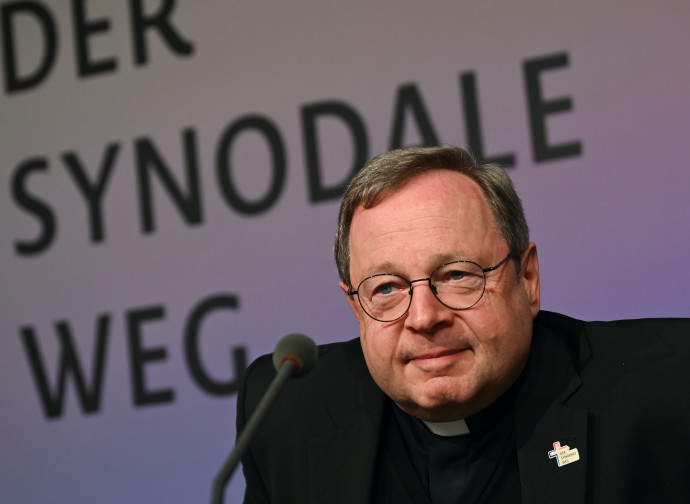
Today marks the beginning of a decisive week for the Church in Germany. Until Thursday, the German bishops will be engaged in a plenary assembly with two important items on the agenda. They must elect a successor to Monsignor Georg Bätzing, the outgoing president of the Conference, who has announced that he will not seek a second term. The race is still open, but the strongest candidates are the Archbishop of Paderborn, Udo Markus Bentz; the Bishop of Trier, Stephan Ackermann; and the Bishop of Essen, Franz-Josef Overbeck.
Overbeck, who is very ambitious, will arrive at the plenary assembly fresh from a two-day visit to Rome, where he is also expected to have met Monsignor Filippo Iannone, Prefect of the Dicastery for Bishops. Overbeck intends to secure the presidency by presenting his colleagues with Rome's approval of the statute for establishing a synodal conference, which is set to transform the Church forever.
This is the other major issue to be addressed during the German Bishops' Conference's four-day meeting. The protagonists of the German Synodal Path were dismayed by Rome's failure to respond to letters containing resolutions that contradict Church doctrine on same-sex unions, celibacy, the diaconate, the role of women in the priesthood, and the role of the laity. They are now demanding the introduction of a system to monitor bishops, who will effectively have to justify their decisions if they do not intend to adopt the Conference's desired innovations.
This is an attempt to discipline the bishops and possibly expose those who oppose the "synodals'" impositions to public criticism. The Synodal Conference statute, which the plenary assembly will be called upon to vote on, clearly undermines episcopal authority by claiming decision-making power. However, the majority of the body will be laypeople: there will be 27 bishops, 27 members of the Central Committee of German Catholics, and 27 laypeople.
The revolution sought by the German synodal party is in open contrast to the teachings of the Second Vatican Council, particularly Lumen Gentium, which recognises that bishops have the 'sacred right and duty before God to give laws to their subjects, to judge and regulate everything pertaining to worship and the apostolate'.
In light of this, if negotiations between Germany and Rome were already tense, the situation in Germany has now become extremely delicate for the Holy See, given the implications of a probable split with the Lefebvrians. Fidelity to the Second Vatican Council must be defended, even against those who would like to reduce the number of bishops on issues concerning the functions of government, favouring a more 'parliamentary' than ecclesial approach.
The German situation is ready to explode, and to defuse it, it would be helpful to elect a Bishops' Conference president who differs from the last two. However, this seems a very unlikely scenario.
Among the strong candidates, in addition to those already mentioned, is Monsignor Heiner Wilmer, the Bishop of Hildesheim, who was chosen by Bergoglio in 2023 to head the Congregation for the Doctrine of the Faith.
Cardinal George Pell's rejection of him was his last victory, but it went down in history as a Pyrrhic victory because Francis ultimately preferred Víctor Manuel Fernández. Should his confreres choose him as president, he would find himself dealing with the very Argentine who stole his job three years ago.
