
Gender and new rights: Sarah denounces the EU’s blackmail of Africa
Invited by the ECR Group in the European Parliament, the cardinal does not mince his words; on the contrary, he exposes the distorted use of such language to convey and impose – even outside Europe – an anthropological vision that runs counter to faith and reason, one that has been artificially created in the ‘corridors of Brussels’. It is a message that also resonates within the Church itself.
- Europe is changing the language to destroy man and the family by Robert Sarah


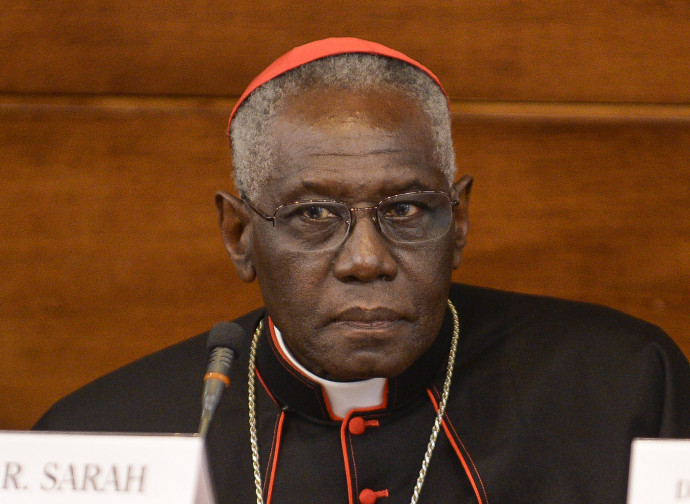
‘Well then, honourable Members, I ask – respectfully, yet with equal firmness – that the terms “man”, “woman”, “marriage” and “family” should not be reduced to social constructs that can be altered at will by the ideological fashions of the moment, but should be safeguarded as ontological realities.’ These are the central words of Cardinal Robert Sarah’s courageous speech at an event held at the European Parliament, which echoes the spirit of Benedict XVI’s great speeches in Berlin, Paris and London, and which constitutes a solemn condemnation of the way in which the European Union operates a ‘system’ of imposing upon individuals and peoples an anthropological vision artificially created in the ‘corridors of Brussels’ that runs counter to reason and to their faith. It is a ‘tough’ speech, containing well-documented criticisms of the European Union’s exploitative and blackmailing behaviour towards African countries in regulatory, legal and financial terms, which may surprise those accustomed to hearing the Cardinal speak primarily on matters of spirituality and liturgy, but which is all the more effective and penetrating for that very reason. The event took place on 15 July at the European Parliament in Brussels and was organised by the ECR Group, European Conservatives and Reformists, under the title Europe and Africa. In conversation with Cardinal Robert Sarah.
The speech revisits the framework of thought of Benedict XVI, to whom a specific section is dedicated, entitled: ‘Benedict XVI and the primacy of the logos’. Here, the Cardinal revisits the profound meaning of Pope Benedict’s famous major speeches in Berlin, London and Paris. In many passages, it seems as though he is speaking directly, although the Cardinal’s commitment to demonstrating continuity with Pope Francis – and his use of the term ‘cultural colonialism’ – and with Pope Leo XIV is evident; the latter, in his Address to the Diplomatic Corps, emphasised the great urgency that ‘words should express certain realities’. It is precisely the word that lies at the heart of the entire discourse, elevated to the point of being linked to the Logos, the Word of God made flesh, who in his Wisdom created things according to an order and desires that our words be true, that is, that they respect this order. Hence the frequent use in the discourse of the term ‘ontology’ and the adjective ‘ontological’, that is, relating to the being of things and not to human inventions. Axiology is not enough – the cardinal clarifies – because there may be many values that deserve respect, chosen after being weighed against one another; we must start afresh from ontology, from what things are and what words must express in accordance with the truth.
The word reflects an order, and this order points to an ordering Wisdom, ‘From this follows a consequence that I would like to emphasise strongly before this assembly: a reason which, in the face of the divine, turns a deaf ear and relegates religion to the realm of private subcultures, becomes itself incapable – these are still Benedict’s words – of engaging in the dialogue of cultures’.
Reason, including political reason, needs the true religio of the Logos—Christianity—otherwise it distorts the words it employs and transforms them into instruments of violence. Drawing on what Ratzinger said in 2011 to the German Bundestag, Sarah demonstrates the irrationality of political rationalism, which seeks to exclude true religion on the grounds that it assumes it to be irrational: ‘Is not European legislation which claims to be “neutral” towards every anthropological vision, but which in fact imposes – through treaties, aid and trade conditions – a specific and questionable vision of humanity throughout the world, slipping precisely into that very irrationality against which Pope Benedict XVI warned us?’
The Cardinal denounces the fact that ‘in relations between the European Union and Africa, words are today used not to reveal reality, but to conceal it or even to overturn it. There is talk of ‘sexual and reproductive health’, which in many cases means access to abortion. We speak of ‘gender equality’ and, at times, this means the deconstruction of the sexual difference between man and woman inherent in the human body. We speak of ‘human rights’ for African countries, and this means the imposition of legal categories alien to our history, our faith, our culture and our anthropological vision… How can Africa trust a Europe that speaks in ambiguous, double-meaning terms?
Abortion and gender, as proposed and imposed by the European Union, are ‘subversions of the Logos’, they are ‘against the Logos of creation’ and, as such, are systematically imposed on African countries – and not only on them – which seek to remain faithful to the link between the dignity of the person and the defence of life, as evidenced by the constitutions of many countries, from Kenya to Uganda. In its dealings with African countries, the European Union applies a policy of conditionality on gender and abortion: ‘If you do not sign, there will be consequences.’ In this way, the words used are not merely an academic matter but become a political reality because ‘whoever controls the meaning of words effectively controls the outcome of the negotiations, without the other party realising it’.
The discussion is highly analytical, examining specific treaties and particular cases of coercive imposition, such as that of Uganda. Two topics of great interest are also addressed: the self-determination of peoples, beginning with African peoples, and the principle of subsidiarity. Regarding the first, Cardinal Sarah points out that ‘respect for a people’s religious and cultural history – all the more commendable the more it safeguards the family, life and the transmission of the faith – is not an obstacle to development, as is sometimes insinuated in the corridors of Brussels, but a fundamental requirement of justice’.
The application of the principle of subsidiarity to the EU-Africa context is also highly relevant:
“Applied to international relations, this principle tells us that the European Union, however well-intentioned, does not have the task of rewriting from the outside the family law, criminal law and education systems of sovereign African states: rather, it has the task of supporting them, when they so request, in achieving their own legitimate aims.”
In his address, Cardinal Sarah is not speaking solely to MEPs, but also intends to address the Church itself, and this is not – in our view – a marginal point: “The crisis of the Church in the West and the crisis of the West itself are, at heart, one and the same crisis. It is because the Church in many European nations has lost its identity, its prophetic voice, that the West itself has lost the meaning of its own civilisation … Be willing to receive from Africa what it can still offer to a weary West: the witness of a living faith and a sense of family, which can help Europe itself to rediscover its own logos.”
