

Freedom outside the Church — the Lefebvrians real goal
Approve the announced episcopal ordinations, but without granting them any canonical status. Don Pagliarani's request to the Pope shows that it is not Rome that refuses to regularise the Society of Saint Pius X, but rather the latter that claims to save souls outside the Mystical Body of Christ.


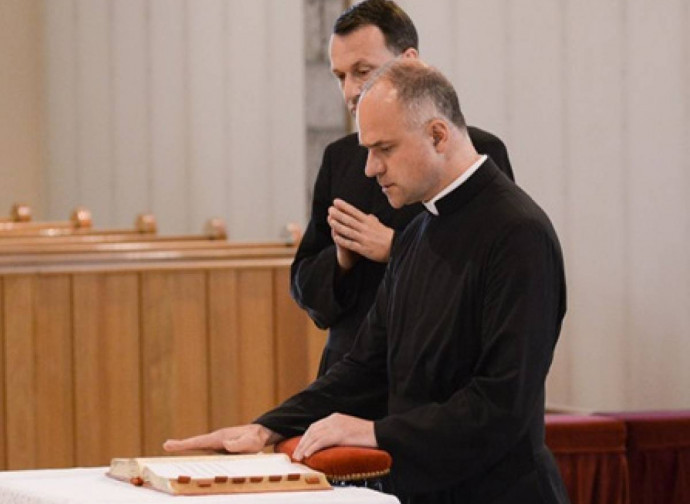
The Prefect of the Congregation for the Doctrine of the Faith (CDF), Cardinal Víctor Manuel Fernández, revealed to The Pillar the contents of the letter sent by the Congregation to the Priestly Fraternity of St. Pius X. The Lefebvrian General House referred to this letter in its communiqué of 2 February. The Prefect explained that he had responded 'simply in the negative regarding the possibility of proceeding now with new episcopal ordinations'. He added, 'We have recently exchanged letters. Next week, I will meet with Fr Pagliarani at the CDF to seek and find a fruitful path of dialogue.' The meeting is scheduled for Thursday, 12 February. Whether the Superior General will subsequently be granted an audience with the Holy Father remains to be seen.
Meanwhile, the Superior General of the FSSPX has given a lengthy interview in which he makes it clear that the episcopal consecrations will go ahead regardless of any response from Rome, for the sake of the 'salvation of souls'. It is understood that the Fraternity's leaders do not intend to ask the Holy See to regularise their position, something they have always refused to do, but rather to ask the Pope to approve the continuation of the FSSPX's existence and operations without canonical status within the Church, thus accepting the episcopal consecrations necessary for their apostolate to continue. Taking into account the Fraternity's unique circumstances, the proposal is to ask the Holy See to allow them to continue in their current situation temporarily, for the benefit of those who turn to them. It seems to me that such a proposal is both realistic and reasonable and could be accepted by the Holy Father,' Fr Pagliarani explained.
According to the FSSPX's logic, the state of necessity in which the Church finds itself and the urgency of saving souls would justify an 'exceptional situation' in which bishops could be consecrated without the Pope's mandate (or even against his will), and the ministry of these bishops and FSSPX priests could be exercised without missio canonica and outside of any legal constraints. Essentially, the Fraternity is asking the Pope to approve its continued existence and operation outside of any canonical structure. This would be possible because 'suprema lex, salus animarum' ('the supreme law is the salvation of souls') is a classic maxim of canonical tradition [...] and, in the current state of necessity, the legitimacy of our apostolate and our mission to souls who turn to us ultimately depends on this higher principle.
Clearly, it is not the Holy See that does not want to regularise the Fraternity's situation, which would allow it to obtain legitimate episcopal consecrations with the Pope's mandate; rather, it is the Fraternity that does not want this. The Fraternity cannot accept any offer of regularisation, not even that of a personal prelature or ordinariate, because it would entail a reduction in the 'freedom' it enjoys today. This 'freedom' includes the ability to proceed with ordinations, establish or suppress seminaries, schools and convents, admit or expel members, open Mass centres and priories, and declare marriages null and void without consulting anyone or depending on a higher authority.
Don Pagliarani also expressed this a little over a year ago, on 15 November 2024, when he was referring to the Ecclesia Dei communities. "What they do not say is that they actually have limited freedom. They only have the freedom granted by a more or less benevolent hierarchy inspired by personalist and liberal principles. As a result, their apostolate and influence are curtailed, hindered and compromised, so that the question of their practical survival becomes increasingly worrying.'
However, Don Pagliarani fails to mention that the freedom claimed by the FSSPX, due to its independence from the Catholic Church hierarchy, is actually called schism. One of the most insightful clarifications on schism comes from Cardinal Tommaso de Vio, also known as Gaetano, who states that the schismatic refuses to act as part of a whole, governed by a legitimate hierarchy. The schismatic therefore refuses to act as part of a whole because they want to live and act as an autonomous body. This is precisely what Don Pagliarani claims for the Fraternity. Simply meeting with the Pope, maintaining relations with the Holy See, mentioning the Pope in the canon or displaying his photo at home is not enough to avoid being considered schismatic. Don Pagliarani's superiority and statements highlight what was unclear during Monsignor Bernard Fellay's regency: the FSSPX intends to reject any proposal for canonical regularisation a priori, in order to maintain total independence from the legitimate Catholic hierarchy. In other words, it intends to ask the Pope to approve its refusal to act as part of a whole, i.e. to bless a state of schism. For the good of the Church and of souls, this is a total short circuit.
Underlying this request is an inadequate understanding of the Pope's role in episcopal consecrations and of the Church as a visible society. According to Don Pagliarani, the Fraternity's situation would be one of simple illegality, acting outside the rules that the Church has set itself for internal order and good governance. However, this would be overcome in a state of necessity by the higher criterion of salus animarum. This 'overcoming' would be possible because it is an ecclesiastical law, not a divine one.
However, the juridical dimension of the Church belongs to its divine constitution, just as Peter's exclusive right to appoint bishops is a constitutive part of his primacy. After all, it is a dogma of faith that the Church, as a perfect visible society constituted by Christ, is bound by legal ties. Pius XII, while illustrating the profound reality of the Church as a mystical body, strongly insists that it received its legal authority from Christ himself. Addressing those who consider the Church to be a spiritual entity devoid of legal bonds, Pius XII reminds us that "they fail to recognise that the divine Redeemer intended the community He established to be a perfect society in its own right, endowed with all the legal and social attributes required to perpetuate the Redemptive mission on earth [...] Consequently, no genuine conflict or incompatibility can exist between the invisible mission of the Holy Spirit and the juridical authority bestowed upon Pastors and Teachers by Christ" (Encyclical Mystici Corporis).
Therefore, the necessity of belonging to the Church through legal bonds concerns the divine constitution of the Church, not mere ecclesiastical law; to sever or reject these bonds is not simply illegality, but schism. Divine law also states that one must receive a missio canonica in order to exercise the ministry: 'For, by virtue of that juridical mission by which the divine Redeemer sent the Apostles into the world as he himself had been sent by the Father (cf. Jn. 17:18; 20:21), it is he himself who baptises, teaches, governs, absolves, binds, offers and sacrifices through the Church' (Ibidem). Pius XII teaches that the necessity of this 'juridical mission' to exercise the ministry is founded in Revelation itself, in the heart of the Holy Trinity, in the Father's sending of Christ and Christ's sending of the Apostles. For this reason, the Council of Trent condemns as contrary to the Catholic faith those who maintain the legitimacy of the ministry of the word and sacraments of bishops who have not been 'regularly ordained or sent by canonical ecclesiastical authority' (Denz. 1777), considering them 'thieves and robbers who did not enter through the door' (cf. Jn 10:1) (Denz. 1769).
For this reason, this is not a question of 'legality', formalism or a misunderstanding of the supreme law of the Church, but rather a question of the divine constitution of the Church as a visible society endowed with the legal bonds necessary for the exercise of ministry. Claiming legal freedom means cutting oneself off from communion with the Mystical Body of Christ. No more, no less. This is anything but a 'realistic and reasonable proposal'.
