
Bishop Suetta's pro-life bell defends natural law
Remembering the babies whose birth was prevented by abortion is a matter of reason, not religion. If anything, the question is why Catholicism only defends common sense. This is why critics (and even some defenders) of the Bishop of San Remo are missing the point.

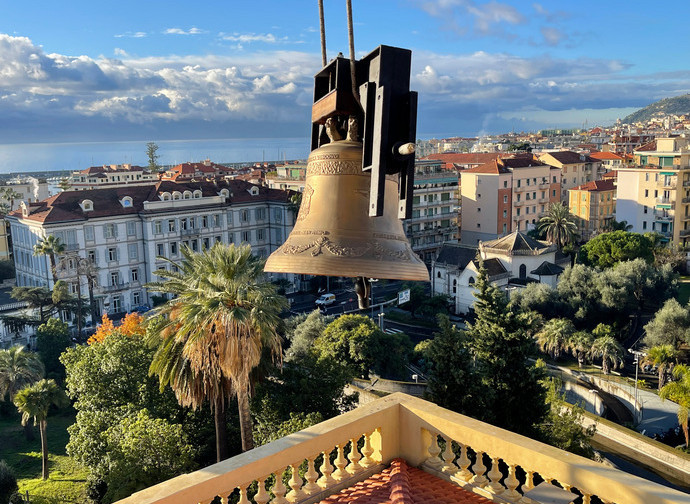
Monsignor Antonio Suetta, the Bishop of Sanremo-Ventimiglia, a renowned seaside resort on the Ligurian coast of Italy, rings a beRemembering the babies whose birth was prevented by abortion is a matter of reason, not religion. If anything, the question is why Catholicism only defends common sense. This is why critics (and even some defenders) of the Bishop of San Remo are missing the point.ll every day to commemorate the children who were prevented from being born by abortion laws. This has obviously sparked controversy, and as expected, the women of the Democratic Party have condemned the initiative, considering it "very serious" as it infringes on women's rights. However, this article will not address these old and over used ideological disputes, but will instead address issues of interest to Catholics that have been overlooked.
Firstly, it should be noted that with this initiative, Bishop Suetta has addressed a matter of natural law and morality. In other words, he has simply defended the order of things — a principle of common sense and a reasonable norm — namely that it is morally forbidden to kill an innocent person. He summarised this himself with the phrase 'Abortion is not a right, but a crime'. The bishop established law as the source of duties, and therefore rights as the source of duties. He recalled the correct logical sequence. Subjective rights depend on law, that is, the objective order of justice, which imposes the duty on reason to respect its unwritten articles. It is on these that subjective rights are based. However, not all rights are legitimate; only those that are grounded in law and justice are legitimate. Unjust rights are not rights.
It would be a mistake to assign an exclusively religious meaning to Suetta’s bell, overlooking its common sense dimension. Online, one can read comments by Catholics who support the bishop's initiative but overlook the point we have just discussed. They justify their defence of Suetta's choice by emphasising that the secular nature of the state is not about fighting a religion, but about allowing all religions to be heard: therefore, Suetta has this right too. Comments of this kind miss the mark in that they attribute primarily religious significance to a provision — that of Suetta — whose primary significance is actually that of natural reason. The state must defend the principles of natural reason because failing to do so would be contrary to the common good, which is its constitutional purpose. However, if the state's primary duty were to give a voice to all religions, it would hypothetically have to do so even for religions that consider abortion to be lawful.
The sound of the bell reminds everyone, not just Catholics, that this natural order exists and that human reason can recognise it. Political power has a duty to defend this order.
However, the discussion does not end there. Suetta is a Catholic bishop who has defended natural law and the principle of natural moral law. He has done so not only as a man and a citizen, but also as a bishop. It would be reductive to stop at the first level, given the need to avoid neglecting it. This is highly significant: it means that the Catholic religion illuminates and protects natural law and that the Church has the task of defending it, as it always has, despite some of the widespread uncertainties of our times. As Paul VI taught in Humanae Vitae (1968), 'No faithful person can deny that it is the duty of the Church's teaching authority to teach natural moral law... for natural law is also an expression of God's will, and faithful observance of it is equally necessary for the eternal salvation of mankind.' Every day, the bell of San Remo-Ventimiglia will remind us that there is a law of nature and that the Catholic Church confirms, defends and purifies it with the law of the Gospel. It will remind everyone, including those within the Church who have forgotten or deny this fact.
Finally, there is another development that is even more decisive: the bell means more than we have just seen. Today, no other religion rings its bells in defence of the natural order — only the 'Catholic' bell does so. By being the only religion to do so, Catholicism expresses and claims a primacy of uniqueness in the eyes of a political power that intends to defend natural law ('if' it intends to defend it). Bishop Suetta has reaffirmed this primacy. However, Catholics who support the Suetta initiative online by telling the state that secularism consists of allowing religions to speak, and who defend the right of the Suetta bell on this basis, do not take into account the primacy of the Catholic religion. The Suetta bell compels the state to fulfil its duty to pursue the common good by defending natural law and encourages the Church to reclaim its primacy in achieving the same goal. In this respect, the Catholic Church's voice is not just one opinion among many; it is a unique and powerful force.
If our reasoning is correct, then all the Catholic bishops of Italy should ring their bells every day at the same time.
