
An exhibition rediscovers Léon Harmel, the entrepreneur of Leo XIII
He was a giant of social doctrine, revolutionising relations with his factory workers and one of the inspirers of Rerum Novarum. Léon Hamel is the subject of one of the two exhibitions that Leo XIV will visit in Rimini which brings him out of obscurity. Entitled Profezia di un’impresa, (Prophecy of an Enterprise) it is a prophecy that still has much to say in the era of Magnifica Humanitas.

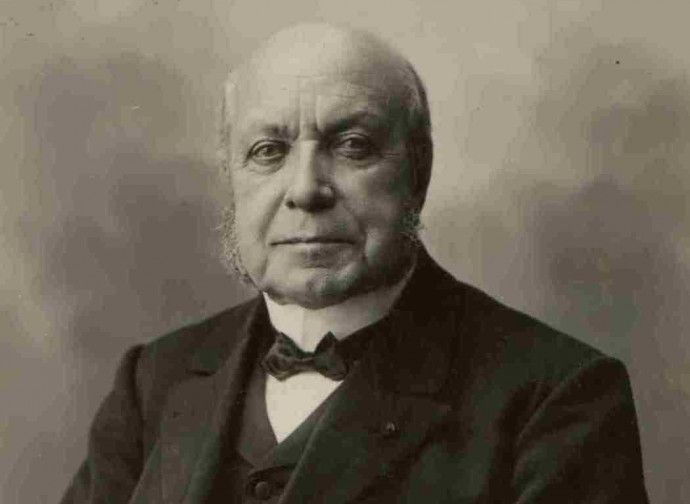
‘We need more people like Léon Harmel,’ said Pope Leo XIII in 1887. Yet the French entrepreneur, who revolutionised relations with his workers in his textile factory by making them co-responsible for the business, and who inspired many of the concepts in the 1891 encyclical Rerum Novarum, fell into oblivion. He has now been brought back into the spotlight specifically for the 2026 Rimini Meeting, and the exhibition dedicated to him is one of two that Pope Leo XIV will visit, the other being the exhibition on St Augustine, before his address to the attendees of the Meeting. But how did this re-evaluation of Harmel come about?
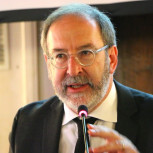
'It all began with the first Mass celebrated by Pope Leo XIV,' explains Ubaldo Casotto, curator of the exhibition, 'when, to explain his chosen name, he drew a parallel with Leo XIII.' Just as Leo XIII had tackled the challenge of the first Industrial Revolution, Pope Prevost saw the new Industrial Revolution (whether it be the fourth or fifth) as the challenge he intended to tackle. This brought to mind some of Fr Luigi Giussani’s lectures in the late 1970s, when he said that if we had followed Leo XIII, the relationship between the Church and the modern world would have been very different. He pointed to Harmel as the only entrepreneur to have put the Church's social doctrine into practice.
This sparked a research project that led Casotto to describe Harmel as a giant. There was no shortage of material, particularly as one of Harmel’s great-grandsons, Émeric Saucourt-Harmel (who was also present at the meeting), is the author of a comprehensive biography reconstructing his life's work and thought in detail. The exhibition is aptly entitled 'Prophecy of an Enterprise' because Harmel introduced a series of revolutionary innovations for the industry of that time: family allowances, a reduction in working hours from 12 to 10 hours, a ban on child labour for those under 12, reduced working hours for young workers to allow them to study, paid maternity leave, a training school for Christian managers, the Works Council, the formation of Christian trade unions and the application of the concept of cooperation, synonymous with subsidiarity. These innovations inspired Leo XIII, as Casotto notes in Rerum Novarum, which presents itself as 'a reflection on an ongoing experience'.
At the heart of all these transformations lies the conviction that, as Harmel put it, 'man's labour is not a commodity but a human act; it would be an affront to moral law and equity if wages were to reach the point of no longer ensuring one’s daily bread'. It is therefore a matter of justice.
Another interesting aspect is the strong bond between Harmel and Leo XIII, which was forged through the pilgrimages to Rome organised by the labour movement. The first of these took place in 1885, when around a hundred industrialists and some two hundred prelates (including factory chaplains, priests, and bishops involved in social issues) presented themselves to the Pope, who, at that time, was essentially 'a prisoner in Rome'. However, at the Pope's request, Harmel returned to Rome with two thousand workers two years later, and again in 1889 with ten thousand. This was a particularly significant event for Leo XIII; Casotto recounts that he said the encyclical Rerum Novarum was an expression of gratitude for the pilgrimages. Following the publication of the encyclical, Harmel brought twenty thousand workers to Rome in 1891 'to thank the Pope for the encyclical'.
To grasp the enormity of the event, one must consider what it meant to transport 20,000 workers from France to Rome at the end of the nineteenth century.
The Meeting is therefore preparing to welcome Leo XIV, equating his 'Magnifica Humanitas' with Leo XIII's 'Rerum Novarum'. Yet it is precisely the exhibition dedicated to Léon Harmel that highlights a fundamental difference. Pope Leo, when considering the digital revolution, has no Harmel to look to; he has had no significant experience of Catholics engaged in artificial intelligence from which to draw inspiration. It is no coincidence that, at the presentation of the encyclical on 15 May, the Holy See had to 'make do' with the presence of Christopher Olah, co-founder of Anthropic — an artificial intelligence company that has perhaps more than any other sought to reflect on the ethical issues raised by new technology — but which is certainly not an example of Catholic thought in action.
This is not to diminish the value of 'Magnifica Humanitas', but rather to express the hope that the reflections proposed by Leo XIV will encourage Catholics working in the digital sector to establish enterprises bearing a truly Catholic imprint.
