
Africa celebrates Christmas between terrorist attacks and Christian testimony
In northern and central Nigeria, Burkina Faso and northern Mozambique, Christmas is a day when the risk of a jihadist attack is at its highest. Yet, the faithful risk their lives to persevere in their faith.


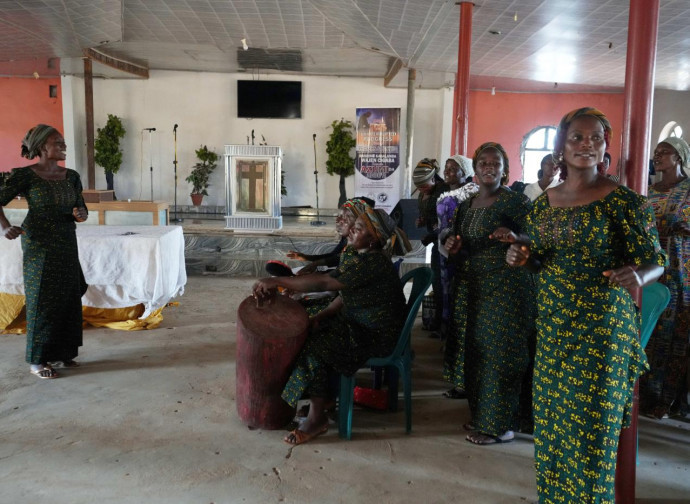
This is a difficult Christmas for many Christians around the world who are preparing to celebrate it in challenging circumstances. The Nigerian Church has urged the faithful living in the north-east and central parts of the country not to give in to despair and fear, but to remain steadfast in hope and faith. These areas have experienced a long and painful history of terrorist attacks on their churches and communities, and there is a particular fear of an intensification of these attacks as the Christmas holidays approach.
In Nigeria's north-eastern states, which have a Muslim majority, the threat comes from Boko Haram and ISWAP, two jihadist groups affiliated with al-Qaeda and ISIS respectively. In the central states, gangs of Fulani Muslims sow terror among Christians, especially in rural areas, attacking villages and often setting them on fire after looting crops, livestock and vehicles. This forces inhabitants to leave permanently, leaving them without possessions or a home. Furthermore, in the north-west and central states, jihadist violence is compounded by that of 'bandits'. This is the generic term used in Nigeria for criminals who carry out kidnappings for ransom, a crime which has become a real social scourge due to the number of people affected. In one month alone, several worshippers were kidnapped from two churches attacked a few days apart, as well as over 300 students and 12 teachers from a Catholic school.
Religious authorities and associations are calling on the Nigerian government to increase security measures to protect communities, rather than simply warning Christians. They advise the faithful to remain vigilant but not to abandon services and rituals during Advent and Christmas. “The government is issuing security warnings. Do not hold night vigils,” they advise. “If you must practise your rituals in church, do not stay for long and be careful.” But if we cannot attend Christmas Eve services out of fear, then it means that the extremist ideology of the Boko Haram jihadists is winning, because they do not want Christians to practise their faith," says Father George Omaku Ehusani, director of the Nigerian non-governmental organisation Lux Terra Leadership Foundation. If people are too afraid to go to church, then their ideology wins.'
In western Nigeria and Burkina Faso, Christians living in areas infested with jihadists have no choice. They do not give up celebrating Christmas, but they are forced to avoid evening ceremonies, especially Midnight Mass. In the Catholic diocese of Kaya, midnight Mass has been held before dark for the past ten years for security reasons, to avoid the faithful having to travel at night. However, this year, other dioceses have also reluctantly decided to follow suit. Jihadist groups have been active in the north of the country, on the border with Niger and Mali, for years. However, since the military seized power in 2022 with two coups within a few months of each other, the situation has deteriorated rapidly. As in Mali and Niger, the jihadists' operational range and the frequency and intensity of their attacks and bombings have increased exponentially. They now control 40% of the country and more than a million Christians have been displaced, living in refugee camps. Those who still have a church can consider themselves lucky.
In the eastern and northern regions, only 5% of parishes remain accessible. In the diocese of Dori, for instance, only two parishes are operational, and the bishop can only travel there by helicopter or with a military escort. Masses, including Midnight Mass, must be celebrated before dark, but all the open churches will be packed as always, and despite everything.
“The Christians of Burkina Faso keep their faith alive, persevere in prayer, and do not lose hope,” says Monsignor Théophile Naré, the bishop of Kaya, as quoted by Aid to the Church in Need. He cites Tertullian: 'The blood of martyrs is the seed of new Christians. If the enemy thinks he can extinguish Christianity, he is wasting his time. Christianity is growing in Africa.' The facts prove him right. In March, two million faithful people took part in celebrations to mark the 125th anniversary of the evangelisation of the country at the Marian shrine of Yagma.
Christians in the province of Cabo Delgado in northern Mozambique will experience a Christmas of both faith and pain. They are victims of jihadist violence perpetrated by al-Sunnah Jama'ah, a group affiliated with ISIS that has been active since 2017. There are now more than 100,000 displaced people. Almost all of them live in refugee camps. These are people who have seen their children, husbands, and neighbours slaughtered by jihadists. These are children who have seen their mothers killed or kidnapped. They have had to abandon everything: their homes, fields, livestock, and all their other possessions.” This is how the displaced persons in the Ntele camp, where more than 300 families are housed and assisted, are described by the catechists, speaking to Aid to the Church in Need. Meetings with the displaced persons and religious services are held in a chapel or outdoors in the shade of trees.
The faithful in northern Mozambique lack not only churches, which have been closed for security reasons or reduced to rubble by jihadists, but also priests. There are so few priests that they cannot visit all the communities and make contact with all the faithful. Some refugee camps and communities are visited only once a year by their priests. As in Ntele, catechists throughout the region work tirelessly despite many difficulties, including practical ones. Even the few sacred texts provided by the dioceses are shared among them, and they have to take turns using them. For many Christians in northern Mozambique, the question this year is not whether Midnight Mass will have to be brought forward because no priest will be available to celebrate it, but whether it will be celebrated at all.
