
A second breakaway will see five new Lefebvrian bishops ordained
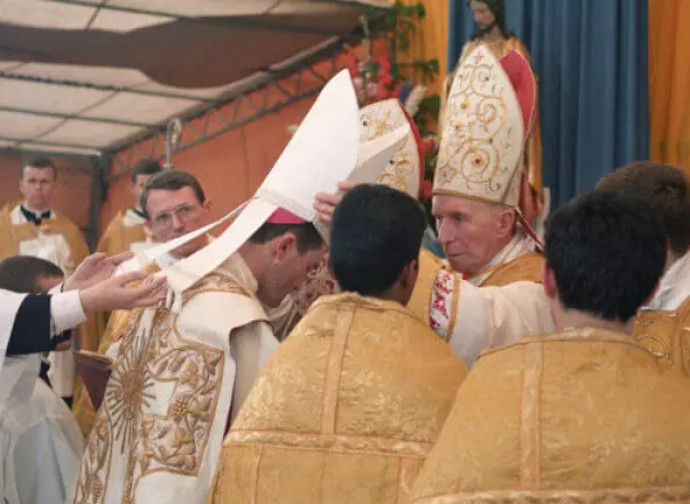
Episcopal ordinations without a papal mandate, as in 1988. On 1 July, the Society of Saint Pius X will repeat Archbishop Lefebvre's gesture, this time ordaining an additional bishop.The Holy See has expressed its willingness to continue dialogue in order to avoid a new rupture.


New episcopal ordinations are in the offing for the Priestly Fraternity of St. Pius X, as was publicly announced by the Superior General of the FSSPX, Fr Davide Pagliarani, at the end of his homily on 2 February during the vestitions at the Holy Curé d'Ars Seminary in Flavigny-sur-Ozerain, France. He said, “We think the time has come to reflect on the future of the Priestly Fraternity of St. Pius X and on the future of all the souls that we cannot forget or abandon. This raises questions that we have been asking ourselves for some time, and perhaps we must now give an answer.'
Fr. Pagliarani then revealed that he had written to the Holy Father ‘to explain this very particular situation in which the Society finds itself, and to ask him to take the necessary measures to ensure that this work can continue’. However, he added that these reasons had not yet found an open door at the Holy See, and asked, ‘Must we still wait before considering the consecration of bishops?’ According to the Superior General, the time to act is now: 'That is why we think that 1 July could be a good date for episcopal ordinations. It is the Feast of the Most Precious Blood of Our Lord.'
Shortly thereafter, the General House in Menzingen officially confirmed the decision and the date of 1 July in a statement. According to our sources, five priests will be ordained as bishops by Bishop Bernard Fellay and Bishop Alfonso de Galarreta on 1 July, one more than the bishops ordained by Archbishop Marcel Lefebvre on 30 June 1988.
The announcement of new episcopal ordinations by the SSPX comes as no surprise. Abbé de Journa, director of the important French district of the FSSPX and rector of the Écône seminary for over twenty years, began to prepare the ground when, in the Lettres aux Amis et Bienfaiteurs of 19 June 2024, he explained that the four bishops ordained by Lefebvre in 1988 'were quite young at the time, but are obviously less so thirty-six years later. Since the situation of the Church has not improved since 1988, it has become necessary to consider the possibility of giving them assistants who will one day become their replacements.'
A few weeks after the death of Bishop Tissier de Mallerais on 8 October 2024, one of the four bishops consecrated by Archbishop Marcel Lefebvre, Don Davide Pagliarani began to make his listeners, both 'Roman' and non-Roman, aware in an interview with The Angelus magazine that the FSSPX would need new bishops. This was because the death of Bishop De Mallerais, combined with the expulsion of Bishop Richard Williamson from the Fraternity (who died on 29 January 2025 after consecrating six other bishops), had halved the number of Lefebvrian bishops. 'This death raises the question of the continuity of the Fraternity's work, which now has only two bishops and whose mission seems more necessary than ever in these times of terrible confusion within the Church,' declared Fr Pagliarani on 1 November.
Just two months later, the Courrier de Rome, the unofficial magazine of the FSSPX, published an article by Abbé Jean-Michel Gleize. Gleize is a theologian of the Fraternity and was a member of the ‘commission’ responsible for liaising with the Holy See when Benedict XVI initiated discussions regarding possible regularisation. Entirely devoted to the possibility and necessity of episcopal consecrations without and against the Pope's mandate, the article explicitly intended to ‘lead the Catholic faithful to have no hesitation when the time comes, at the hour set by the Superior General’.
The article sets out the FSSPX's entire 'doctrine' regarding episcopal consecrations in a 'state of necessity' (we will have occasion to discuss this).
On 13 December 2025, in Friedrichshafen, when asked about upcoming episcopal ordinations without a papal mandate, Fr Pagliarani hinted that they were imminent: 'It's a million-dollar question, it's a question... I'm not here to give dates or names, but certainly to entrust this intention to your prayers.' On this occasion, the Superior General praised Archbishop Lefebvre's 'supernatural prudence', which he said demonstrated his 'docility to the Holy Spirit'. This 'prudence' forms the corner stone of the FSSPX's position and is the reason behind the consecration of new bishops, with or without the Holy See's mandate. According to Lefebvre, the transmission of the power of order is possible even against the will of the Pope, since in usurping the Petrine prerogatives, only the power of jurisdiction would be transmitted, not the power of order. The Church's situation of necessity since Vatican II would, in this sense, justify the lawfulness of proceeding with episcopal ordinations without a mandate: they would not be schismatic since they do not intend to transmit jurisdiction and would thus not usurp the prerogatives deriving from the Petrine primacy.
The Daily Compass previously explained why this approach is incorrect and will return to the subject. For now, we simply acknowledge the announcement and await the 'additional explanations on the current situation and on his decision' promised in the aforementioned communiqué from the General House. This will give us a clearer picture of the situation. We also note the Holy See's initial reaction, which was rather sparse. Through the director of the Press Office, the Pope expressed his willingness to continue contacts with the FSSPX in order to ‘avoid rifts or unilateral solutions to the issues that have arisen’.
