

War is evil, but Catholic pacifism exacerbates it
The conflict in the Middle East has reignited the debate among Catholics over the “just war,” and—especially in Europe—a radical pacifism prevails within the Church, one that effectively denies the existence of original sin and exposes the weakest to the designs of whatever aggressors happen to be in power.


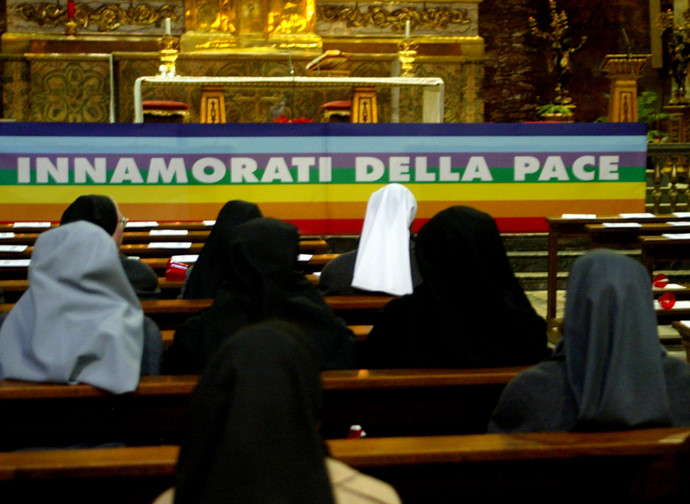
First of a series of two.
With the start of the Israeli–American war against Iran, the debate within the Catholic world over the so-called 'just war' has intensified, with views ranging from absolute pacifism to justifying any war waged in defence of the West.
Curiously, in this debate, there is a great deal of reluctance to start from the four conditions set out in the Catechism of the Catholic Church must be met simultaneously for armed conflict to be morally justifiable.These conditions are: “That the harm inflicted by the aggressor on a nation or community of nations must be permanent, catastrophic, and undeniably proven; that all other peaceful and diplomatic means of ending the aggression must have been shown to be completely impractical or ineffective; that there are well-founded prospects of success; and that the use of arms must not produce evils and disorders graver than the evil to be eliminated. In assessing this condition, the power of modern means of destruction carries immense weight”.
In a subsequent article, we will have the opportunity to explore the doctrine of justification in greater depth. Here, however, it is worth focusing on the pacifist tendency that currently prevails in the Church, thanks in part to the pontificate of Francis, and which, in its most radical forms, would even condemn the existence of armies. We have already had the opportunity to refute certain arguments expressed regarding the military parade in Italy on 2 June, for example, with the Magisterium.
However, it is important to identify an error that lies at the root of certain deviations and misunderstandings surrounding the issue of war. Pacifism — with its vision of a world without weapons, aggressors or victims, based solely on human will — is a utopia that ignores an undeniable truth: original sin. Indeed, because war is the consequence of sin against God, as the Pastoral Constitution Gaudium et Spes warns, “Insofar as men are sinful, the threat of war hangs over them, and hang over them it will until the return of Christ.” (no. 78). Therefore, the idea of a world without war or the threat of war is a dangerous utopia, which is perhaps understandable coming from John Lennon, but far less so when proclaimed by the leaders of the Church.
The commitment to preventing wars — or better yet, to peace — is a different matter. But this means only one thing: conversion to Christ. As the Compendium of the Social Doctrine of the Church warns, peace "is one of the greatest gifts that God offers to all men and women, and it involves obedience to the divine plan" (no. 489).
Many use 'the power of modern means of destruction' as a pretext to deny the possibility of justifying war. Pope Francis also wrote about this in the encyclical Fratelli Tutti, stating that it is now very difficult to uphold the rational criteria developed in past centuries in order to speak of a possible 'just war'. However, the Catechism considers the existence of weapons of mass destruction to be an additional factor for reflection and prudence when making the decision to intervene militarily in self-defence, and certainly not as a negation of the possibility of legitimate defence.
Changes in contingent situations may prompt further elaboration of the doctrine of legitimate defence, but they cannot alter its criteria. Examples of this can be found in the statements on the subject by John Paul II and Benedict XVI. The former, taking into account the atrocities of the war in the Balkans unfolding in the early 1990s, introduced the concept of 'humanitarian intervention', defining it as 'a duty and a right to disarm someone who wants to kill'. This is not promoting war, but preventing it.'
This principle has its conditions, which John Paul II set out in his message for the World Day of Peace on 1 January 2000. Actions to disarm the aggressor “must be limited in time and precise in their aims, carried out in full respect for international law, guaranteed by an authority, that is internationally recognised and, in any event, never left to the outcome of armed intervention alone” (no. 11). Subsequently, in his important address to the United Nations General Assembly on 18 April 2008, Benedict XVI took up this concept again, referring to the 'responsibility to protect'. Furthermore, the Compendium of the Social Doctrine of the Church explains that, “the right to use force for purposes of legitimate defence is associated with the duty to protect and help innocent victims who are unable to defend themselves from acts of aggression” (no. 504).
This clarification enables us to highlight a common misconception in pacifism, including Catholic pacifism: the confusion of the use of force with violence. These are two distinct concepts, because the use of force is sometimes legitimate and even obligatory, whereas violence — the intention to destroy human life or indifference to it — is never justifiable. “Violence is evil; violence is unacceptable as a solution to problems; violence is unworthy of man,” said John Paul II during his 1979 trip to Ireland. “Violence is a lie, for it goes against the truth of our faith, the truth of our humanity. Violence destroys what it claims to defend: the dignity, the life and the freedom of human beings.”
This also applies in times of war, when all efforts must be made to establish the conditions for peace as soon as possible, and when humanitarian law is not suspended. As Gaudium et Spes further emphasises, “the mere fact that war has unhappily begun mean that all is fair between the warring parties” (no. 79).
Therefore, it can certainly be argued that most current wars are unjust, and one might also debate whether certain defences of national borders truly meet all the conditions for genuine self-defence. However, what is contrary to the Catholic vision is this prevailing pacifism within the Church, which, on the one hand, preaches total disarmament (preferably unilateral), yet paradoxically finds itself supporting bloodthirsty and violent regimes.
