United States, bishops oppose appointment of pro-abortion professor
The Catholic University of Notre Dame appoints a pro-abortion professor to head one of its institutes. Scandal among the faithful. The bishop takes a stand along with a dozen other confreres, including the president of the Episcopal Conference.


In the US Catholic world, a case involving the University of Notre Dame in South Bend, Indiana, has been making headlines for several days: the appointment of a well-known abortion advocate, Professor Susan Ostermann, as director of an institute for Asian studies (the Liu Institute for Asia and Asian Studies) at the same university. The story has been dragging on since 8 January this year, when Ostermann's appointment was announced, effective 1 July 2026. Ostermann already works as an associate professor of international affairs at one of Notre Dame's schools, but her appointment to the head of an academic unit has caused particular scandal among faculty, students (present and past) and benefactors of the university, founded in 1842 by a French priest, Father Edward Sorin, of the Congregation of Holy Cross.
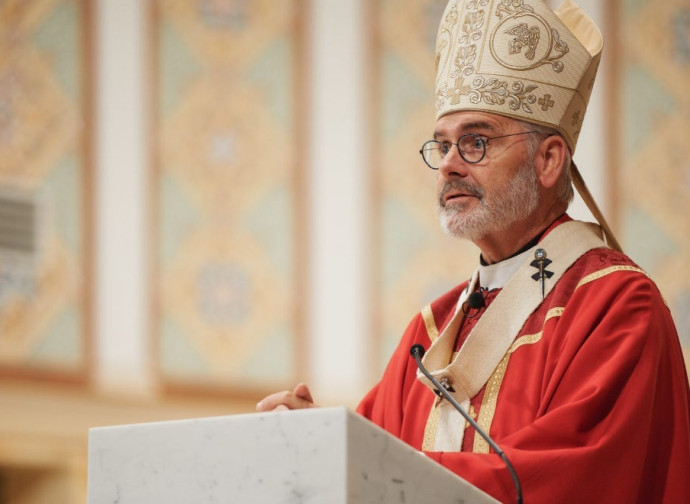
The bishops have not remained indifferent to the scandal. In fact, the controversy has intensified since 11 February, when Monsignor Kevin Rhoades, head of the Diocese of Fort Wayne-South Bend, which includes the University of Notre Dame, intervened directly. Along with him, about a dozen American bishops have taken a stand against the appointment. Among them is the president of the United States Conference of Catholic Bishops, Paul Coakley, who on 13 February published a post on X expressing his open support for Monsignor Rhoades, hoping that the university would "rectify its poor judgement in hiring a professor who openly stands against Catholic teaching when it comes to the sanctity of life, in this case protection of the unborn".
Clear words, which go hand in hand with the articulate statement that the Bishop of Fort Wayne published asking the university to withdraw the appointment. Monsignor Rhoades took the trouble to read several opinion pieces written by Ostermann, in which the professor not only promotes abortion but also attacks the pro-life movement, claiming that it has "its roots in white supremacy and racism" and is steeped in misogyny. It is unfortunate that the opposite is true, both in terms of racism (see the whole story surrounding Margaret Sanger and the birth control movement) and misogyny, since abortion puts women against their vocation to motherhood. Incidentally, Ostermann even takes issue with pregnancy help centres, which she calls "anti-abortion propaganda sites" that deceive women, when they are simply helping them to give birth to their children. Furthermore, the professor argued that Catholic doctrine on "integral human development" is pro-abortion because it increases women's (misunderstood) freedom. This idea is even more serious because, as Archbishop Rhoades points out, it misrepresents a central teaching of the Keough School of Global Affairs, the Notre Dame school that houses the Liu Institute, of which Ostermann has been appointed director. In short, this is confusing.
And that's not all, because Ostermann has also worked as a consultant for the Population Council, an organisation committed to promoting abortion worldwide and which has been linked to Chinese birth control policies. Considering all these aspects, the Bishop of Fort Wayne rightly states that "Professor Ostermann’s extensive public advocacy of abortion rights and her disparaging and inflammatory remarks about those who uphold the dignity of human life from the moment of conception to natural death go against a core principle of justice that is central to Notre Dame’s Catholic identity and mission". Archbishop Rhoades then recalls that «Notre Dame has publicly committed as a Catholic institution to the life and dignity of the human person. It affirms the Church’s teaching that “human life must be respected and protected absolutely from the moment of conception” (Catechism of the Catholic Church #2270)» .
The bishop therefore asks the university to withdraw the professor's appointment because it "understandably creates confusion in the public mind as to Notre Dame’s fidelity to its Catholic mission". He recalls his own duty as bishop in light of Ex Corde Ecclesiae (1990), the apostolic constitution on Catholic universities, in which St. John Paul II, at the beginning of no. 28, writes: "Bishops have a particular responsibility to promote Catholic Universities, and especially to promote and assist in the preservation and strengthening of their Catholic identity [...]".
The president of the Pontifical Academy for Life, Monsignor Renzo Pegoraro, also spoke about the matter during a press conference presenting an international seminar on healthcare. According to EWTN News, Pegoraro spoke out against abortion but did not comment directly on the controversy. The controversy continues, as the university has so far defended its decision.
The Notre Dame case also confirms the attention that the US episcopate pays to the issue of defending life from conception onwards and to other non-negotiable principles. Of course, there is no unanimity of views and sensibilities, but at the same time there is a healthy frankness in the States that is much rarer in Europe than overseas.
