

The Society of Saint Pius X lodges an appeal, but excommunications stand
The Lefebvrian bishops were consecrated on the basis that any condemnation would be invalid; they are now asking Rome to revoke the decree. However, the excommunication latae sententiae takes effect before, and irrespective of, the relevant judgement. The consequences are uncertain, but the contradiction regarding Petrine authority is clear: it is recognised, but only in order to act against it.

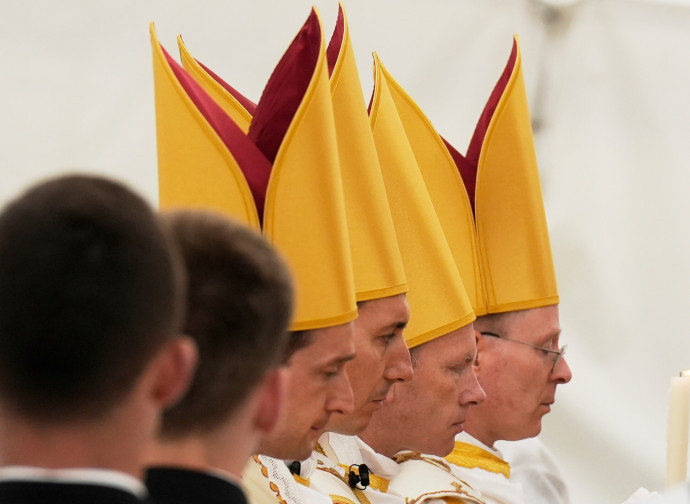
The news is now in the public domain: on 13 July, the Priestly Fraternity of St Pius X announced that it had lodged a preliminary administrative appeal against the 2 July decree of the Congregation for the Doctrine of the Faith, which declared the excommunication of the six FSSPX bishops. This appeal, also known as a 'request' or 'complaint', is required before a hierarchical appeal can be lodged. It is intended to draw the attention of the authority that issued the decree to any errors contained therein so that it can be corrected, reworded, supplemented, or even annulled.
The consequences of this appeal are not so clear, however. The General House in Menzingen was quick to state in its press release — perhaps to reassure some of the faithful with troubled consciences — that this preliminary appeal 'has the effect of suspending the execution of the decree, in accordance with canon 1353 of the Code of Canon Law'. Consequently, the idea has spread in newspapers and on news websites that the excommunications have been suspended and that all is well again.
However, this is not quite the case. This is because the excommunications affecting five of the six bishops relate to canon 1387 for being consecrated and consecrating others as bishops without a papal mandate. These are therefore 'latae sententiae' excommunications, which take effect as soon as the act is performed. This means that the excommunications precede the decree by which they are declared by the competent authority because they are linked to the act performed, not a judgement. It was an unequivocal public act performed before thousands of people and broadcast throughout the world.
Moreover, the Apostolic See has already rejected the Fraternity's invocation of a 'state of necessity' as a justification. On 24 August 1996, the Pontifical Council for Legislative Texts explained that 'there is never a necessity to ordain bishops against the will of the Roman Pontiff, Head of the College of Bishops'. This would imply the possibility of 'serving' the Church by attacking its unity in a matter connected with the very foundations of that unity'.
Therefore, these excommunications remain 'in force'. Only the decree declaring the penalties can be challenged, not the penalties themselves, because the decree did not impose the excommunication (so, if the decree is suspended, the penalty is also suspended), but the act carried out by the bishops did. The decree merely declared what had taken place.
The Congregation for the Doctrine of the Faith has thirty days to respond to the preliminary appeal. It may either confirm its own interpretation of the law, amend the decree or choose not to respond, in which case the FSSPX may proceed with the hierarchical appeal. However, this will not affect the excommunications, which can only be lifted by the Holy See once signs of repentance are evident. The Dicastery might also seek the Pope's approval in forma specifica; in this case, the FSSPX would not be able to lodge a hierarchical appeal, as a papal decision is final.
Another issue concerns the party that lodged the appeal. According to the press release, this party appears to be the FSSPX. As we are not familiar with the text, we can only proceed on the basis of assumptions. However, if this were the case, the appeal could be rejected by the Dicastery on the grounds that the Fraternity does not have legal status within the Church. It existed as a pious union of the faithful ad experimentum (for six years), established on 1 November 1970 by Bishop François Charrière of Lausanne, Geneva and Fribourg, and suppressed by him on 6 May 1975. From that moment onwards, the FSSPX ceased to exist legally within the Church; therefore, a non-existent entity cannot lodge an appeal. However, the individual bishops involved can do so.
Having set out all these clarifications, this curious fact cannot go unnoticed. In the statement read on 1 July instead of the apostolic mandate, the FSSPX asserted that 'any penalty or condemnation levelled against this act [of episcopal consecration] is null and void'. The FSSPX thus decreed that it would regard as null and void any measure that might come from the Apostolic See. Following the declaration of excommunications on 6 July, it published a lengthy article on its website rejecting every single assertion in the decree and the explanatory note in detail: no one is excommunicated; all the sacraments administered are legitimate; and confession and marriage are valid. On 9 July, the same message was repeated: there is no schism, no excommunications and no illegitimate or invalid sacraments.
Thus, the FSSPX — which has already established that no sanction issued by the Holy See against it is valid, that no declaration concerning it has value and that the canon regarding consecrations without a mandate does not apply — is now lodging an administrative appeal 'in a spirit of respect for ecclesiastical authority and faithful attachment to justice, truth and the good of the Church'. It goes without saying that, if the sanctions are confirmed by the relevant authority, they must not be complied with. Obviously, with all due respect.
Regarding the consecrations of 1 July, the FSSPX boasted of its deference towards the Apostolic See, as it sent the dossiers relating to the four new bishops to Rome, as is customary. This is a sign of its attachment to the Successor of Peter. However, it is unfortunate that this is precisely because the Roman Pontiff, by virtue of his primacy, has the right to choose the bishops to be consecrated and to grant or refuse the mandate. Yet the Fraternity presented the Pope with decisions that had already been made and could not be retracted.
Don Davide Pagliarani tore his garments in his homily on the occasion of the consecrations to express his love for the papacy and his indignation at 'the humiliation of the Pope', yet he has no qualms about making decisions that are a slap in the face for the Apostolic See. It's as if he's saying, 'We acknowledge you in words, but we'll do as we please anyway.' This is no surprise: it is the continuation of the sophistical 'logic' whereby one is not a schismatic if one mentions the Pope in the Canon, displays his photograph in the sacristy and prays for him. Now, mark my words, one can even lodge a canonical appeal as irrefutable proof that one recognises the Pope's authority. Yet, in practice, one habitually acts without taking his authority into account. The primacy of Peter is defended in words, but systematically denied in deeds. One does not resist any orders contrary to God’s law, but evades his authority systematically.
This is the very essence of the disconnect between professed and practised faith that brings to mind the pontificate of Pope Francis. Ultimately, Pagliarani and Bergoglio are not so far apart.
