

Sánchez’s lies about the invasion of Ceuta from Morocco
The Spanish prime minister is proving increasingly ill-equipped to handle the most colossal migration crisis in recent times. He continues to ‘exonerate’ Morocco, but intelligence reports contradict him. Even the European Union is beginning to see through his bluff.


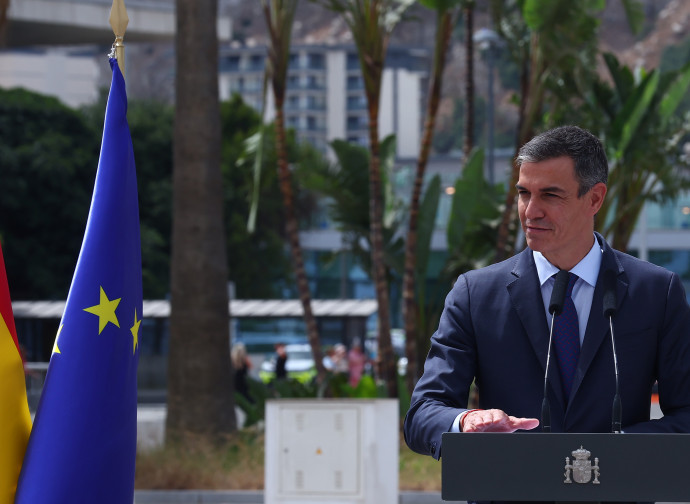
Yesterday, during his address to Congress on the Ceuta crisis, the Spanish Prime Minister, Pedro Sánchez, reiterated that he had never received any advance warning of the events that were about to unfold, despite the reports from the police and security forces. This was more than a month after the orchestrated invasion.
According to Sánchez, none of the reports from the preceding days ‘went beyond a description of the facts or a routine alert’. Similarly, he once again exonerated Morocco from the accusation of having invaded the autonomous city, as he had already done last week, which the Daily Compass reported. He stated that 'there is no evidence to that effect'. Whether there was incompetence or inaction is a matter that will have to be clarified, but no one has provided the Spanish government with concrete evidence that Morocco planned or carried out the incident.'
This is a typical response from socialists and communists when they are in trouble. As we anticipated in recent weeks and as reports in the Mundo have now confirmed, there were advance warnings about the scale of the Ceuta crisis. There were clear and unequivocal signs of what was about to happen and information from the Moroccan police that served to raise the alarm on the other side of the border.
Despite the government's denials, critical reports had indeed indicated the 'massive' scale of the 'collapse' that was looming as 'highly probable'. The two key intelligence reports on the Ceuta crisis, to which this Spanish newspaper had exclusive access, demonstrate this beyond doubt, leaving no room for political justifications; their content is both crucial and evident. The first report comes from military intelligence and, on 27 July, warned of a ‘highly likely’ ‘massive influx of irregular migrants’ into Ceuta on the 30th.
Three days later, just before the influx, the National Police issued an internal briefing note warning of the 'extreme risk of collapse' of an 'immediate nature'. The word 'extreme' appears in capital letters, underlined and in bold. 'Immediate nature', in bold and underlined. Videos also show officers of the Moroccan Royal Gendarmerie (in both uniform and plain clothes) clearly directing the migrants and facilitating their passage, rather than containing the flows. One video even shows lorries full of people being unloaded under the supervision of Moroccan gendarmes.
Similarly, testimonies and interviews with 300 irregular migrants are in circulation in which they explicitly state that Morocco encouraged and facilitated their journey to the Spanish border crossings. During the parliamentary debate, the leader of the People's Party, Alberto Núñez Feijóo, accused Sánchez of being blackmailed by Rabat ('What does Morocco know about you?'), while Santiago Abascal (Vox) openly spoke of 'betrayal' of the country.
Even the far-left and pro-independence parties (Sumar, ERC and Bildu) have turned on the prime minister, describing his pro-Moroccan defence as 'not credible' and comparing his government's narrative to that of the PP government during the 11 March 2004 crisis, which led to José María Aznar's resignation. Given the fragility of his coalition, which relies on the support of left-wing and pro-independence parties, Sánchez should be trembling with fear rather than lying shamelessly to Parliament and the people.
In an attempt to quell discontent and reassure the local population, yesterday Sánchez announced a series of token measures for Ceuta and Melilla: the government will commit to permanently including Ceuta and Melilla in the European Union’s Committee of the Regions; fully integrating them into the customs union; and securing for them the formal status of EU outermost regions. These measures are a mockery, given the economic and social crisis and the insecurity faced by the inhabitants of these areas.
The inhabitants and institutions of Ceuta and Melilla have found unconditional support and total solidarity from hundreds of thousands of citizens and public officials across Spain. On Wednesday 2 September, huge crowds took to the streets to demonstrate against the Sánchez government, from Madrid to Barcelona, Zaragoza to Bilbao, León to Oviedo, and then Murcia and Andalusia.
Sánchez’s days are numbered, and the silence of his European Socialist colleagues is emblematic of their embarrassment. Doubts are also growing in Brussels regarding the adequacy of the Sánchez government. Yesterday, the Commission’s spokesperson, Markus Lammert, stated that several important issues remain unresolved and that the Spanish authorities must provide answers before Madrid’s request for greater Frontex involvement in Ceuta can be accepted.
