
Priest cremated and turned into a diamond creates confusion
Don Lanfranco Casali chose to be cremated and turned into a diamond. He explained his reasons in a video that has now been made public following the completion of the 'transformation'. The Diocese of Fano finds itself in an awkward position over a choice that runs counter to Church teaching, causing confusion regarding the resurrection of the flesh.


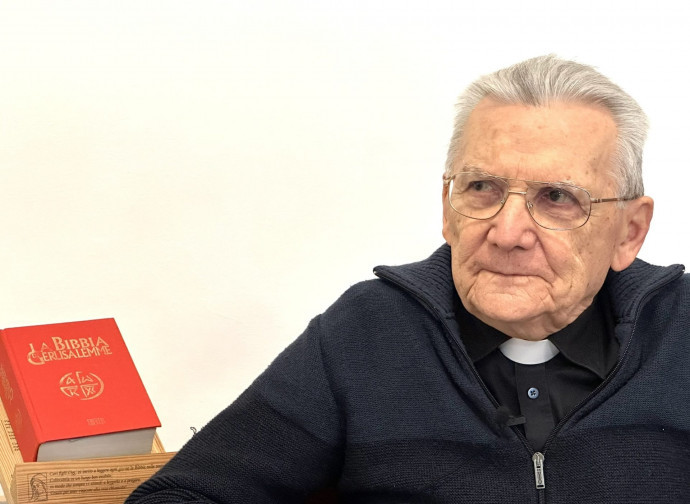
It is almost instinctive to quote the advert 'A diamond is forever' when faced with the curious fate of one's mortal remains as chosen by Don Lanfranco Casali. The 93-year-old priest from the Marche region died on 22 November 2025 and had decided to be cremated and turned into a diamond to reflect the light of God, as he put it. This idea, or 'leitmotif', as we shall see, was already evident in the opening lines of the funeral notice announcing his death: ‘You are looking for him! If he is there, reflect him'. The news has recently become public knowledge, along with the video he recorded about a year before his death. Now that the transformation has been completed through a sophisticated and costly process carried out by a Swiss company, his ashes have become a precious blue gemstone to be placed in a sacred place, in accordance with his wishes. In the video, he explained the reasons behind his choice. On 9 September 2026, the Diocese of Fano-Fossombrone-Cagli-Pergola, to which he belonged, distanced itself from his decision with a brief and embarrassed statement, highlighting the contradiction between the priest’s last will and testament and the Church’s teaching on the matter.
‘For years now, I have been seriously thinking about the day when the Lord will call me to Himself,’ explained Father Casali in the video. ‘As a priest, I have always sought to live as a reflection of the light of Christ in the Church. In my will, I have arranged for the cremation of my mortal remains, which I wish to donate, with liturgical and spiritual references.” Cremation itself, which the Church tolerates but advises against, is already somewhat controversial for a priest. ‘But I would like to go further,’ he continued. ‘It is my wish that my ashes be turned into a diamond, which the local Church will place in a sacred location for all those who might choose this form of burial in the future.’ Therefore, it is not merely a personal choice, but a hope that the practice of turning ashes into diamonds will become more widespread.
‘This choice is intended to show, as I sought to do in life, that the light of the Lord passes through us and bestows beauty to be passed on. Ash Wednesday, the day marking the beginning of the great Easter season, reminds us that we are ashes, originating from that primordial dust, brilliant and sparkling through the presence of a ray of uncreated light. We are dust and ashes, yet we pulsate with reflected light and love.'
The link with the Ash Wednesday liturgy is somewhat tenuous since the biblical reference is closely tied to the body’s return ‘to the earth, for from it you were taken: you are dust, and to dust you shall return!’, as we read in the Book of Genesis (3:19).
Don Casali expressed his desire to ‘be a diamond with countless facets in order to live out and reflect anew the blazing rays of God’s continually flowing love’. It is beautiful to think of 'diamondisation' as a sign of the transfiguration that we must welcome and facilitate, where this stardust — which, by the will of the Other, the wholly Other, has become a living creature — allows itself to be transformed by God’s love.
The subjective 'mysticism of the diamond' contrasts with the Church's more objective teachings. Given that this concerns a priest, the matter is significant. For this reason, on 9 September, the Diocese of Fano issued a statement reiterating what had already been expressed to the Italian news agency Ansa a few days earlier. Whilst remaining certain of Don Casali's good faith and intentions, the statement declares that this was a personal choice made by the late priest which was not shared with the bishop or others. While it 'sees this event as an opportunity to highlight the many good works carried out by Father Lanfranco during his ministry', it also 'calls on everyone to observe the authoritative Ecclesial Magisterium, which defines the matter in question in the instruction Ad Resurgendum cum Christo, issued by the Congregation for the Doctrine of the Faith on 15 August 2016'.
Christ died and was buried, not cremated, and it is precisely in light of his death, burial and resurrection that the aforementioned instruction reaffirms the 'doctrinal and pastoral reasons for the preference for burial' and recalls the crux of the matter. 'By burying the bodies of the faithful departed, the Church affirms her faith in the resurrection of the flesh and highlights the dignity of the human body as an integral part of the person whose history it shares.' She cannot, therefore, permit attitudes and rites that involve erroneous conceptions of death. Furthermore, burial in cemeteries or other sacred places is an appropriate response to the piety and respect due to the bodies of the faithful departed, and fosters remembrance and prayer for the departed among family members and the entire Christian community.
For these reasons, the Church has always recommended ‘the burial of bodies in cemeteries, churches or areas designated for this purpose’, opposing ‘the tendency to conceal or privatise the event of death and the significance it holds for Christians’. Cremation is permitted, provided it is not chosen for reasons contrary to Christian doctrine, but rather for hygienic, economic or social reasons (which are not present in the case of Don Lanfranco), and precautions must be taken to avoid any form of scandal or religious indifference. However, the Church continues to prefer burial, as this demonstrates greater respect for the deceased.
The instruction regarding the creation of diamond memorials is even more categorical: 'To avoid any kind of pantheistic, naturalistic or nihilistic misunderstanding, it is not permitted to scatter the ashes into the air, onto the ground or into water, nor to convert the cremated ashes into commemorative mementos, jewellery or other objects, bearing in mind that hygienic, social or economic reasons which may justify cremation cannot justify such practices'. While the deceased presumably had a clear understanding of the truths of the faith, the same cannot be said of those who might be led to adopt 'erroneous conceptions of death' because of choices such as his.
This is not a debatable decision, such as where to be buried, but a sign pointing directly to the resurrection of the flesh. The great omission in Father Lanfranco’s 'posthumous preaching' is the resurrection of the flesh — a concept now scarcely known even to believers. The word 'cemetery' derives from the Greek 'koimetérion', meaning 'sleeping place', not 'crematorium', and burying the deceased in the ground or in a tomb more explicitly recalls the idea that their bodies will also awaken from that 'sleep', whereas sudden destruction or transformation can easily lead to the belief that the matter resulting from cremation is merely the shell of a pure spirit. Of course, at the end of time, God may raise bodies even from ashes or a blue diamond, but while we are on earth, it is signs that speak to or confuse us. There is already plenty of confusion, even without the creative input of certain priests, both living and dead.
