
Pope’s Pro-Life Message on Nativity Scene in Paul VI Hall
A pregnant Madonna and thousands of ribbons symbolising the countless children saved from abortion. When Pope Leo inaugurated the unprecedented work, he also recalled this, breaking not only the mould, but also the mould of those bishops who looked with annoyance at the prayers for life in front of abortion clinics.


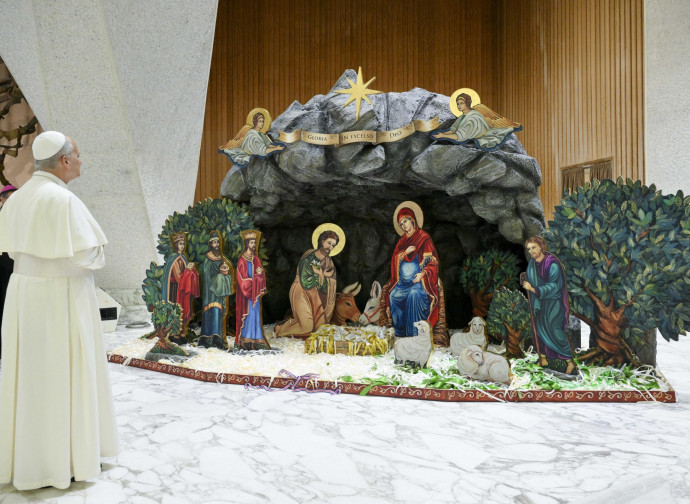
There is an unconventional nativity scene in the Vatican this Christmas, but it is not the usual upheaval inspired by the hackneyed desire to 'break the mould'. Alongside the 'traditional' nativity scene in St Peter's Square, the Paul VI Hall is displaying a piece by Costa Rican artist Paula Sáenz Soto entitled 'Nacimiento Gaudium'. This features a 'pregnant Virgin Mary and 28,000 coloured ribbons, each representing a life saved from abortion thanks to the support and prayers of Catholic organisations for mothers in need', as stated in the Governorate of Vatican City's press release. 'While respecting tradition', the press release continues, 'the work introduces an original element: two interchangeable representations of the Madonna.' During Advent, a pregnant Mary statue, symbolising expectation and hope, will be on display. On Christmas Eve, this will be replaced with a kneeling Virgin statue in adoration of the newborn Child. Additionally, 400 ribbons bearing prayers and wishes written by young patients at the National Children's Hospital in San José will be placed in Jesus' cradle."
Pope Leo XIV took up this message and relaunched it when he inaugurated the nativity scene on 15 December. He recalled that "each of the 28,000 coloured ribbons decorating the scene represents a life preserved from abortion thanks to the prayers and support provided by Catholic organisations to many mothers in difficulty. I thank the Costa Rican artist who, alongside the message of Christmas peace, wanted to launch an appeal for the protection of life from the moment of conception.' If, as Antoni Gaudí said, true originality consists in returning to one's origins, then the originality of Paula Sáenz's nativity scene refers directly to the origins of life in the womb.
The Costa Rican artist is no stranger to the Vatican, having created the mosaic of Our Lady of the Angels, the patron saint of her country, in the Vatican Gardens. In a 2023 interview with the Fundación Cari Filii, she described this work as 'an example of how God can choose anyone; you don't have to be a famous artist'. Her artistic vocation also stems from a return to faith after a period of estrangement and a 'miracle of life': a son who arrived in his twenties after she surrendered to God's plans.
"What we painters of sacred art do is write prayers," says Paula Sáenz, who looks to the Via Pulchritudinis ("the way of beauty," defined as a "crucial challenge" in a document of the Pontifical Council for Culture during the Ratzinger era) and bluntly states that the Church "cannot accept every trend that comes along without first offering its own perspective." Otherwise, sacred art literally loses its physiognomy: 'They erect faceless stones and call them the Holy Family', or consider the example in the USA where the Holy Family 'had no face because they said it could not have a gender' (something similar was recently seen in Brussels).
Inevitably, thoughts turn to certain experiments already seen in the world's most famous nativity scene in St Peter's Square. As in 2017, when a nude shepherd stole the show from the Divine Infant. Even worse was the modernisation project of 2020, which saw statues created between 1965 and 1975 by students of the Castelli Art Institute in Teramo being displayed. Whatever the intentions and inspirations, the scene resembled another planet, probably Mars, more than heaven in a spiritual sense. To the question, ‘Do you like the nativity scene?’, many would have replied like one doubtful Thomas 'No', 'I don't like it' and 'Do I have to like it?'.
Paula Sáenz's nativity scene breaks the mould, but in a completely different way. The pregnant Madonna and the ribbons — each of which, as we recall, represents a life saved from abortion thanks to the support and prayers provided by Catholic organisations to mothers in need — consign the era of pro-lifers being addressed with contempt by some bishops to the attic. These bishops did not like the 'expressionless faces of those who pray outside clinics that perform abortions', to quote the most famous example. Or Cardinal Blase Cupich, who, as bishop of Spokane, prohibited priests from standing in front of abortion clinics yet attended the Democratic Convention during the last American election campaign without saying a word about what was happening a few blocks away at the Planned Parenthood mobile clinic. Not to mention the most recent case: the abortion law defined as 'a pillar of our social life' by the former president of the Pontifical Academy for Life! This time, the 'fateful' question – 'Do you like the nativity scene?' – should be addressed to them.
