
Pope Francis’s insults against Opus Dei used in dispute over statue of Mary
A clash over the statue of the Virgin Mary placed in a church commissioned by St Josemaría Escrivá. Bishop Pérez is demanding its return to its original location and has dredged up two letters from the late Pope in which he spoke of 'mafia-style intrigues'. The Prelature cites the agreements of the time and asserts that legal differences cannot “be turned into an offensive and baseless accusation”.


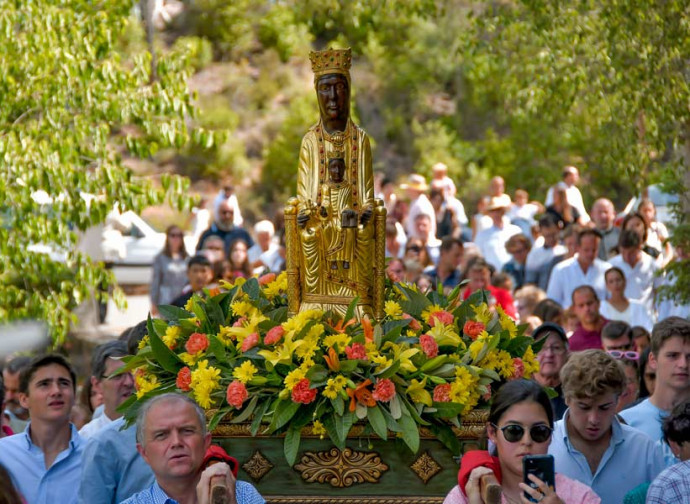
Tensions between the Bishop of Barbastro, north east Spain, Monsignor Ángel Pérez Pueyo, and Opus Dei preceded the 47th edition of the annual Romería de Vírgenes de Ribagorza y Sobrarbe pilgrimage, which took place in Torreciudad on Saturday 6 September and features dozens of Marian statues, or Vírgenes. In this Aragonese town stands a church destined to be recognised as a sanctuary. It was consecrated in 1975 and commissioned by Saint Josemaría Escrivá, who was born in Barbastro. However, Marian devotion in the area dates back much further. The highly venerated wooden statue of Our Lady of the Angels dates back to the 11th century and was housed in a small chapel (ermita), just a few dozen metres from the current building where it was moved fifty years ago.
For the Romería, the 'lady of the house', Our Lady of the Angels, returned to her former location for a few hours. According to the bishop, she should remain there, 'in her traditional home, where she has always been for over a thousand years until she was taken away fifty years ago', as stated in his 31 August press release. However, the transfer took place following agreements signed in the 1960s between the bishop’s predecessor, Monsignor Jaime Flores Martín, and Opus Dei. Opus Dei was entrusted with the care of the statue and the original chapel, whilst the diocese retains ownership. Notably, the dispute over Our Lady of the Angels is merely one chapter in the wider conflict concerning the Torreciudad complex. This dispute began in 2020 when Bishop Pérez requested a review of the agreements. In 2023, he appointed a diocesan priest as rector, rather than a prelature priest as had been customary until then. On 9 October 2024, at the diocese's request, Pope Francis appointed Monsignor Alejandro Arellano Cedillo as 'plenipotentiary pontifical commissioner' for Torreciudad. Meanwhile, the Pope had intervened with Opus Dei with a specific motu proprio (Ad charismam tuendum), establishing that, among other things, the prelate 'shall not be conferred, nor be eligible for, the episcopal order'.
Last Saturday, during the pilgrimage, Monsignor Pérez adopted a more conciliatory tone in his homily, in contrast to his much more pointed remarks of the previous days. He expressed gratitude for all the good that the Prelature of Opus Dei has done in Torreciudad over the years, and hoped that it may continue its mission there, developing its charism for the benefit of the wider Church of Barbastro-Monzón.
Nonetheless, the bishop has not backtracked, as was made clear in his 'humble request' during the prayer offered before the Virgin: 'So that, like the elderly Eleazar, I may prove myself worthy of my work as a shepherd, leaving future generations an example worthy of the dignity of this people'.
The figure of the elderly Eleazar was at the heart of the aforementioned statement, in which the bishop firmly upheld the permanent return of Our Lady of the Angels of Torreciudad to the chapel. He stated that the historical and legal documentation gathered by the diocese rules out the possibility of considering the removal of the image from the hermitage as a voluntary relinquishment of custody by the town. Referring to the elderly man described in the Second Book of Maccabees (6:18–31), who chose death over compromise, Bishop Pérez said, ‘I cannot sign, approve or consent to a formula that deprives the inhabitants of Barbastro-Monzón of their Mother, or that transforms her into a stranger who pays occasional visits to her children from someone else’s home’, and ‘like the elderly Eleazar, I prefer to set an example of fidelity to our history and memory rather than betray my duty to protect it’. In other words, either the statue returns, or he will leave.
These accusations were rejected by Opus Dei on 4 September, when they presented a dossier including the public deed of 24 September 1962 and the notarial deed of 8 September 1966. The latter was signed by the then Bishop, Jaime Flores Martín, and representatives of Opus Dei. According to the Prelature, 'it has never been in dispute that ownership of the statue lies with the diocese'. The dispute concerns the scope and validity of the rights of use, custody and placement established through agreements between the parties', and whilst different legal interpretations of the agreements are legitimate, they cannot be used as a basis for offensive and baseless accusations. Opus Dei states that ‘the statue was never secretly removed. With the bishop’s authorisation, it was restored in 1964 and again around 1970. Since 1975, it has presided over the altarpiece of the new church and has been on public display for veneration by all the faithful. Furthermore, the 1966 document states that the construction of the new church was prompted by the need for greater capacity, as the original chapel could no longer accommodate the growing number of pilgrims.
Broadly speaking, this is the dispute between the diocese and the prelature, in which Pope Francis's involvement also re-emerges — indeed, the Bishop of Barbastro explicitly mentioned two handwritten notes on 31 August. Alongside the example of the biblical elder, the prelate appeals to the authority of the late pontiff, who 'was personally aware of the problem', as he made clear during the ad limina visit in December 2021. 'Subsequently, in a handwritten note dated 13 July 2023, he wrote to me in his own hand: “Do not give in!” On 18 September 2024, when I met him in St Peter's Square, he asked me directly once again: “Angel, have they already removed the Virgin?”. A few weeks later, in another handwritten note dated 13 October 2024, he expressly warned me of the 'mafia-style intrigues afoot' surrounding this matter, just as I had done in my homily in our cathedral exactly one year earlier.'
Surely these are inappropriate words for a Pope to use, regardless of the rights and wrongs surrounding the placement of the Virgin of Torreciudad. They also bring to mind the two letters signed ‘F’, which were unearthed in the days leading up to the conclave when the Sacred College was faced with the dilemma of whether to admit Cardinal Becciu to the Sistine Chapel – a matter that was subsequently resolved when the cardinal decided to step aside. The ‘mafia-style intrigues’ belong to the repertoire of the most ill-chosen soundbites, much like the term ‘Mexicanisation’, which was used in a private email in 2015 to express the Pope’s concern about the spread of drug trafficking in Argentina, but which ended up offending the feelings of Mexicans. The last twelve years have been marked by catchphrases – sometimes rather colourful – and messages in bottles intended to be used even after his death. Both can be found at Torreciudad.
