
Monsignor Pozzo: in 2018, it was the Fraternity that rejected the agreement
The Écône schism is “a serious wound to the Church that could have been avoided” eight years ago: it was not the Apostolic See that closed the door, but the Fraternity that demanded Rome correct its errors and reject the Declaration – “the result of a joint effort” – as the former secretary of the Pontifical Commission Ecclesia Dei recalls in La Bussola.


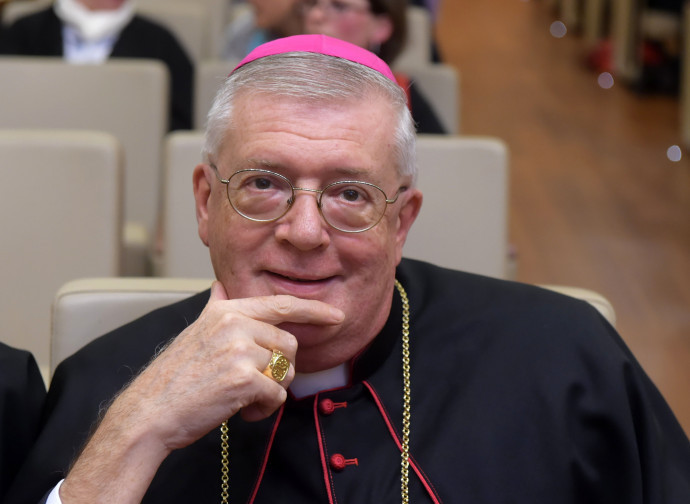
History might well have taken a different course had the Priestly Fraternity of St Pius X (FSSPX) not, eight years ago, rejected the doctrinal declaration proposed by Rome – despite it being the result of a joint effort – and demanded that the Apostolic See engage in self-criticism. That process of reconciliation, which was interrupted at the time, has now been followed by the rift that took place on 1 July in Écône, an event experienced with sorrow by those who are closely acquainted with the facts. Speaking to La Bussola is Monsignor Guido Pozzo, titular archbishop of Bagnoregio, currently superintendent of finance for the Pontifical Musical Chapel, who served as the last secretary of the Pontifical Commission Ecclesia Dei from 2009 to 2018. The prelate is well aware of the post-conciliar ‘turmoil’ affecting the Church community, but he reiterates that none of this can justify a schismatic act, nor a so-called ‘emergency Church’ removed from the Pope’s authority.
Your Excellency, how did you feel upon hearing the news of the episcopal consecrations carried out without papal authorisation on 1 July in Écône?
With a heavy heart and great regret. It is a serious wound to the Church, which could have been avoided had the FSSPX accepted the Doctrinal Declaration proposed by the Congregation for the Doctrine of the Faith (CDF), which would also have been followed by canonical recognition in the legal form that would have been established. His Excellency Bishop Fellay, during the meeting on 28 February 2018 with Cardinal Ladaria—then Prefect of the Congregation—and myself at the Dicastery, said that he would submit the text of the Declaration for consideration by the SSPX Chapter, scheduled for July 2018. In the autumn of 2018, Cardinal Ladaria and I met with the new Superior of the FSSPX, Fr Davide Pagliarani, who had been elected in July at the Chapter meeting. He informed us that he would not sign the Declaration, as he considered it insufficient and inadequate to address the difficulties and critical issues raised by the FSSPX, and that Rome would have to acknowledge its errors. This refusal was noted, and Pope Francis, having been informed of the negative outcome, decided to abolish the Ecclesia Dei Commission, which since 2009 had been engaged in doctrinal discussions with the Superior of the FSSPX with a view to achieving reconciliation, and entrusted the Congregation for the Doctrine of the Faith (CDF) with responsibility for any future relations with the FSSPX. I must confess that I was very disappointed by the FSSPX’s refusal, not least because many points in the Declaration had been the result of joint work during the dialogue that had taken place up to that point.
There is one aspect that few commentators mention, namely the inner dimension: that is to say, what are the effects on souls of an act claimed to be in the name of salus animarum but which, at least on an objective level, remains schismatic in nature?
Salus animarum is not something subjective that can be separated from obedience to the formal and juridical authority of the Pope. There is no such thing as an ‘emergency church’ that can withdraw from the visible unity of the Church to establish an ecclesial order not in full communion with the Successor of Peter. No Catholic group nor any individual Catholic may appeal to a subjective sense of truth to oppose the institutional Church and the jurisdictional authority of the Roman Pontiff, not only in matters concerning faith and morals, but also in those concerning the discipline and governance of the Church. This is the doctrine of the Catholic faith, from which no one may depart without forfeiting the faith and salvation (cf. First Vatican Council, Dogmatic Constitution on the Church, Pastor aeternus, chap. 3, DH 3060).
Although the rite is the most conspicuous element, we know that the issue is not primarily liturgical. What, in your view, are the main ‘cruxes’?
The main issues are the acceptance of the teaching of the Second Vatican Council and of the subsequent Magisterium. When I speak of the Council, I am referring to the contents of the documents, not to the ‘Media Council’ or the ‘virtual Council’ or ‘para-Council’, nor to the phantasmagorical ‘spirit’ of the Council, which, unfortunately but in reality, has come to overshadow the true Council in public opinion and in numerous ecclesial circles.
In this regard, the main points of the CDF’s Doctrinal Declaration proposed for acceptance by the FSSPX addressed precisely these issues, and, in my view, did so satisfactorily.
a) The FSSPX was asked to accept the Catholic truth that ‘Christ the Lord has entrusted the deposit of faith – that is, Sacred Scripture and divine “tradition” – to the Magisterium to be safeguarded, defended and interpreted’ (Pius XII, Encyclical Letter Humani generis, 18, Denz. 3884) and that ‘the Magisterium is not above the Word of God, but serves it, teaching only what has been handed down’ (Second Vatican Council, Dogmatic Constitution Dei Verbum, 10). The Magisterium of the Church, in turn, has the authority to explain or clarify even previous documents of the Magisterium, including those of the Second Vatican Council, in accordance with the truths of the Catholic faith and in the light of the perennial Tradition which progresses within the Church with the assistance of the Holy Spirit, not through a contrary innovation, but through a better understanding of the depositum fidei, in eodem scilicet dogmate, eodem sensu eademque sententia (cf. First Vatican Council, Dogmatic Constitution Dei Filius, 4, Denz. 3020; Second Vatican Council, Dogmatic Constitution Dei Verbum, 8).
b) It was requested that it be recognised that the Second Vatican Council must be understood in the light of the whole Tradition and on the basis of the constant Magisterium of the Church, whilst always allowing for the possibility of legitimate discussion and theological clarification regarding the formulation of particular points in the conciliar documents or concerning subsequent reforms of the liturgy and canon law.
c) It was requested that the validity be recognised of the Rite of the Holy Mass and of the Sacraments legitimately celebrated in accordance with the liturgical books in their editio typica, promulgated by Pope Paul VI and Pope John Paul II.
It would not, however, be fair to address issues concerning the FSSPX without acknowledging that, since the Second Vatican Council and up to the present day, Catholicism has been in the midst of a period of turmoil—certainly not due to the teaching of the Council and the subsequent Magisterium, but to many factors both within and outside the ecclesial community—which manifests itself in profound divisions and errors within the Church (but not of the Church), regarding Catholic doctrine and identity, as well as pastoral practice, with many deviations and ambiguities that create confusion and uncertainty amongst the faithful. Criticism of and the fight against such errors and deviations must not be neglected, but one cannot justify the schismatic act of consecrating bishops without a papal mandate, nor can one justify the presumption of acting as judges in declaring that the current Magisterium or that of the Council is at odds with the Church’s Tradition of faith. One may demand clarifications or precisions regarding certain formulations or guidelines expressed by the ordinary Magisterium—which are non-definitive or of a practical-pastoral nature—in order to avoid unilateral or reductive interpretations of the Magisterium itself.
But is it possible to wish to ‘save’ the Catholic priesthood (as the Fraternity has always declared) by transplanting it outside the visible Church?
I certainly do not think so. Let us recall the teaching of St Robert Bellarmine, which was subsequently taken up and defined by the First Vatican Council in Pastor aeternus. The nature of the Church is described as the assembly of believers who profess the same faith, participate in the sacraments and allow themselves to be guided by the legitimate Bishops in communion with the Roman Pontiff. Communion with the Roman Pontiff is the absolutely necessary condition for membership of the Catholic Church. This applies all the more to the Catholic priesthood.
In this regard, it struck me as implausible that the FSSPX should, on the one hand, assert that it belongs to the Church by virtue of its integral profession of the faith (which is in fact only one of the essential elements, but not the only one) and, at the same time, to assert (and judge) that the Church’s authorities display an attitude contrary to the faith and act against Holy Tradition and the constant Magisterium of the Church. It may happen (it has happened in the past and, unfortunately, it happens today) that some bishops and priests, theologians and laypeople fall into errors and deviations regarding faith and morals, but one cannot extend this criticism to the Church’s authorities in general, much less disobey hierarchical communion with the Supreme Authority.
It seems, to say the least, strange that the FSSPX should ask the Pope for a gesture of fatherly concern whilst at the same time accusing the authority of the Holy See of straying from Tradition and of being subservient to a modernist Church.
The consecrations of 1 July replicate those performed by Archbishop Lefebvre in 1988: are we facing a definitive break, or is there still a glimmer of hope for a future reconciliation between the Fraternity and Rome?
Never say never. We would need to start afresh from the contents of the Congregation for the Doctrine of the Faith’s Doctrinal Declaration, but above all it is necessary to change the FSSPX’s prejudicial attitude, whereby it is assumed that Rome is in the wrong and the FSSPX is certainly in the right.
Would you rule out the creation of a structure (proposed by Cardinal Müller) similar to Ecclesia Dei or, for example, the establishment of ordinariates modelled on those for former Anglicans?
I would not rule out legal arrangements of this kind, provided that the doctrinal issues are resolved and that a sufficiently substantial group of priests can be formed who, as has already happened with the Priestly Fraternity of St Peter or the Institute of the Good Shepherd, intend to return to full communion with the Roman Pontiff.
Naturally, there is a great deal of media hype surrounding the FSSPX, but there are ‘traditional communities’ that already live sub Petro: are they not perhaps ignored and perhaps somewhat marginalised within the Catholic world itself, as if they were reserves rather than a gift to be offered to the whole Church?
The Institutes to which he refers are living realities that are constantly growing. As Pope Benedict XVI taught and declared, the two liturgical forms—that of the Novus Ordo, which is the common, customary and universal form of the liturgy, and that of the Vetus Ordo, for particular and special groups—are both mutually enriching and are not in opposition to one another. The Institutes and the faithful who follow traditional liturgical and spiritual disciplines must not only not be marginalised or isolated, but must contribute, in communion with other ecclesial communities, to evangelisation and the Christian apostolate. What seems to me to be a matter of urgency is to strengthen those ecclesial and priestly communities which live in fidelity to Tradition, to the integrity of the Catholic faith, and to the sacred liturgy, in full communion with the episcopal order sub Petro et cum Petro.
