
Mary Co-Redemptrix manifests her total union with the Redeemer
The Mother's suffering on Calvary was her unique participation in her Son's mission, not an alternative route to salvation. To clarify any misconceptions and prevent reductionism, the reflection on Marian Co-Redemptrix continues with a series in two parts of insights by Mark Miravalle and Robert Fastiggi, cooperators of the International Marian Association document published on 8 December 2025 in response to the Note Mater populi fidelis.

First part of two.
On January 2, 2026, Monsignor Antonio Staglianò, the President of the Pontifical Academy of Theology and former Bishop of Noto in Sicily, published an article entitled “The ‘no’ to the title, Co-redemptrix? Why Mary leads us to Christ.” This article appeared in the journal, Avvenire, which is affiliated with the Italian Bishops Conference. The author maintains that the Co-redemptrix title leads to a “distortion” of Christ’s Redemption. Unfortunately, the article presents a grave misunderstanding of the Marian title, Co-redemptrix, and ultimately undermines not only Mary’s participation in Redemption but all human participation in the salvation of souls.
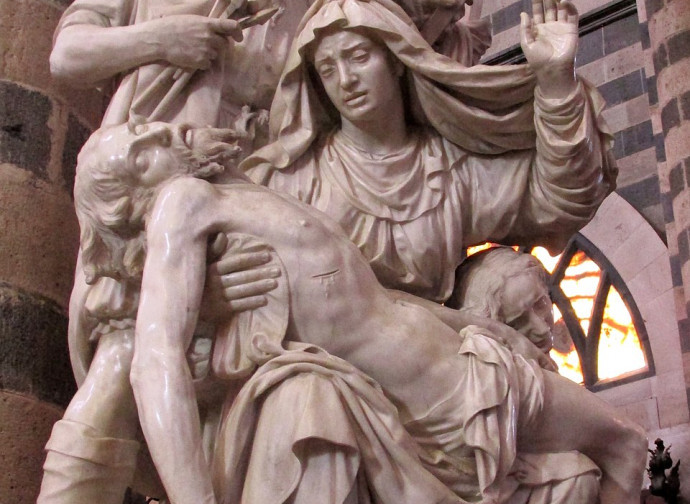
Msgr. Staglianò is correct to say that Mary is “at the doorstep of the house not to offer a different path but to accompany us into the open arms of her Son.” He wrongly assumes, though, that Mary as Co-redemptrix leads us along a path separate from Christ. Mary’s co-redemptive role is always united to that of Jesus because she is united to Jesus by an “intimate and indissoluble bond” (arcto et indissolubili vinculo unita, Lumen Gentium, 53). Msgr. Staglianò speaks of Mary’s “intimate union with the Son,” but he fails to see that Mary’s role as Co-redemptrix is a manifestation of her complete union with Jesus, the divine Redeemer, especially under the Cross. Lumen Gentium, 58 tells us that Mary “faithfully persevered in her union with her Son unto the cross, where she stood, in keeping with the divine plan, grieving exceedingly with her only begotten Son, uniting herself with a maternal heart with His sacrifice, and lovingly consenting to the immolation of this Victim which she herself had brought forth.” As Co-redemptrix, Mary in no sense “offers an alternative path” as Msgr. Staglianò claims. On the contrary, her role as the Co-redemptrix is always with and under her divine Son. She is the New Eve, united with Christ, the New Adam, in the one united sacrifice at Calvary.
Eve initiated the Fall by her “no.” Mary initiated the Redemption by her “yes.” Coredemption also means that Mary paves the way for Redemption, not only in the historic accomplishment of Redemption, but also now for us as Spiritual Mother throughout time and history. As our Spiritual Mother, she participated with her Son in acquiring the graces of salvation, and now as “Mediatrix” she “brings us the gifts of eternal life” (Lumen Gentium, n. 62). These maternal functions are what are contained in the titles, Co-redemptrix and Mediatrix of all graces.
Msgr. Staglianò alleges that calling Mary the Co-redemptrix implies that the sacrifice of Jesus was not sufficient. According to him, the title Co-redemptrix means Mary must “co-complete” Christ’s sacrifice with a “parallel” or “supplementary” work of salvation. This, in fact, is a complete distortion of the Catholic doctrine of Marian co-redemption. Catholic popes, theologians, and saints have always understood Mary’s coredemptive role as subordinate, secondary, and dependent on Christ. In his book, The Co-redemptrix in the Mystery of Christ and the Church, Msgr. Brunero Gherardini explains: “The work of Christ is not only foremost, but sovereign and perfect; that of Mary is subordinate, secondary, and instrumental.” (Brunero Gherardini, La Corredentrice nel mistero di Cristo e della Chiesa (Roma: Edizione Vivere IN, 1998), p. 372: “L’opera di Cristo è non solo principale, ma sovrana e perfetta; quella di Maria è subordinate, secondaria, strumentale.”)
Bishop Staglianò says that “Mary’s role is to lead to Christ, not to replace him or assist Him in a work of which He alone is the author.” This statement rings of Protestant soteriological overtones. Mary does assist Jesus in Redemption by the predestined will of the Father. Mary’s association with Christ in the work of Redemption is not due to the insufficiency of Christ’s sacrifice, but to the perfection and love of the Redemption of Christ, who seeks to associate and include humanity in his saving work, especially his immaculate Mother. St. Augustine’s foundational Catholic teaching cannot be denied here: “God created us without us, but He did not will to save us without us” (Sermo 169, 11, 13. Pl. 38, 923). Mary’s active participation in Redemption is based on the free will of Christ and “the intimate and indissoluble bond” between Him and his mother. Because of this union of love between Jesus and Mary, Pius XI said:
"By necessity, the Redeemer could not but associate His Mother with His work, and for this reason, we invoke her under the title of Co-redemptrix. (Il Redentore non poteva, per necessità, non associare La Madre Sua alla Sua opera, e per questo noi la invochiamo col titolo di Corredentrice) She gave us the Savior, she accompanied Him in the work of Redemption as far as the Cross itself, sharing with Him the sorrows of the agony and of the death in which Jesus consummated the Redemption of all mankind (L’Osservatore Romano, December 1, 1933, p. 1)."
In his 1984 apostolic letter, Salvific Doloris, John Paul II explains that the all-sufficiency of Christ’s sacrifice does not prevent participation or sharing in his redemptive work, but rather provides for it:
"The sufferings of Christ created the good of the world's redemption. This good in itself is inexhaustible and infinite. No man can add anything to it. But at the same time, in the mystery of the Church as his Body, Christ has in a sense opened his own redemptive suffering to all human suffering. In so far as man becomes a sharer in Christ's sufferings—in any part of the world and at any time in history—to that extent he in his own way completes the suffering through which Christ accomplished the Redemption of the world."
John Paul teaches that Mary shared in Christ’s passion in a unique way while she was there under the Cross at Calvary:
"… it was on Calvary that Mary's suffering, beside the suffering of Jesus, reached an intensity which can hardly be imagined from a human point of view but which was mysterious and supernaturally fruitful for the redemption of the world. Her ascent of Calvary and her standing at the foot of the Cross together with the Beloved Disciple were a special sort of sharing in the redeeming death of her Son (Salvifici Doloris, 25)."
John Paul II states that Mary’s suffering under the Cross “was mysterious and supernaturally fruitful for the redemption of the world.” This is what Marian coredemption means. Mary as Co-redemptrix “neither takes away from nor adds anything to the dignity of Christ the one Mediator” (Lumen Gentium, 62). Her merit, as St. Pius X, teaches, was congruous not condign or absolute (See Pius X’s 1904 encyclical, Ad diem illum: Denz.-H, 3370). Nevertheless, her suffering in union with Christ was “supernaturally fruitful for the redemption of the world.” What is substantially missing in Msgr. Staglianò’s analysis is the foundational Catholic and metaphysical principle of participation. As Luisella Scrosati has noted, this critically important principle, which is at the heart of Marian coredemption, is likewise absent in the Dicastery for the Doctrine of Faith’s doctrinal note, Mater Populi Fidelis. Mary’s union with Christ in the work of redemption is participatory. Her salvific influence, as Vatican II teaches, “originates, not from some inner necessity, but from the divine pleasure. It flows forth from the superabundance of the merits of Christ, rests on His mediation, depends entirely on it and draws all its power from it. In no way does it impede, but rather does it foster the immediate union of the faithful with Christ.” To participate or share in the work of God does not diminish God. Even our very existence is a participation in God’s being. As St. Thomas Aquinas teaches, “God is essential being whereas all other things are beings by participation” (ST I, q. 4, a. 3, ad 3). To deny Mary’s participation in Redemption is also to deny that of the People of God. It ultimately comes down to Catholic active participation versus Protestant passive receptivity.
One of the most disturbing points of Bishop Staglianò’s article is the claim that devotion to Mary as Co-redemptrix is grounded in “the subconscious persistence of a vengeful God, whose wrath must be appeased” by a more merciful Mother. This constitutes an extreme ad hominem attack on Marian coredemption and Catholics who have used the title, which include St. John Paul II, St. Teresa of Calcutta, and the recent doctor of the Church, St. John Henry Newman. It is sad that any Vatican associated theologian would resort to such a distorted stereotype of Mary’s coredemptive role. This is precisely the stereotype that Protestant opponents of Catholic Marian devotion sometimes bring forth. It is not what one would expect from a member of the Pontifical Theological Academy.
These forms of unfounded hyperbole do not contribute to the potentially valuable synodal process happening right now concerning Mary’s subordinate role in Redemption. In effect, Msgr. Staglianò produces a theological “straw man” by claiming that Mary as Co-redemptrix suggests that we must have access to the mercy of Mary as a refuge against the lightning bolts of a vengeful and threatening Divine Justice. In fact, Catholic Tradition and the Magisterium recognize that Marian coredemption presupposes a harmonious unity between the infinite justice and mercy of Jesus—manifested in his historic Redemption of humanity—and the cooperative mercy of his Immaculate Mother, who, as a human person, participates in perfect obedience to the predestined plan of the Heavenly Father.
It was not Mary who inserted herself into the plan of Redemption. It was rather God Himself who predestined Mary to say yes on behalf of the entire human race (cf. St. Thomas Aquinas ST III, q. 30, art 1). Once again, it must be emphatically stated that Mary’s faithful yes and consequent lifelong suffering culminated at Calvary in meritorious fulfillment of the Father’s redemptive plan. It was the Father who predestined that Redemption would happen in a wondrous unity of Jesus, the divine and human New Adam, in union with Mary, the immaculate and human New Eve. This is biblical, patristic, and magisterial. In personified refutation of the author’s unfounded claim, it was not by accident that St. John Paul II, who placed so much emphasis on Divine Mercy, would also affirm Mary as Co-redemptrix multiple times during his pontificate and generously teach the doctrine. He was also the pope of the alliance of the Hearts of Jesus and Mary, recognizing the two Hearts united in mutual love and mercy for the human race (cf. Angelus Address of September 15, 1985).
Bishop Staglianò’s premises appear to undermine authentic Catholic teaching on the supernatural value of redemptive suffering, as rooted in St. Paul’s recognition in Colossians 1:24 that in his own sufferings he completes “what is lacking in Christ's afflictions for the sake of his body, that is, the Church." Again, Staglianò’s position appears to be more in line with a solus Christus Protestant Christology and ecclesiology than the fully Catholic concepts found, for example, in Pius XII’s encyclical, Mystici Corporis, and John Paul II’s apostolic letter, Salvifici Doloris. Pius XII, in Mystici Corporis, 44, teaches that, “The salvation of many souls depends upon the prayers and voluntary mortifications offered for that intention by the members of the Mystical Body of Christ” (AAS 35 [1943], 213). In n. 106 of the same encyclical, he writes:
"For although our Savior's cruel passion and death merited for His Church an infinite treasure of graces, God's inscrutable providence has decreed that these graces should not be granted to us all at once; but their greater or lesser abundance will depend in no small part on our own good works, which draw down on the souls of men a rain of heavenly gifts freely bestowed by God (AAS 35 [1943], 245). "
St. John Paul II offers a postconciliar re-affirmation of the same magisterial teaching in Salvifici Doloris. Once again, Bishop Staglianò seems to think that attributing a co-redemptive value to Mary’s suffering undermines the all-sufficiency of Christ’s sacrifice. John Paul II, however, directly refutes this argument by explaining what St. Paul means when he says that in his own sufferings he completes “what is lacking in Christ's afflictions for the sake of his body, that is, the Church" (Col. 1:24):
"Does this mean that the Redemption achieved by Christ is not complete? No. It only means that the Redemption, accomplished through satisfactory love, remains always open to all love expressed in human suffering. In this dimension—the dimension of love—the Redemption which has already been completely accomplished is, in a certain sense, constantly being accomplished. Christ achieved the Redemption completely and to the very limits but at the same time he did not bring it to a close. In this redemptive suffering, through which the Redemption of the world was accomplished, Christ opened himself from the beginning to every human suffering and constantly does so. Yes, it seems to be part of the very essence of Christ's redemptive suffering that this suffering requires to be unceasingly completed (Salvifici Doloris, n. 24)."
If Mary’s sufferings have no redemptive value then neither do ours. The Church, however, has rightly taught that by uniting our sufferings to those of Christ we can become “co-redeemers of humanity.” St. John Paul II, when speaking to the sick at the Fatebenefratelli Hospital on April 5, 1981, invited them to unite their sufferings to the passion of Christ as “co-redeemers of humanity” (corredentori dell’umanità). In a similar manner, Pope Benedict XVI, when blessing the sick at Fatima on May 13, 2010, reminded them that if their sufferings are united to Christ they can “become—according to his design— a means of redemption for the whole world.” According to Benedict XVI, they will become “redeemers in the Redeemer.”
(to be continued)
