
Lourdes: the Pope arrives and Rupnik disappears
Those controversial mosaics would have been an embarrassing backdrop for the papal visit in September. Instead, the visit is providing an opportunity to complete the steps already taken by Bishop Micas when he had the mosaics partially covered during the Jubilee. They will now be completely covered and will remain so even after Pope Leo XIV’s departure.


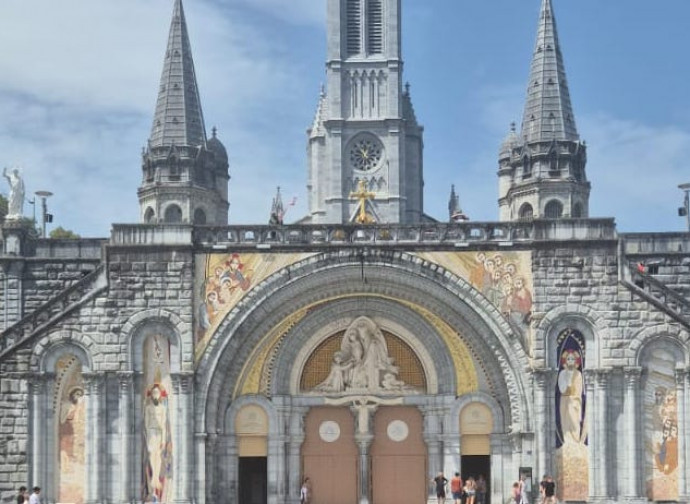
Marko Ivan Rupnik’s mosaics, which are still partially visible on the façade of the Basilica of Our Lady of the Rosary at the Lourdes shrine, will be fully covered for Pope Leo XIV’s visit in September and will remain covered afterwards. To dispel any doubts, we sought and received confirmation by telephone from the shrine’s press office after reading the announcement made by Bishop Jean-Marc Micas in an exclusive interview with La Dépêche du Midi, a French regional daily newspaper, yesterday, 20 August. This decision follows previous steps taken by the bishop in this direction. He is personally convinced of the advisability of removing the mosaics, as he stated in July 2024. Having faced fierce opposition to his proposal within the ad hoc committee set up the previous year, he chose to cease illuminating the mosaics during the evening Rosary. He described this as a 'first step' while awaiting further reflection, in order to avoid exacerbating an already volatile situation with isolated decisions. This was followed in the Jubilee Year by the covering of the doors.
It took the Pope’s visit to Lourdes to break the deadlock. ‘It is an opportunity to take a step forward,’ the bishop told La Dépêche du Midi, announcing that ‘all the works on the façade will be covered and then decorated with a theme relating to Leo XIV’s apostolic journey’. To confirm that this would not merely be a temporary cosmetic fix to avoid embarrassment for the Pope, Micas clarified that 'the mosaics will remain covered after the Holy Father’s pilgrimage, at the end of which a new round of deliberations will begin'. The current commission will be expanded to specifically include artists and theologians in order to reflect on the future of the basilica’s façade”. Finally, he emphasised 'the symbolic dimension of the message of Lourdes in relation to victims of sexual violence', which explains why the Pyrenean shrine remains constantly in the spotlight, despite the fact that the priest-mosaicist's works are scattered throughout the world and there are even larger ones.
Since establishing the commission, Bishop Micas has not remained indifferent to the problem posed by these works in light of the allegations of abuse against their creator. The sight of these works caused further harm to pilgrims who had survived abuse, in a place where people go to seek physical and spiritual healing. This was highlighted by the prelate in an interview with the Christian magazine La Vie in March 2023, who cited not only Lourdes, but also 'another place of healing: the tomb of Padre Pio of Pietrelcina'. In 2024, the 'obscuring' was ordered, followed by partial covering the following year. From 31 March 2025, panels were placed over the 'mosaic doors' at the centre of the façade so that no one would be deterred from passing through them during the Jubilee Year.
More recently, another mosaic has taken centre stage in Lourdes — not by Rupnik this time, but by one of his accusers: Sister Samuelle, creator of a 'total' work entitled Renaissance. La Symphonie des tesselles includes the creation of a 'reparative mosaic' in tribute to victims of abuse. This mosaic is composed of 200 fragments which, after the exhibition, will be dismantled and placed in numerous places of worship. The project also includes a symphony by Baptiste Capitanio and a documentary film by Quentin Delcourt, due for release in 2027. Sister Samuelle laid the final pieces of the mosaic in Lourdes on 30 June, where fragments 1 and 200 will subsequently be kept.
However, Rupnik's influence remained clearly visible on the rest of the basilica's façade, despite the central doors being covered. This will certainly provide an awkward backdrop to the papal visit, especially in light of the Vatican's 7 August statement: 'During his forthcoming apostolic journey to France, Pope Leo XIV will meet, in private, with some victims of abuse within the Church. The victims themselves will be involved in the preparation of this meeting. Further details may be provided at a later date.' While the event has not yet been included in the itinerary on the Holy See’s website, it already appears in the official itinerary of the French bishops, with the time and arrangements to be confirmed. It is scheduled to take place on the afternoon of Sunday 27 September, following the private meeting with the Carmelite nuns of Lourdes. It would be rather jarring for the Pope to meet victims of abuse in front of works associated with the scourge itself.
It is also worth recalling the implicit foreshadowing seen during Lent, when the spiritual exercises returned to the Vatican in the Pope’s presence. This took place in the Pauline Chapel rather than the Redemptoris Mater Chapel, which had cemented the former Jesuit’s artistic reputation. However, we would not be wondering today what to do with the controversial works if another question had been asked at the time: whether it was necessary to adorn sites such as Lourdes, the Redemptoris Mater Chapel and the tomb of Saint Pio of Pietrelcina with mosaics. If Lourdes can lead the way in dispelling reservations about covering the mosaics, a simpler 'grassroots' solution could be implemented in San Giovanni Rotondo – namely, to only visit during the colder months when, for logistical and weather-related reasons, the saint is moved from the new church to the nearby crypt of Santa Maria delle Grazie.
One could then pray to him in peace, away from the gaze of those distinctive figures with their big black eyes.
