

Leo XIV has a problem, his name is Cupich
The Cardinal and Archbishop of Chicago's interventionism in matters of internal and ecclesiastical politics, such as his attacks on the ancient rite, risks causing difficulties for the Pope, who favours unity. Cupich is approaching 77 years of age. When will he resign from his position as leader of the archdiocese


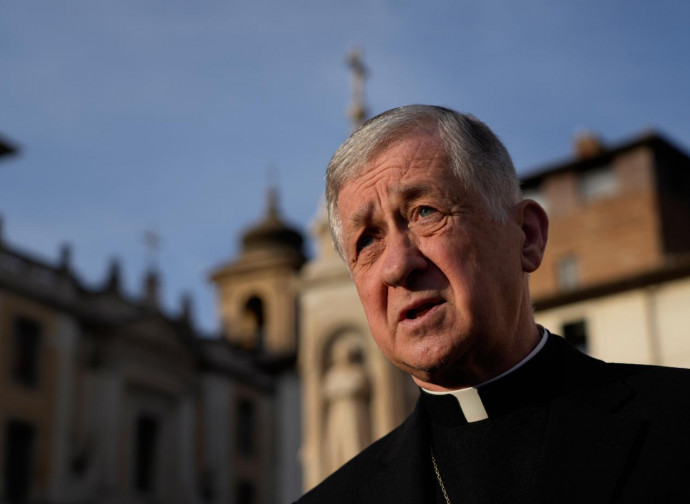
Leo XIV has a problem called Blase Cupich. The loquacity of America's most liberal cardinal risks putting his fellow countryman, the Pope, in a difficult position. Recently, the Archbishop of Chicago decided to lead the opposition against the Trump administration. In several television appearances, he accused government officials of lying about the death of Alex Pretti. Furthermore, when discussing the tensions in Minneapolis, he drew a risky analogy with Nazi atrocities. This latest criticism of Trump comes shortly after the bombastic letter he signed with two other ultra-progressive cardinals, Robert McElroy and Joseph Tobin. The letter questioned 'the moral role of the US in the world' and criticised its 'destructive policies' in Venezuela and the Arctic.
Cupich's interventionism is not limited to domestic politics, but also extends to ecclesiastical matters. Commenting on the liturgy report prepared by Cardinal Arthur Roche for the Extraordinary Consistory, Cupich dusted off one of his favourite themes, criticising the faithful of the Tridentine Mass in an editorial published on the diocese's website. "In line with his predecessor St Pius V, there must be only one rite to preserve the unity of the Church," Cupich wrote in defence of the apostolic letter Traditionis Custodes (2021), promulgated by Pope Francis. 'It would be trivial to read the tensions, unfortunately present around the celebration, as a simple divergence between different tastes regarding a particular ritual form. The issue is primarily ecclesiological,' he declared, citing an alleged refusal to accept the Second Vatican Council among those participating in celebrations according to the 1962 Missal. By doing so, Cupich and Roche have dismissed Benedict XVI, who probably knew more about ecclesiology than they do.
Regardless of one's opinion of the text written by the Archbishop of Chicago, there is no doubt that this initiative will cause further damage to the fabric of the Church. All of this runs counter to the unity that Leo XIV has sought to establish as the manifesto of his pontificate since his election. This is not the first issue Cupich has created for Leo's reconciliation project. In September 2025, his archdiocese awarded an honour to pro-choice Democratic Senator Dick Durbin. After controversy and a papal statement, the recipient himself rejected the award. Cupich was the most powerful bishop in America during the Bergoglian years, despite the fact that the majority of the local episcopate held different views. The beginning of the new pontificate raised hopes that this influence might diminish, but this has not yet happened. In fact, Cupich now seems to consider the role of the Episcopal Conference to be completely usurped, and he is increasingly assuming the right to speak on behalf of the American Church. Yet the governing body of American bishops has shown that it is willing to speak out against the excesses of the Republican administration.
The Archbishop of Chicago is over 76 years old and will turn 77 on 19 March. Pope Francis has called for diocesans to retire at the age of 75. While he has opened up the possibility of exceptions for cardinals, this treatment has not been extended to Cardinal Timothy Dolan, whose resignation from the See of New York has already been accepted, despite him being a year younger than his counterpart in Chicago. Cupich may well step on the gas, particularly in matters of national politics, in order to put the Pope in a position where he cannot easily replace him. Cupich may have been a key supporter of Bergoglio in the conclave, but then again, so was Dolan.
Retiring him would be beneficial as it would avoid the double standard mechanism, one of the most criticised aspects of Francis's pontificate. The two know each other well, not only because Chicago is Prévost's archdiocese of origin, but also because of their shared experience in the Congregation for Bishops (now the Dicastery).
Given that, in 2021, when the Augustinian's appointment as head of the Congregation seemed imminent, it was precisely the name of the cardinal dear to Francis that was used to question it, it is difficult to consider Cupich a loyal supporter of the Pope. Cupich himself had ambitions to be appointed to Rome at the time, which would have blocked his compatriot's path to the cardinalate and, in all likelihood, to the papacy. However, Francis decided otherwise, also being comforted by the opinion of the Order of St. Augustine's then superior, Father Alejandro Moral Antón. Almost nine months after his election, Leo XIV may need to ask himself whether Cupich's divisive activism is more helpful or more of an obstacle to his unifying magisterium.
