

Iran, students join the merchant's rebellion
The bazaar revolt in Iran spreads and involves students. Among the main causes: the collapse of the rial (the Iranian currency) and the continuing executions, both consequences of the war lost with Israel in June.


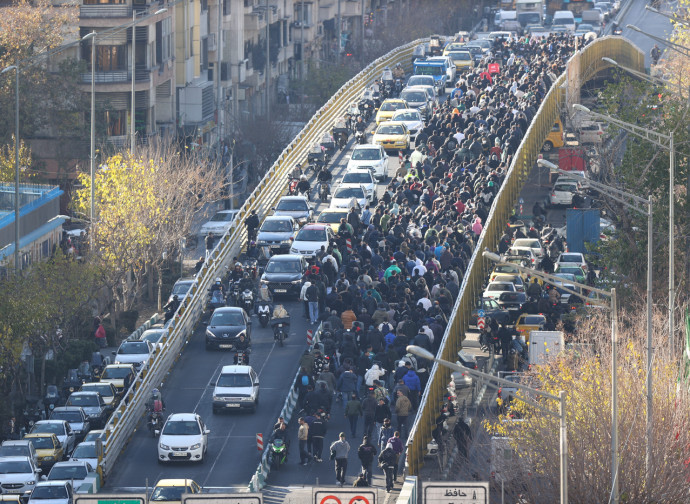
In the history of contemporary Iran, there are two types of revolt. There is the student, intellectual, urban revolt, destined to be short-lived and end badly. And then there is the revolt of the middle class, of shopkeepers, of bazaars, involving much larger masses and destined to last a long time. The revolution that led to the deposition of Shah Reza Pahlavi in 1979 mainly involved the middle class. On Sunday, a bazaar revolt broke out and, in three consecutive days, it has involved increasingly large sectors of the Iranian population. It does not only concern the capital Tehran, where it started, but is spreading like wildfire to all the main cities of the country.
In Tehran, the first to rebel was the large central bazaar. Most shops are still participating in a protest lockout, and street demonstrations are increasing. On the island of Qeshm, off the coast of the Persian Gulf, protesters chanted the slogan “death to the dictator” (Ayatollah Ali Khamenei) at night, while motorists honked their horns in support, as shown in some videos. In Hamedan, in western Iran, protesters chanted slogans calling for the return of the Shah of Persia's dynasty. Other videos show street demonstrations in Kermanshah, to which the police responded with tear gas. In Mashad, in the north of the country, thousands of people also took to the streets.
University students joined the protests on Tuesday 30th, chanting anti-government slogans including “Death to the dictator”. All the universities in the capital joined the protest, urging shopkeepers to keep their shops closed. Again, some protesters were also heard chanting slogans in support of the son of the late Shah Mohammad Reza Pahlavi, who was overthrown by the 1979 Islamic Revolution, including “Long live the Shah”. Reza Pahlavi, who lives in exile in the US, wrote on X: “I am with you. Victory is ours because our cause is just and because we are united”.
Also yesterday, Tuesday 30th, saw the spread of what has become the symbolic photo of this uprising. A young man, alone, crouching in the middle of a wide street in Tehran, opposes a column of Basij motorcyclists, the Islamic paramilitaries who flank the police and do the dirty work against the riots. The young man's resistance, his calmness, his pose, are reminiscent of the photo of the man in Tiananmen Square, alone in front of a column of tanks belonging to the Beijing regime.
Why are traders rebelling (and students supporting them)? Iran is facing a weak rial, extremely high inflation and international sanctions. The Iranian rial has lost 60% of its value since the June war with Israel. The country's central banker, Mohammad Reza Farzin, resigned on Monday 29 December.
At the same time, water resources are running out and power cuts are widespread and frequent. ‘If it doesn't rain in Tehran by the end of November, we will have to ration water,’ Iranian President Masoud Pezeshkian said last month. ‘If it continues not to rain, we will have to evacuate Tehran.’
But what creates a greater sense of oppression is the government's campaign of terror. Discovering that it had been infiltrated by Israeli spies everywhere, after the June war it launched a campaign of arrests and executions. A climate has been created in which everyone suspects everyone else, and denunciations and summary trials are on the rise. After the war, the Islamic regime broke the world record for the number of executions. According to international organisations, including Amnesty International, at least 1,791 people were executed in the first eleven months of the year. The death penalty continues to be used as a political and intimidatory tool, disproportionately affecting minorities, opponents and political prisoners. This is a conservative estimate. Executions take place in secret and less than 5% are announced by the state media. Families are often only informed when the body is returned.
The rebellion of the commercial classes is gaining support everywhere because the fear of poverty is compounded by the fear of being killed by the regime and now affects everyone.
There had not been a revolt by Iranian traders since 2019. Six years ago, it was crushed only by violent military repression that cost thousands of lives. Subsequent youth and student rebellions against the veil, which broke out following the brutal killing of Kurdish student Mahsa Amini (guilty of not wearing the mandatory Islamic veil properly) in the autumn of 2022, were crushed with arrests and an increase in executions.
