

Holy children, innocent suffering that converts hearts
Twenty-eight stories of children who have not yet been canonised but whose lives clearly demonstrate holiness, collected in an exhibition that has been touring Italy for months. Children who experienced suffering in union with Jesus, showing us the way to Paradise. La Bussola interviews the curator, Sister Maria Concetta Visone.


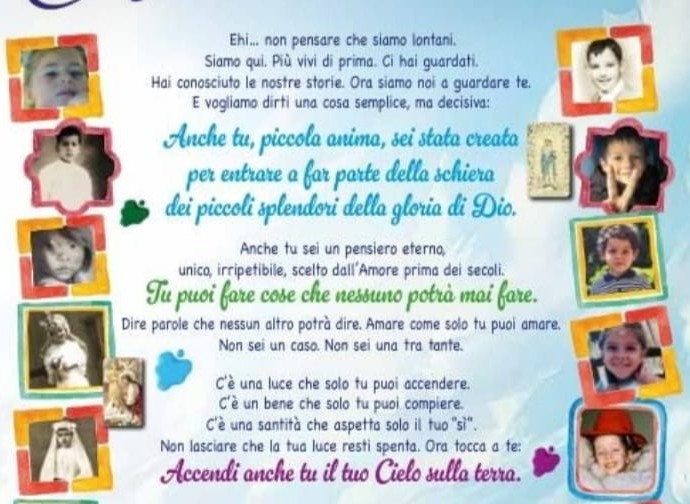
From Lisa Rossi to Laura Degan, from siblings Cosimo, Giastin and Rosaria Gravina to Davide Fiorillo, from Sara Mariucci to Irish Ellen Organ. These are some of the names of the 28 children at the centre of the exhibition Piccoli Splendori della Gloria di Dio (Little Splendours of God's Glory), which has been touring Italy since June 2025 and can currently be visited (until 7 January 2026) at the Shrine of the Infant Jesus of Prague in Arenzano (Genoa).
These are the names of children who do not appear in history books, unknown to most, yet who have played – and continue to play – an important role in the history that matters most: that of salvation. Many of them are already known to readers of Nuova Bussola, which has also published a book on Laura Degan and, before that, another publication – Il chicco di grano (The Grain of Wheat).
Storie di ‘Santi Giovani’ in mezzo a noi (The Grain of Wheat: Stories of “Young Saints” Among Us) – telling the stories of six children and young people (some of whom have already been canonised or whose cause for beatification has been initiated) who conformed themselves to Christ. The 28 children in the exhibition have not yet been proclaimed saints or blessed, but their lives show signs of holiness and are at the origin of countless conversions. Hence the decision to hold an exhibition to make them known, as Sister Maria Concetta Visone, superior of the Franciscan Missionaries of Mary Immaculate in the convent of Rezzato (Brescia), explains in this interview with Bussola.
According to the logic of the world, these children were unfortunate and their deaths a misfortune. What does the logic of Heaven tell us instead?
Showing the logic of Heaven is somewhat the meaning of the exhibition, which has two purposes. The first is to teach children that holiness is possible, that it is not just for adults. In fact, this exhibition is attracting many children because they see how others their age have quickly reached the heart of God in their simplicity and purity. Travelling around Italy, I have noticed how many children are fascinated by the panels with the short biographies of their “predecessors” and even stop to talk to them, as if an immediate spiritual communion were established.
Secondly, the exhibition is also aimed at adults, to strengthen their Catholic faith. I have seen many adults cry in front of these panels. Some have said, “Now I truly understand what life is,” or, “Finally, I can make sense of the suffering I have experienced until now.” The holiness of these children is something very simple and direct, which can penetrate even the hearts of adults. As St Paul says, ‘God has chosen what is weak in the world to confound the strong.’ In this exhibition, I decided not to include children who have already been beatified or canonised, but rather to present figures who are not yet well known but who deserve to be, both to inspire enthusiasm in the faith and because these children can intercede for us from Heaven.
These children united their suffering with that of Jesus. What is the value of this offering?
Their holiness passed through very painful paths, a bit like the Way of the Cross. Some of them lived their entire lives in this suffering united with the Crucified One, others only a few years. Yet it was precisely from that pain that this fragrance of grace emanated, like incense that enveloped their lives and those of their parents and those close to them. They also had fragile bodies and were often ill, but through this suffering, which these children unceasingly united to the sacrifice of Jesus, they managed to bring forth swords of light in the midst of darkness. Pain, if lived well, is a source of immense grace. These children, with their pain offered to God, managed to do more than many sermons or conferences. Another important aspect is also the offering of their mothers. In following the lives of these children, I often paused to reflect on the phrase from the Gospel: ‘You are destined to be the mother of the Saviour, and your soul will be pierced by a sword.’ We must not forget that the pain of Jesus was united with the pain of a mother, Mary. Beneath each of these children's crosses was also their mother, suffering for the sufferings of her children.
In each of these children's yes to the cross, their pain became love, and there was also the yes of their mothers, echoing the fiat of the Immaculate Conception.
In some of these stories, the whole family is involved, and sometimes these children are at the origin of their parents' conversion.
That's right, in most cases it is the children who have brought their whole family to Jesus, because we find many cases where the parents were not very practising. Regarding the pain of the innocent, I am very struck by the passage in the Gospel of St John (chapter 9) about the man born blind, where the disciples ask Jesus whose fault it is that he is blind. And Jesus replies that it is neither his fault nor his parents', “but it is so that the works of God may be manifested in him”. These illnesses do not come as a divine punishment: rather, the suffering of the innocent is permitted so that through it the works of God may be manifested. The suffering of the innocent has a strength, an irresistible power of appeasement and intercession on the heart of God.
Many of these children, if not all, were also little mystics who experienced the realities of Heaven already on earth. What does their example teach us?
It teaches us that mysticism, union with Jesus, is much simpler than we think. Theology is certainly fundamental, but we can say that these children were little theologians, even without studying books or listening to lectures. These children teach us that true mysticism consists above all in the simplicity of a heart that wants to draw close to Jesus with great faith, great hope and immense love: these children embodied the three theological virtues, which are the foundation of Christian life. And through their purity, they managed to live – we can say – all the stages of the ascetic and mystical life, that is, the stages of purification, enlightenment and then union with God: they succeeded without extraordinary works, but with this simplicity of gaze that united them to Jesus in everything.
Can you give some examples?
Yes, one example is little Lisa Rossi: this exhibition originated from my meeting with her parents and thus with the life of Lisa, who died at the age of just 9. She is the first of these 28 children I have come to know. What strikes me most about her extraordinary figure is the vigour, energy and faith with which she lived her ordeal. This put in my heart the desire to make her known, also because I follow many young people and I see that many of them are tired of living, almost to the point of not having the strength to plan for the future. Lisa, despite being ill since she was three years old, never stopped fighting, doing gymnastics or giving strength and comfort to everyone, including her parents, from whom she perhaps should have received that courage. I have always been struck by something she said to her mother: “Jesus is so good to me, he never misses a beat”. It is a phrase that encapsulates a very high level of mysticism, because it is an act of faith, hope and charity. She was convinced that Jesus had not missed a beat even with her illness, about which Lisa always said: “It is not for death, but for the glory of God”.
Even in the three Gravina siblings, ‘the three volcanoes of joy,’ we see that their lives are a slap in the face not only to those who consider certain lives useless, but also to those who think that happiness depends on physical perfection or natural talents.
In the three Gravina siblings, who were limited in many ways and constantly exposed to the risk of death due to their genetic disease, we truly see an immense joy given by their union with Jesus, so much so that they were able to bring Jesus not only to their parents but to all the people who knew them.
Ultimately, what message do these children give to families and to their peers who may also be struggling with a serious illness?
They give a message of hope, confirmed by the testimonies I receive from many people who tell me that they have managed to have hope against all hope, in their lives, in their trials and sufferings. Another beautiful aspect is that all these children had a special relationship with Our Lady and many of them with their guardian angel. I have received many testimonies from people who have told me that thanks to these children, they have understood that Our Lady is a mother who knows how to take care of our souls, our sufferings, and who comforts us in difficult moments. Through their lives, these children have truly taught us heavenly wisdom.
