
Germany: fears of Nazism is only vote for party against EU diktat
The German right-wing party Alternative for Germany (AfD) won in a small, poor region. However, for the media — as well as for the German Church — this is a tragedy. But are we really witnessing the return of Nazism? The AfD's ideas are not Nazi. But they do breach every taboo of pro-European and progressive culture.

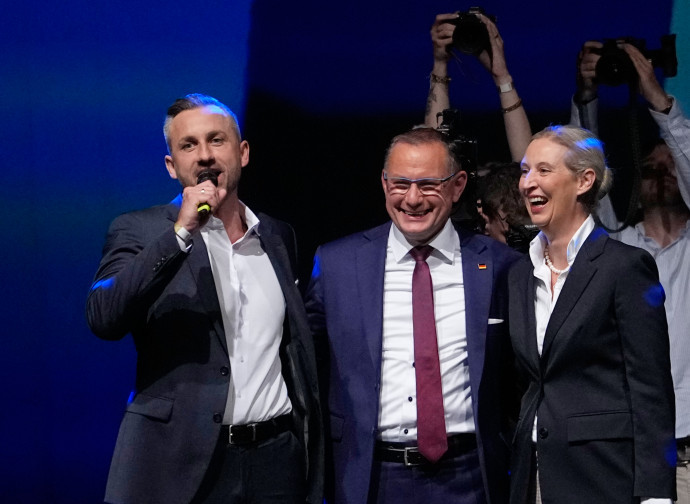
The much-feared event has come to pass. On television, across Europe and beyond, it is the only topic of conversation. Alternative for Germany (AfD) won the local elections in Saxony-Anhalt in eastern Germany (formerly the GDR).
All political parties are pre-emptively condemning the election winner, even though it is not yet clear whether AfD will be able to form a government, as it does not hold an absolute majority in the state. In a joint statement issued by the Council of the Evangelical Church and the Bishops’ Conference, 'very serious concerns' are expressed, and the parties commit to intervening 'should the dignity of the individual, the democratic order, or the rule of law be called into question'. This fear is shared by the media, not only in Germany, but also internationally. The radicalism of Ulrich Siegmund, a candidate for the regional presidency, is highlighted: He has been labelled 'Germany's most dangerous man' by the newspaper Der Spiegel. The most disturbing statements are being dredged up and summarised by The Times as 'deportation and segregation'.
Never underestimate the dangers of modern politics. However, for Nazism to emerge, people must first and foremost want it. The programme, philosophy and founding manifesto of the Alternative for Germany (AfD) party (drafted in 2016) are anything but Nazi. The German right-wing party was founded in 2013 in response to the euro and the centralisation of the EU. In 2015, it also adopted an anti-Islamisation campaign. In recent years, the party has distinguished itself through its stance on illegal immigration, calling for 'remigration'.
While it is certainly right-wing, Nazism was characterised by absolute centralisation of power. In contrast, the AfD advocates greater separation of executive and legislative powers, a more independent judiciary, maximum regional decentralisation, and greater direct democracy. While National Socialism was socialist in economic terms, the AfD's programme is more liberal than that of the centrist parties, as demonstrated by its leader Alice Weidel's recent interview with Elon Musk. While Nazism advocated state indoctrination, the AfD wants schools to be free from politics. This would make them free from ideologies imposed by the state, including gender and anti-colonialist studies. In Saxony-Anhalt, Höcke even proposes abolishing compulsory schooling altogether to oppose state indoctrination and pave the way for homeschooling. The Nazis disarmed their citizens first and foremost; the AfD wants greater freedom to bear arms and the right to self-defence. Nazism imposed an ideological monopoly on the media, which was governed with diabolical efficiency by Joseph Goebbels. By contrast, the AfD would like to terminate Saxony-Anhalt’s contract with German public television, which, like state schools, is viewed as a tool of indoctrination.
German and International journalists play on the emotions stirred by certain slogans and, in doing so, resort to massive doses of hypocrisy.
Journalists who may have previously supported the legalisation of euthanasia are now invoking the spectre of a new 'Aktion T4' (the Nazi programme of forced euthanasia) in response to the AfD's proposal for separate classes or schools for people with disabilities in Saxony-Anhalt. The aim is to help them keep up with lessons, not to eliminate them. Intimidated by Siegmund’s victory, journalists are crying out about the danger of a new ‘brown shirt’ movement. Yet the party’s local manifesto merely calls for the establishment of a volunteer corps to support the police in maintaining public order, not replace them. Perhaps these are the same journalists who downplayed the threat posed by the 'Sharia police', who patrolled immigrant neighbourhoods such as those in Wuppertal in breach of the law.
The constant return to the fear of Nazism occurs when certain raw nerves are touched.
The first of these is, of course, the EU and its currency, the euro. The AfD has been calling for a referendum on this ever since its inception. The most emotionally charged issue is immigration. It was the AfD that introduced the concept of remigration. While regional manifestos and updates following various elections may have introduced concepts and practices of varying degrees of stringency, the principle set out in the 2016 Manifesto remains: 'For decades, people without a right to political asylum have had a key incentive to immigrate due to the German welfare system.' In short, the AfD wants to put an end to this failure to comply with the rule of law. We call for the Return Act to be strengthened, simplified, and consistently applied'.
Regarding integration and culture, the manifesto states that 'the concept of a multicultural society has failed'. In order to live in peace with immigrants in the future, integration is indispensable. It is the only way to halt the further spread of parallel societies in our country. Successful integration requires immigrants of all ages to acquire sufficient spoken and written German skills, respect and support our legal and social systems, and earn a living after a reasonable period of time.' This has nothing to do with Nazi biological racism. Here, we are talking about the rule of law and culture. We are talking about choice, not birth.
The decline in the birth rate is perceived as an existential threat that cannot be resolved through increased immigration. Proposals vary from region to region, but the overall framework involves supporting families with children through tax and housing benefits, as well as improving work-life balance for mothers, so that children can be raised within the family. The right-wing party does not regard abortion as a right, but as a problem. As stated in its 2016 manifesto, 'Alternative for Germany' supports 'respect for life', defining this as beginning with the embryo. This is in line with German law. We therefore call for the primary objective of abortion counselling to be the protection of unborn life.' Prospective parents and single women in need should receive financial and other support during and after pregnancy to discourage thoughts of abortion. Adoption procedures must be simplified”.
As if that were not enough, the party stands for humanity and development and is therefore also opposed to climate alarmism and in favour of a return to nuclear power. Two more taboos broken.
Siegmunda, unable to act from his eastern federal state, clearly advocates Germany's withdrawal from the Paris Agreement. The right-wing party regards anthropogenic global warming as a theory, not a scientific certainty. Consequently, the party opposes the energy policies that have led to the deindustrialisation of Germany, notably the funding of renewables. These policies are always imposed under the pretence of an inevitable catastrophe and a constant state of emergency.
For any journalist, observer, columnist or academic who has been brought up on the tenets of Europeanism, feminism, immigration and environmentalism, the AfD's ideas must come as a shock. This explains the cries of 'Nazism'. But are there really Nazis infiltrating the party? It will be up to the German security services to uncover and punish them, as National Socialism has been illegal since the end of the Second World War. However, the 'journalistic establishment' believes that no distinctions should be made and that it is acceptable to criticise a party that goes against its ideas.
