
Euthanasia: the French bishops’ resistance is a lesson for the Italian Bishops’ Conference
For years, the French episcopate has justified its opposition to the law on euthanasia and assisted suicide. Now that the law has been passed, the French bishops have issued an unequivocal condemnation. Some bishops have even warned pro-euthanasia MPs that they will not be permitted to receive Holy Communion. This stance is very different from that of the Italian Bishops' Conference (CEI), which favours a 'democratic' law

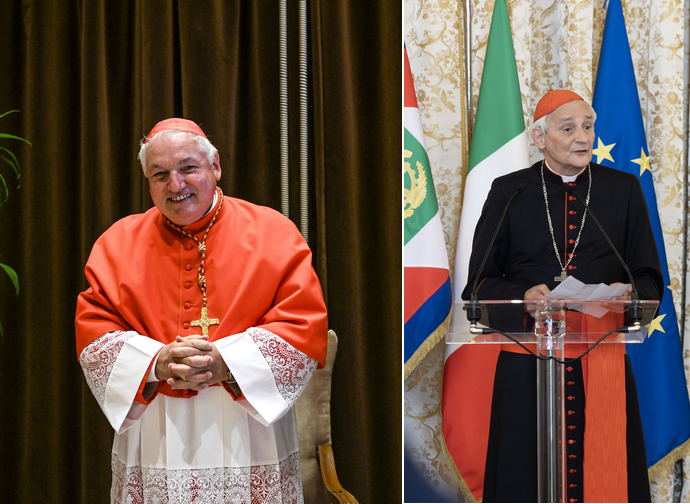
Last Wednesday, 15 July, the French National Assembly passed the euthanasia law on the 'right to kill oneself or be killed'. Aside from the substance of this grave issue, it is worth making a few observations on the position taken by the French bishops in the face of such a traumatic choice. In the four years leading up to the parliamentary vote, the episcopate participated in the national debate, setting out arguments based on reason and faith. Immediately following the news of the law’s approval, the leadership of the Bishops’ Conference, headed by Cardinal Jean-Marc Aveline, Archbishop of Marseille, issued a statement condemning the decision and pledging their continued commitment, as the battle for life cannot end.
The tone of the French bishops' statement is solemn, firm and resolute, and their condemnation of the political decision is expressed in plain language: 'This 15 July 2026 marks a grave rupture in our country's history. (…) Members of Parliament have enshrined in French law the possibility of causing death. This decision breaks with the long tradition of care aimed at alleviating suffering and accompanying every person to the natural end of their life”.
According to the French episcopate, ideological positions and political interests have prevailed over serious and in-depth debate. This accusation appears to be directed at President Emmanuel Macron, who had promised to guarantee precisely the opposite outcome. The statement says that the serious consequences can already be envisaged: the relationship with vulnerability will change; the bonds between generations, and the social bonds of trust between carers and patients, will be eroded; and the poor may feel pressured to die. The statement also expresses a clear desire for 'a renewed commitment, together with families, healthcare workers, volunteers, relatives, associations and chaplains', and calls for Catholic healthcare facilities to be 'faithful witnesses to essential ethical principles and respect for fundamental human values'. Furthermore, Catholics are 'inspired by the firm hope given to them by the Gospel' (…). For the Christ in whom they believe came so that the world might have life”.
The French bishops have not spoken with institutional caution. They have made it clear that there are moments in politics when a clear 'yes' or 'no' is required. They do not regard the Republic as superior to the common good. They have not feared confrontation in social life, and they will continue to fight for their beliefs in the future. They trust in natural values, but even more so in the Gospel of Christ.
There is also another important aspect to consider. While some bishops in their dioceses have used rational arguments to condemn this unjust law, they have also explicitly relied on the doctrine of the Church and the Gospel. The Church is not a political lobby that supports or opposes individual bills; it serves the truth of Christ, which enlightens right thinking so that just laws may be enacted. In this context, it was highly significant that some bishops declared their opposition to the new law in their homilies during Eucharist celebrations, rather than issuing a cold curial statement. They did not fear 'dividing' their communities. Furthermore, some of them warned before the vote that Catholic MPs who voted in favour of the bill would be unable to receive Holy Communion. The truth of the faith demands consistency, even in public life. While it is well known that the French episcopate faces internal divisions, some new and positive signs of resolve have emerged from France on this occasion.
The difference between this approach and that taken by the Italian episcopate regarding a similar bill (which is, in some respects, even worse) is clear to see. Fortunately, this bill is currently on hold in Parliament. On 19 February 2025, the Italian Bishops' Conference (CEI) presidency published a statement in which it did not oppose parliamentary debate on a bill providing for assisted suicide within limits set by the Constitutional Court. The statement also called for Parliament to legislate on the matter. In this way, whilst stating in its note that 'dignity does not end with illness', the CEI accepted that Parliament, by legislating on the 'right to die', would recognise that right. The bishops also called on MPs to engage in a 'broad debate that reflects the country and the real needs of its citizens', suggesting that if a law on assisted suicide were to be passed following such a debate, it would be acceptable. Rather than natural law and the Gospel, which were never mentioned in the CEI document, participatory and inclusive democracy, and the needs of citizens would be the values to be safeguarded in the name of democracy.
We must also remember that, the daily newspaper Avvenire, owned by the CEI, has frequently published opinions in favour of fully implementing the Constitutional Court’s ruling and debating the issue in Parliament, explicitly supporting a 'yes' vote on a potential law. The unity that the bishops wanted to uphold for the sake of democracy has led to division within the Catholic world.
These are two very different approaches.
