
Europe slumbers ten years after Father Hamel’s martyrdom
On 26 July 2016, Father Hamel, an 85-year-old priest, had his throat slit at the foot of the altar by two young jihadists in the church of Saint-Étienne-du-Rouvray. Though struck at its very heart, the Old Continent has continued to slumber in the face of mounting threats. Nonetheless, his blood has not been shed in vain for French Catholics, especially the younger generation, who have experienced a renewal of faith in recent years.

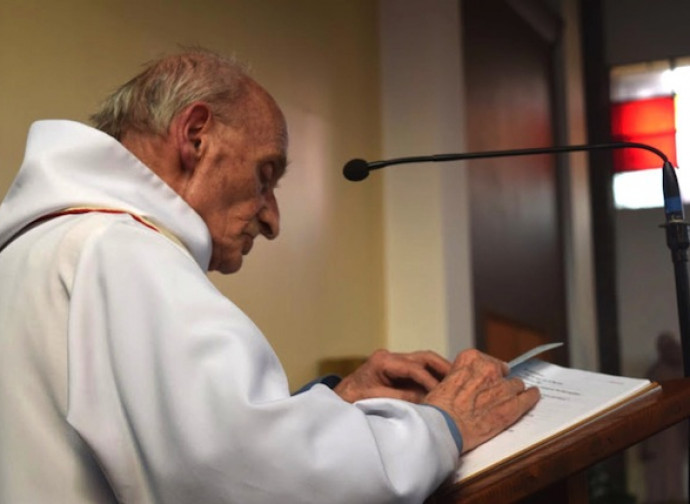
26 July marks the tenth anniversary of the martyrdom of Father Jacques Hamel, the elderly French priest who was murdered in 2016 by two young jihadist terrorists who had sworn allegiance to the so-called Islamic State (ISIS). His murder, which took place while he was celebrating Mass in the church of Saint-Étienne-du-Rouvray in Normandy, left a deep mark on the Church’s conscience: a gentle man, beloved by all killed in cold blood for no reason.
Father Hamel was brutally murdered at the foot of the altar, in the very place where he had dedicated his life to proclaiming the Gospel, and where the Eucharistic sacrifice has been celebrated for twenty centuries. When faced with violence, he responded by clearly rejecting evil. To those who ordered him to renounce Christ, he thundered, “Get behind me, Satan!” These were his last words. Pope Francis described Father Hamel as a martyr, stating that he had been killed 'out of hatred for the faith'. In 2017, the cause for his beatification was opened, recognising his death as a heroic witness to fidelity to Christ and to the priestly ministry.
Sadly, the murder of Father Hamel is not an isolated incident; killings motivated by hatred of the faith occur all over the world, especially in countries suffering most at the hands of terrorist organisations. The 21st century is the new age of martyrs. However, the case of the priest whose throat was slit at the altar has shaken people’s consciences. Father Hamel has become a symbol of the West under attack, even in the tranquil French countryside. His barbaric murder at the altar has brought to mind other famous cases, such as that of the Salvadoran bishop, Saint Óscar Romero, who was killed in 1980 while celebrating Mass. It has also reminded us that the Eucharist is a sacrifice — the saving sacrifice of Christ — which Catholics embody in the sacrifice of their own lives as they follow the Way of the Cross.
Ten years have passed. Now, while the cause for the beatification of Father Hamel is ongoing, we might ask whether his sacrifice has helped to rouse numb consciences, as well as swelling the ranks of the martyrs. Have Europe’s ill-advised policies changed?
Have the nations of the Old Continent recognised the danger posed by the influx of diverse peoples, many of whom are unfortunately culturally hostile? The answer is obvious: nothing has been done since the murder of Father Hamel or the many subsequent attacks on European soil. The dangers denounced years ago remain exactly the same. Indeed, one might say that they have become more insidious, with the perpetrators of violence becoming more obstinate and protected by a political and cultural system that turns a blind eye to the tragic situation that has now emerged.
Just as Nero played the harp while Rome burned, so a certain political establishment contemplates and takes pleasure in its collapse: everything is fine, even though it is plain to see that the Parisian suburbs are beyond state control, that London is no longer essentially English, and that many northern capitals, Stockholm included, have become no-man’s-lands. Over the past ten years, what has changed is the radicalisation of political correctness: people kneel in the name of George Floyd, yet not for the Christians being massacred in countries ranging from Nigeria to Pakistan and even in France, once known as the Church's eldest daughter.
In reality, a mere outward gesture would be inadequate. Christianity teaches us not to kneel before man, but before the Son of Man. If that were the case, Christianity would be a trendy religion, just as the world would have it. While institutions and the cultural world may not have learnt any lessons from Father Hamel’s martyrdom, many Catholics, particularly in France, have quietly drawn inspiration from it. Young people in particular have witnessed a renewal of faith over the past ten years. The attack on 26 July 2016 may have opened the eyes of some, while others have forgotten. If there is any hope, it lies with the young people, who were perhaps also deeply moved by that ruthless execution, just as the early Christians were strengthened by the blood of so many martyrs.
The French Church has not forgotten the martyred priest. The Archdiocese of Rouen has organised a programme of events to commemorate him, including a Holy Mass to be presided over by Cardinal Jean-Marc Aveline, Archbishop of Marseille and President of the French Bishops’ Conference. Afterwards, in the square, there will be 'republican speeches'. Heaven forbid that the memory of the first priest to be martyred on French soil – since the days of the Jacobin Republic! – should stir consciences too deeply.
