
Eat, pray and score, but only if you’re Muslim, not Christian
German player Nmecha prays after scoring a goal and is inundated with criticism: ‘Obsessed with Christ, a bleak view of humanity’; for the talented Spaniard Yamal, on the other hand, raising his arms to the sky in praise of Allah was a gesture befitting a ‘true Muslim’. Meanwhile, submission to Islam brings us a halal-compliant stadium.


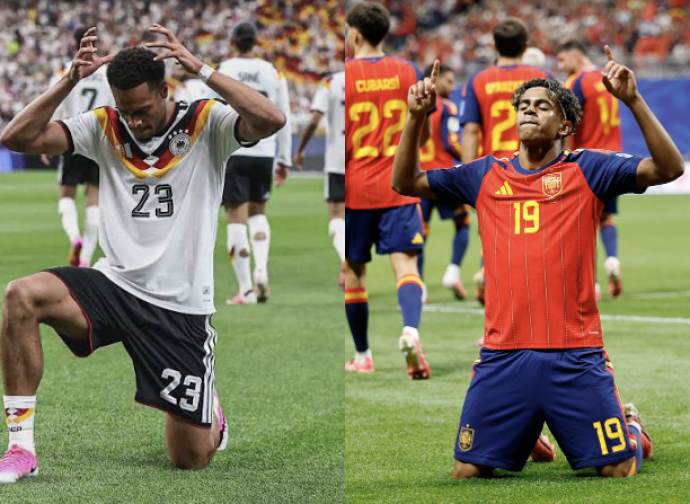
Christianity is a thorn in the side even at the World Cup, whilst Islam is treated with the utmost deference. The prayer offered by footballer Felix Nmecha at the end of the match in which the German national team beat Curaçao 7–1 did not go unnoticed in his home country, Germany. It was precisely this German striker of Nigerian origin who kicked off the German rout with one of his own goals. But it is not for purely sporting reasons that we are reporting on this.
The reason is linked to his Christian faith. A faith – he professes to be an Evangelical – which the young striker lives out publicly.
After scoring the goal, he knelt on the pitch, formed a crown with his hands above his head and placed it on the ground. He then raised his hands towards the sky and later posted a photo of this moment on Instagram with the words “Thank you Jesus!”. After the match, he also formed a prayer circle together with Jonathan Tah and a couple of Curaçao players.
The reason for this behaviour is linked to his Christian faith. “Football is my passion, Jesus is my foundation,” he had said in the past, adding, “every time I step onto the pitch, it’s not about me, but about glorifying God.” These words and actions are causing more than a few people in his country to turn up their noses, as the nation grapples with dramatic secularisation – as we often write about in relation to Germany in Bussola.
The criticism that has rained down on him has all come from the press, which has not only criticised Nmecha but has also mocked him. “A professional footballer obsessed with Christ: a red card for Jesus!”; “German international Felix Nmecha flaunts his faith like a monstrance. Behind it lies a grim view of humanity”. “Nmecha’s prayer after the World Cup match is a stumbling block”. Things like this, to give an idea of the tone of these vitriolic articles, which dig into his past to find a rotten apple to sink their teeth into.
And indeed they find one. The footballer had, in fact, previously criticised the pro-homosexual ideology championed by LGBT activists, who are also very militant in Germany.
And so they accuse him of being homophobic and transphobic: “The player had previously shared or ‘liked’ various transphobic and homophobic posts on his Instagram account. In one of the posts, the LGBTQ+ movement and the concept of ‘Pride’ were compared to the devil. In another, a US far-right extremist mocked a transgender minor,” according to the German press. All hell broke loose. That was enough to make him a target of criticism and ridicule that extends far beyond the football pitch.
It is nothing new that Christianophobia in Europe is becoming more radical, using criticism of anti-human ideologies – which have taken hold on the Old Continent – as a pretext. And so, even an expression of praise to God for a simple game becomes an opportunity to silence him.
In fact, the controversy is growing because Nmecha has said he belongs to a sort of international fellowship of footballers, who share not their club affiliation, nor their national team, nor even their position on the pitch, but simply their faith in Jesus Christ.
“Ballers in God” (translated: players in God) is a network – to call it a movement would be an exaggeration – founded in 2015 by the English footballer John Bostock, which aims to use football to spread the message of Jesus Christ, supporting and guiding players in their faith. This is commendable, especially when we consider that the world of football – and of top-level sport in general – is as far removed from certain evangelical values as it is possible to be.
But not for certain sections of the press and, evidently certain sections of German and European public opinion, which criticise these footballers for not confining their faith to their private lives, on pain of excommunication. Because the problem lies entirely in bringing faith into the public arena and pitting it against the prevailing ideologies.
But the fact that there is a not-so-subtle double standard is demonstrated by two other incidents set in the Atlanta stadium, where Spain beat Saudi Arabia 4–0 on Sunday.
Here, the religion under scrutiny is Islam, but let us take a closer look at the treatment it received.
First and foremost, the stadium made preparations to welcome the Saudi fans with every honour: designated areas for Islamic prayer and halal food available at the venue’s catering outlets. Rather than religious freedom, this amounts to a gesture of submission that we would be unlikely to see in the stadiums of Rabat if the roles were reversed. Indeed, Cristiano Ronaldo’s sign of the cross, made live on television after scoring a goal whilst playing for Al Nasr, is famous. It caused an uproar; he was reprimanded, although he got off lightly, probably thanks to his millionaire’s salary acting as a shield. But the reason was simple: in Saudi Arabia, any form of public display of faith is forbidden. Footballers are not allowed to enter the pitch making the sign of the cross – which, to be honest, even here has come to be seen more as a superstitious ritual than a public expression of faith. In any case, it would be unthinkable in Saudi Arabia to have a butcher’s stall in a stadium to please Western fans who love pork and barbecued ribs.
American deference aside, still in the same match, it is interesting to note the contrasting fate that befell Lamine Yamal, a rising star of the Spanish national team and, as is well known, of Moroccan descent on his father’s side. On his debut for the Spanish national team at the World Cup, Yamal scored and, whilst celebrating, knelt in the Islamic manner, raising his arms to the sky. A clear sign of reverence towards Allah.
After all, this young Barcelona star is no stranger to displaying his Islamic faith in public. And he did so again on Sunday, in the European champions’ second match at the World Cup in the US.
Protests? None. Criticism in Spain over this display of faith? Not even a shadow of it. Indeed, certain Muslim websites have praised the footballer’s gesture – which is certainly not the first of its kind (Antonio Rüdiger and Mohamed Salah have also done so). It goes without saying that the World Cup is a showcase capable of embedding certain gestures in public opinion and cementing them there. European public opinion, on the other hand – which had been up in arms against Nmecha – has gone silent. Praise rained down on the Muslim Yamal, whilst the poor Christian Nmecha received nothing but criticism. And it is also from these details, to paraphrase the well-known Italian singer-songwriter Francesco De Gregori, that a player is judged and – we might add – that the barometer of Christianophobia is gauged.
