

Double rejection: Lefebvrians reject Rome's proposals
No U-turn from the Society of Saint Pius X after the Holy See's request to suspend episcopal ordinations and resume theological dialogue. Don Pagliarani criticises Müller for the failure of past talks and tries to ingratiate himself with Fernández by leveraging the “todos, todos, todos”


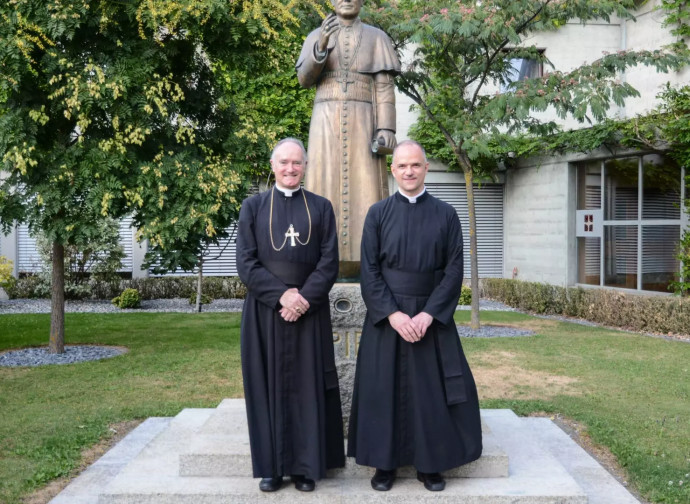
‘While I am obviously pleased with this new opening for dialogue and the positive response to the 2019 proposal, I cannot accept, out of intellectual honesty and priestly fidelity before God and souls, the perspective and aims in the name of which the Dicastery proposes a resumption of dialogue at this juncture; nor, at the same time, the postponement of the date of 1 July.’ The General Council of the Priestly Fraternity of St. Pius X has twice rejected the proposal that the Prefect of the Congregation for the Doctrine of the Faith made to Fr. Davide Pagliarani at the recent meeting on 12 February.
In the press release, dated 18 February 2026 but made public yesterday, the FSSPX rejects the idea of a dialogue aimed at finding a minimum for the regularisation of its situation and, above all, maintains its decision to consecrate bishops (according to our sources, five) on 1 July, regardless of the position taken by Leo XIV. The General Council has also chosen to make public two letters that bear witness to recent exchanges: the letter from Fr. Davide Pagliarani to Msgr. Guido Pozzo, then Secretary of the Ecclesia Dei Commission (17 January 2019), in which the topics for a new theological exchange were proposed; and the letter (26 June 2017) that Cardinal Gerhard Müller, then Prefect of the Congregation for the Doctrine of the Faith, sent to Bishop Bernard Fellay, as Superior General of the FSSPX, indicating the conditions necessary to re-establish communion with the Church.
The Society regrets the long silence of the Holy See after the proposal made in 2019 for a theological dialogue, a silence broken only after the recent announcement of new episcopal consecrations. In essence, the FSSPX rejects any possibility of agreement on doctrine: ‘We both know in advance that we cannot agree on doctrine, with particular reference to the fundamental orientations adopted after the Second Vatican Council.’ The leaders of the FSSPX also believe that the current climate is not conducive due to the ‘now public threat’ of new sanctions, forgetting, however, that it was the Fraternity itself that confronted the Pope with the irrevocable decision already taken to consecrate new bishops.
Leaving doctrine aside, the letter from the General Council reveals its political nature. The Fraternity's objective, as we have already anticipated, is not legal reintegration into the Church, which in its eyes appears (wrongly) as a trifle in view of the objective dramatic situation in which the Church finds itself. The Society does not want to return to the hierarchical communion of the Church at all, which it fears like the plague because of the loss of ‘freedom’ that would result; nor does it consider it possible to reach a doctrinal agreement, since, in its eyes, the only binding constraints would derive from what the Church taught infallibly in the 1960 years preceding Vatican II.
It is therefore understandable that the smoke in the eyes of the FSSPX is not the modernists at all, but Cardinal Müller (and Benedict XVI), guilty of “a unilateral decision” that would “solemnly establish, in his own way, 'the minimum necessary for full communion with the Catholic Church”, explicitly including the entire Council and the post-Council'; The obstinacy ‘in a doctrinal dialogue that was too forced and lacking in sufficient serenity,’ continues Fr. Pagliarani, would have aggravated the situation in the long term. In practice, the German cardinal's fault would lie in having set conditions that were more than obvious for an agreement: to accept the Professio Fidei of 1988, to which every Catholic faithful is required to adhere and which is required prior to assuming an ecclesiastical office; accepting the documents of Vatican II and the subsequent Magisterium, according to ‘the degree of adherence due to them,’ as is the case for every document of the Magisterium; accepting the validity and legitimacy of the Rite reformed after Vatican II (which does not imply either the obligation to celebrate according to this rite or the impossibility of raising criticisms of the liturgical reform). These are three basic conditions, which nevertheless appear unacceptable to the FSSPX.
Don Pagliarani thus plays the card of currying favour with Fernández in the most cynical and opportunistic way possible, namely by showing himself to be the enemy of his enemy. It is the fault of Müller, Benedict XVI, John Paul II, and all those who insisted on a doctrinal minimum in order to reach an agreement, if the ship ran aground before reaching port. The solution suggested by the FSSPX is instead to remind Fernández of his ‘first love,’ to return to the friendly camp of Francis, in the perspective of ‘todos, todos, todos,’ of the special cases of Amoris Lætitia, of breaking the mould: "Over the last decade, Pope Francis and you yourself have widely promoted “listening” and understanding of particular, complex, exceptional situations that are outside the ordinary patterns. You have also called for a use of canon law that is always pastoral, flexible and reasonable, without pretending to resolve everything through legal automatisms and pre-established patterns. The Fraternity asks nothing else of you at this juncture.‘
Don Pagliarani and his assistants are therefore particularly sensitive to the ’flexible" line of Francis, which has devastated the Church for over a decade and has prompted many Catholics, often in good faith, to attend the chapels of the Fraternity in order to escape this very disaster. And yet it is precisely the ‘Francis line,’ which is non-doctrinal and non-juridical, that the Fraternity desires; and it is no secret that Francis himself has been the best interlocutor for the FSSPX, which, strengthened by Bergoglio's friendship with the second assistant general, Don Christian Bouchacourt, superior of the District of South America from 2003 to 2015, sought to exploit the Argentine Pope's gaps in doctrine and his aversion to the juridical dimension of the Church to obtain approval to continue in its schismatic situation. And the game was almost successful: the Fraternity had in fact obtained ‘free of charge’ the faculty for confessions (until then invalid) and the possibility for Ordinaries to grant authorisation to attend the marriages of the faithful linked to the Fraternity.
The next move would have been to ask Francis for a “blessing” for episcopal consecrations, without any reconciliation with the Catholic hierarchy. And this is exactly what the Fraternity is now asking Fernández, asking him to apply the “Franciscan” doctrine of the separation between doctrine and pastoral care: “in the shared awareness that we cannot find agreement on doctrine, it seems to me that the only point on which we can meet is that of charity towards souls and towards the Church,” recognising “the value of the good that it [FSSPX] can accomplish, despite its canonical situation.” After adultery, schism has now also become a “possible good.”
