
Cyprus, on the home front of the Israeli-Lebanese conflict
Cyprus has become a destination for migration and investment for Israelis, particularly since the war began. But it is also a destination for the Lebanese, who were initially fleeing the economic crisis and, since 2023, the war as well.


On our way to Beirut, we stop over at Larnaca Airport on the south-eastern coast of Cyprus, the ‘Greek’ part – the north of the island, comprising 36 per cent of the territory, has been occupied by Turkey since 1974.
Larnaca International Airport, the island’s main airport, is relatively small but handles a significant volume of traffic, traditionally consisting of tourists from Greece and other European countries; however, due to the resurgence of conflicts in the Middle East, in recent years the airport has seen a marked increase in passengers arriving from Lebanon and Israel, except during periods of particularly intense hostilities. Indeed, the presence at the airport of travellers fleeing the war and seeking stability and safety outside their own country is immediately apparent. Whilst we wait our turn at the passport control desk, a middle-aged blonde woman demands to be served first, disregarding the queue: “I’m from Israel,” she shouts loudly enough for everyone present to hear.
Once the entry formalities are out of the way, we catch sight of – amidst the hustle and bustle of tourists and holidaymakers in flip-flops – several men wearing kippahs; in the waiting area, entire families sit beside us who do not go unnoticed – the men, young men and even the children wear black fedoras over their hair styled in side curls, whilst the women have colourful scarves on their heads. In the opposite corner of the hall, a girl at the centre of a group sitting on the floor has a Lebanese flag tied to her rucksack.
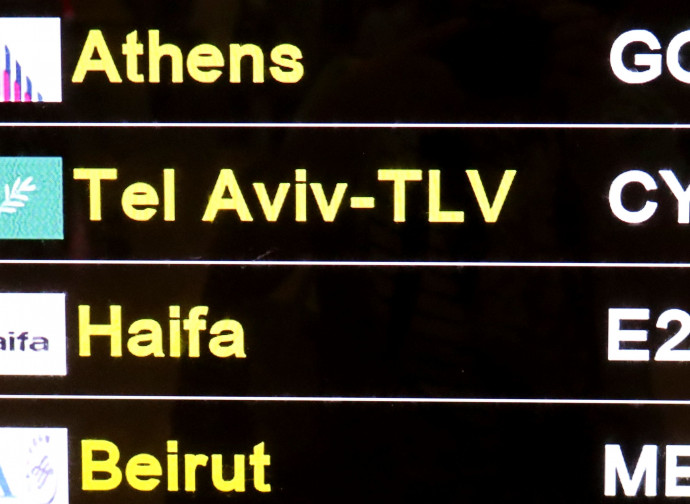
The displays show a constant stream of arrivals and departures to and from Haifa and Tel Aviv, operated by the Israeli airlines Air Haifa, El Al, Arkia and Israir, alongside connections to Beirut operated by Middle East Airlines, the Lebanese national carrier: it feels surreal to see, side by side on the same screen, the names of cities that inspire hatred and revulsion in the neighbouring country – and to find, gathered in the same waiting room, people who spend their lives fleeing from one another, in a mixture of mutual fear and animosity. Yet, in a tragic twist of fate, in Cyprus the exiles from both countries find themselves accidental companions in the diaspora.
As we pass through Larnaca, ‘Israeli peace’ reigns in Lebanon – agreed in Washington between the Jewish State, the US and the Land of the Cedars. Whilst on paper the agreement ensures a ceasefire, in reality the Israeli army continues its operations in the south of the country aimed at eliminating Hezbollah from the territory – but claiming civilian casualties on a daily basis. Although the agreement provides for an unspecified withdrawal of the IDF from the country, Israeli Prime Minister Netanyahu has stated once again that Israeli troops will remain in Lebanon for as long as necessary, because “the war is not over”, a statement also reiterated by his Defence Minister Katz, who, in a pointed rebuke to Donald Trump, asserted: “We did not ask anyone’s permission to enter Lebanon, and we do not need permission to stay”.
In Lebanon since 2 March, the IDF’s military operations in the Land of the Cedars have also taken their toll: according to the latest available figures, during the same period 38 Israeli soldiers were killed on Lebanese territory, often young and very young men, along with a civilian accompanying the troops.
Popular opposition to the Netanyahu government, now on its last legs, has been a constant feature of the Jewish State in recent years: many Israelis – whilst unconditionally supporting ‘the elimination of Hezbollah terrorists’ in Lebanon – are weary of a never-ending war that puts their children at risk, and are therefore choosing to leave the country.
The trend is now well established: since 7 October 2023 a steady stream of Israeli citizens has been leaving the country. According to recent studies, 15,000 of them have taken up residence in Cyprus and purchased property there – buildings, land, resorts – for personal use or for speculative purposes; an investment on the island guarantees the affluent section of the population a sort of ‘escape route’ just an hour’s flight from Tel Aviv when times get tough. The website Israel Properties describes Cyprus as “the island of Aphrodite”, with a “fantastic climate all year round” and a “strategic geographical location at the crossroads of three continents” offering “business opportunities for locals and offshore companies”: an excellent place to invest “from 140,000 dollars excluding taxes”. Last year, the Cypriot government released figures on property purchases by foreigners from 2021 up to January 2025: Israeli citizens are among the leading buyers – either in their own names or through Cypriot front companies – alongside Greeks and Britons.
In Larnaca in particular – where there is a synagogue – Israeli citizens purchased 1,406 properties during the period in question. The reality of massive Israeli investment in Cyprus – concentrated, moreover, in the areas of Larnaca, Paphos and Limassol – has not gone unnoticed in a community which, in the Greek part of the island, has fewer than one million inhabitants; Cypriot MEP Fidias Panayiotou has denounced the ongoing Israeli “colonisation”, which is unpalatable to many on the island, prompting protests from Tel Aviv. Moreover, at an institutional level too, relations between Greece, Cyprus and Israel have recently been strengthened: at the end of 2025, the three countries transformed an energy cooperation agreement signed in 2013 into a joint defence pact, with a “joint military force” to be operational by 2026 - it goes without saying that the nation against which the parties intend to defend themselves jointly is Turkey.
Lebanese emigration to Cyprus is undoubtedly less conspicuous and has less of an impact on the social fabric; the figures are also less clear-cut. Whilst a Lebanese Christian community has always existed on the island, the surge in migration began in 2019 – the year of the major financial crash in the ‘Land of the Cedars’ – and then intensified after 7 October 2023 and the conflicts that followed.
In addition to the need to relocate businesses – which are unable to operate in a country ravaged by economic crisis and war – and the hope of a life free from looming threats, for the Lebanese, a major advantage of investing in Cyprus is undoubtedly the prospect of easier access to Europe (Cyprus has been part of the European Union since 2004).
The requirements for obtaining a Schengen visa are often out of reach for Lebanese citizens, who face endless delays and frequent refusals when applying for the document; the Lebanese passport, ranked 92nd by the Henley Global Passport Ranking – which measures the ‘power’ of passports from 103 countries worldwide – allows visa-free access to very few countries, mostly in the Middle East and Africa. Estate agents therefore offer Lebanese nationals who can afford it so-called ‘Golden Visas’ – packages comprising property and a visa ‘starting from 250,000 dollars’, as stated on a billboard in the heart of Beirut advertising Greece; however, Cyprus – a forty-five-minute flight from Rafik Hariri Airport – is an even more popular destination. According to the Cypriot government data cited above, between 2021 and January 2025 in Larnaca alone, Lebanese citizens purchased 1,744 properties.
To offset the drastic rise in airfares to Cyprus caused by increased demand and the risks airlines face during periods of escalating hostilities, the Lebanese shipping company Cedar Waves has launched a sea route to Larnaca, offering a direct ferry service from Lebanon “from 95 dollars”.
The current relative calm on the “Lebanese front” is a good time to escape the war; at least until the next escalation.
