

China–Écône: who is forcing regularisation and who is rejecting it?
Why not recognise the bishops of the Fraternity in the same way as those imposed by Beijing? The latter, in effect, invite themselves into communion with Rome, whilst the former exclude themselves from it in order to operate independently. The Chinese government’s appointments remain questionable, but they do not justify the Lefebvrian schism.


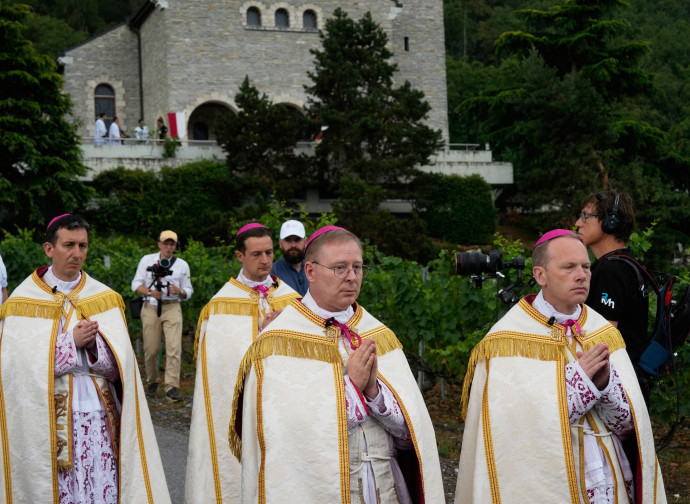
We must address the objection regarding double standards: in China, bishops are consecrated without any mandate from the Apostolic See, at the behest of an atheist and communist government, and the Vatican does not excommunicate anyone; the Priestly Fraternity of St Pius X consecrates four bishops, and the very next day the Congregation for the Doctrine of the Faith pronounces excommunications. This objection is accompanied by another: could the Pope not recognise the bishops of the SSPX, given that he recognises the Chinese ones?
Let us begin with an observation of the circumstances. The China-Vatican agreement, brokered by the Secretariat of State and kept confidential, has repeatedly been the subject of criticism by La Bussola, because it appears, at least as far as can be observed, to be decidedly compliant with the whims of the Chinese government, which has already on several occasions forced certain Chinese Catholic bishops to consecrate others without prior agreement with the Holy See. The problem, therefore, exists and is plain to see. But the extreme delicacy of the situation facing Catholics in China is also evident, where loyalty to the Catholic Church is not infrequently paid for with the loss of freedom and even one’s life. A refusal by the Holy See could have extremely dangerous consequences for the presence of Catholics in China. This is not the case with the FSSPX.
We must also bear in mind that, as we do not know the terms of the Sino-Vatican agreement, we do not know whether the Pope has granted tacit approval to any episcopal consecrations, even without an explicit mandate.
From a purely circumstantial point of view, the situation of the Chinese bishops is therefore not comparable to that of the FSSPX; in China, the Holy See is seeking a practical solution that would allow the Church to continue to exist with a legitimate hierarchy and enable the Catholic faithful to continue to exist and practise their faith (a solution which, as things stand, appears highly problematic), whereas in the case of the FSSPX these necessities do not exist.
But let us get to the heart of the matter: are consecrations without a mandate in the People’s Republic and those of the FSSPX effectively on the same footing? The answer is no. Indeed, from a certain point of view, they are diametrically opposed. In the case of the Chinese bishops, the Holy See could certainly refuse communion to bishops consecrated without an apostolic mandate; however, once it decides to recognise these consecrations, these bishops are bishops of the Catholic Church, they belong to the episcopal college, and they are subject to the Pope. Whatever the Chinese government’s ultimate perverse aim may be, it imposes episcopal consecrations so that these bishops may be accepted by the Catholic Church; in other words, it demands canonical regularisation by the Holy See of bishops ordained without a mandate.
Paradoxically, the FSSPX has taken the opposite course. Faced with the Holy See’s proposal for regularisation, it has always systematically refused to accept it: first in 1988, then in 2012, and again in 2018, when, as Monsignor Guido Pozzo recently stated, Father Davide Pagliarani rejected a statement that had been drawn up by mutual agreement, on the pretext that ‘Rome should first have acknowledged its errors’. Even recently, faced with the Dicastery’s proposal to initiate new discussions with the aim of achieving regularisation, Fr Pagliarani expressly refused. In essence, the Chinese bishops agree to join the Catholic Church legally, despite having been consecrated without a mandate, whilst those of the FSSPX reject this proposal for reinstatement.
Furthermore, we may note that, to date, there have been no episcopal consecrations in China against the Pope’s will, but rather without his mandate. And this distinction is significant. For whilst it is sometimes possible to consecrate without the Pope’s mandate—assuming that the Pope tacitly approves consecrations carried out in situations of grave necessity for the Church—this is not possible when the Pope’s will is explicitly expressed to the contrary.
In light of the above, the answer becomes clear to the second objection mentioned as well: could the Pope not have granted the mandate for the consecrations on 1 July at Écône? We had already addressed this in our response to Bishop Athanasius Schneider, when he asked Pope Leo to grant the apostolic mandate to the FSSPX for the announced episcopal consecrations. But how can the Pope grant a mandate to those who explicitly wish to withdraw from his jurisdiction? Those who think and say that ‘the Pope could well have granted the mandate’ do not realise what they are saying; it would be tantamount to asking the Pope to approve a schism. For the Society was not asking the Pope to grant the mandate so that it might exercise its ministry within the juridical communion of the Catholic Church (which, let us recall, is as necessary as the profession of the true faith), and therefore in submission to the Apostolic See, but precisely so that it might withdraw from it, once it had acquired ‘sacramental independence’.
Finally, there is one last response to be given to the objection regarding double standards. If a state had irresponsibly decided to decriminalise murder, should one then fight to demand that rape be decriminalised as well? Or should one not rather work to ensure that murder is once again punishable and that order reigns in society? If the Sino-Vatican agreement is not a good one, what is the solution: to work to have this agreement amended, or to demand the freedom to commit other acts that constitute canonical offences against the unity of the Church? If there is widespread impunity on many fronts within the house of God, is the solution perhaps to further increase such situations of impunity? It is truly difficult to comprehend the logic of ‘double standards’; one can certainly understand the state of mind of those who may find themselves subject to a sanction whilst others go unpunished, but if that sanction is just, one must not take it out on the Church’s authority, but rather correct one’s own behaviour.
And unfortunately, the excommunications of the six bishops are more than justified, just as it is right to remind the priests and faithful of the FSSPX that the habitual and systematic subversion of the Pope’s authority (by rejecting any proposal for canonical regularisation)—which the FSSPX has been practising for over forty years now—means being in schism, and adherence to schism is a grave sin against Catholic communion, which entails excommunication latæ sententiæ, even if not declared.
