
Abortion and the new Vaughan Spruce case: freedom of thought is at stake
Ascolta la versione audio dell'articolo
The director of March for Life UK is facing trial for the third time for silently praying outside an abortion clinic. If convicted, the consequences would be serious for everyone, as the state would effectively be authorised to control people's thoughts.

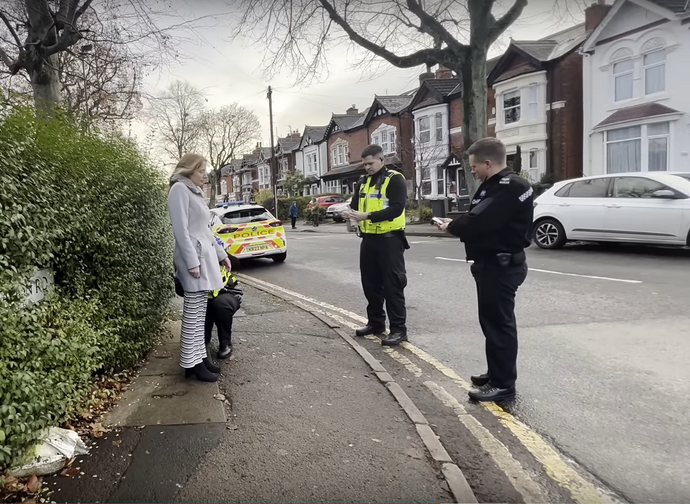
There is no end to the legal persecution of Isabel Vaughan-Spruce, the 48-year-old Catholic pro-life advocate. Daily Compass readers know her well, including the two past attempts in 2023 by West Midlands Police and the Crown Prosecution Service (CPS) to incriminate her for standing in silent prayer in an area under a local Public Space Protection Order (PSPO). Now the police are taking another shot. Having failed twice to bring charges against her under local buffer zone restrictions, they are attempting to incriminate her under the national public order law passed in 2023. This makes Vaughan-Spruce the first person to be charged under the Public Order Act (POA) which introduced nationwide buffer zones around every abortion clinic in the UK. Her alleged crime is always the same: standing in silent prayer within an abortion clinic buffer zone. The penalty for this offence is an unlimited fine at the judge’s discretion.
On 29 January, Vaughan-Spruce was summoned to Birmingham Magistrates' Court to provide her personal details and enter her - not guilty - plea. The charge against her dates back to December 2025 for standing near the Robert Clinic abortion facility in Birmingham on five occasions between June and November of that year. Section 9 of the POA, which came into force on October 31, 2024, made it an offence for a person who is within a safe access zone of 150 metres from any part of an abortion clinic to influence, obstruct or harass anyone accessing the facility in England and Wales.
Paradoxically, no such harassment is alleged in the case against Vaughan-Spruce. When she appeared at Birmingham Magistrates’ Court, Vaughan-Spruce stated that she had merely stood on a public street and prayed silently. "I did not hold signs, speak to anyone, distribute leaflets or interact with anyone in any way," she said. 'Standing is not a crime. Silence is not a crime. Thinking is not a crime.”
Vaughan-Spruce has been at odds with the Robert Clinic and the local police since she started holding a weekly prayer vigil outside the facility for an hour or two after the area came under a PSPO. She told the Daily Compass that, apart from the clinic manager, who came to tell her on several occasions that she would be calling the police to move her on, no one else has complained. “People enter and exit the clinic without even noticing me; to them, I am just a woman looking at her phone,” she said.
All eyes are now on His Honour Judge Tanwer Ikram to see how he deals with this legal hot potato. During the 20-minute hearing, he rejected the CPS's request for a five-day trial reducing it to three days beginning on 6 October, as the facts of the case are not in dispute. (Vaughan-Spruce has been charged with standing in a buffer zone and admits that she was standing in the buffer zone.) For the same reason, he ordered that the five planned prosecution witnesses would not be required.
Vaughan-Spruce is once again relying on the advocacy group Alliance Defending Freedom International (ADF) to provide her with legal support. Her defence team argues that the charge falls outside the scope of the buffer zone law and violates her right to freedom of thought, conscience and religion under Article 9 of the European Convention on Human Rights.
We recall that ADF International successfully defended Vaughan-Spruce in 2023 when she previously appeared at Birmingham Magistrates’ Court in February 2023 alongside Catholic priest Father Sean Gough. However, the CPS dropped the four charges of failing to comply with a PSPO in court. She was arrested again later that year, which resulted in a lengthy police investigation. In August 2024, Vaughan-Spruce received a £13,000 settlement from West Midlands Police following a challenge to her earlier arrests.
Conversely, the prosecution is basing its case on the assertion that Vaughan-Spruce's silent presence constituted 'influencing', as defined by buffer-zone legislation. This is a legal novelty for British courts. Traditionally, British law has regulated behaviour, not belief. In this case, however, the law is being asked to judge Vaughan-Spruce’s presumed internal intentions rather than her outward actions. Criminality will be inferred from her silence and presumed intention.
For this reason, Vaughan-Spruce’s case raises serious issues for everyone. At its core, the case is not actually about abortion. Rather, it is about the right to freedom of thought, conscience and expression. A society that polices inner thought does not protect fundamental freedoms. The case is about whether the law should govern actions or minds, and whether the state should protect pluralism or enforce ideological conformity.
Furthermore, such legislation carries a risk of inconsistent and arbitrary enforcement, thereby undermining the very rule of law it is intended to protect. Today, it is prayer near an abortion clinic. Tomorrow, it could be dissent near another politically sensitive location. A guilty verdict would represent a troubling shift in British law and an unprecedented expansion of state power.
