
US attack on Venezuela: the illusion that force solves problems
Trump has launched a blitzkrieg on Venezuela to arrest President Maduro and put him on trial in New York today. While there is no sympathy for a criminal dictator, the fundamental question to ask is whether the end justifies the means. The answer is no.

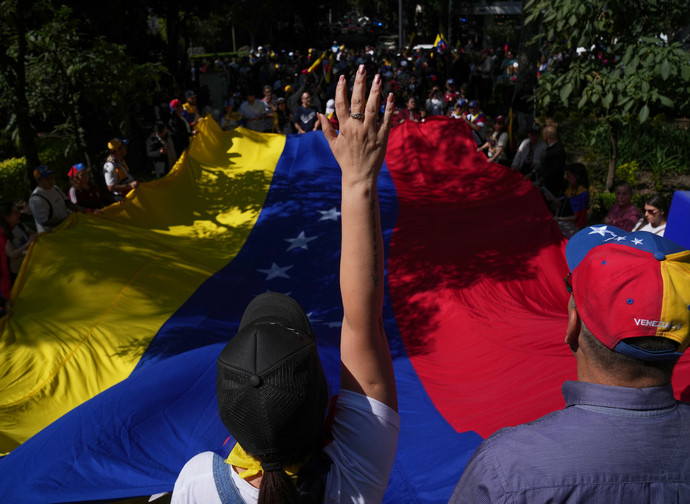
As we discussed just a month ago, it was not difficult to predict the outcome of the crisis that had arisen between the United States and Venezuela. At dawn on 3 January, US President Donald Trump launched a blitzkrieg which ended within a few hours with the arrest of Venezuelan President Nicolás Maduro and his deportation to New York, where he is expected to stand trial today. Although the 'counter-terrorism operation' — as Trump called it, partly to circumvent the necessary congressional approval — was swift, only time will tell how the situation in Venezuela and beyond will develop.
There is obviously no shortage of analysis and in-depth commentary at this time, and the Daily Compass is also contributing to the discussion. However, in the face of such military intervention, there is a question that cannot be avoided: does the end justify the means? Assuming the end is legitimate, such as overthrowing a criminal regime whose damage extends beyond national borders, are any means to achieve that end permissible? This includes violating the most basic rules of international law.
The answer can only be no.
As our readers are well aware, we have no sympathy for the Bolivarian socialist regime established by President Hugo Chávez in 1999 and continued by his protégé Maduro after his death. This regime has reduced Venezuela to starvation, creating over six million refugees abroad, and has established a ferocious repressive machine with thousands of arbitrary arrests. It has also transformed the country into a drug trafficking hub and given hospitality to terrorist groups such as the Colombian FARC and Hezbollah, with the aim of destabilising other Latin American states. It has also perpetuated its power by rigging elections, including the most recent ones in July 2024, when Maduro was proclaimed president instead of Edmundo González Urrutia, who was considered the real winner by foreign observers (after the exclusion of María Corina Machado, the recent Nobel Peace Prize winner).
Many Venezuelans are therefore understandably joyful at the news of Maduro's arrest, but uncertainties remain about what will happen next.
This is not only because the real reasons for US intervention clearly have nothing to do with democracy or respect for human rights — it is not a foregone conclusion that Maduro's arrest will lead to a democratic transition — but also because it is not primarily about drug trafficking and oil. Clearly, the blitzkrieg in Venezuela is part of a broader plan to rearrange the global balance of power based on zones of influence or the definition and respect of the 'backyards' of the great powers. The Trump administration's recent national security strategy document clearly considers the entire American continent to be the United States' backyard.
One could argue that this is nothing new, as great powers have always sought to exert influence over strategically important countries — and this is true. However, military intervention and aggression cannot be an acceptable means, even when the end result is considered positive.
Moreover, history has repeatedly demonstrated that peace cannot be created through war. Wars only create more wars; rearmament calls for rearmament. Recent experience suggests that the post-Maduro era may not be peaceful or democratic; furthermore, American intervention in Venezuela is not an isolated incident: other countries are already in Trump's sights, notably Cuba and Iran.
We must not forget the wider international context: Ukraine is effectively Russia's 'backyard', and China is becoming increasingly assertive and appears ready to annex Taiwan. These are just two of the most striking cases that promise to multiply conflicts and tensions.
In his message for World Peace Day, Pope Leo addressed this very point, calling for a reversal of this mentality and reminding us that peace is not a distant goal, but 'a presence and a journey' that must be welcomed and recognised. 'When we treat peace as a distant ideal, we cease to be scandalized when it is denied, or even when war is waged in its name,' says the Pope, adding: 'In the relations between citizens and rulers, it could even be considered a fault not to be sufficiently prepared for war, not to react to attacks, and not to return violence for violence.' This is an accurate description of the cultural climate in which we live: war at all levels seems not only inevitable, but also desirable. Getting rid of the villain of the moment, without paying too much attention to how it is done, is considered justice. The use of violence and cynicism is seen as political realism.
