
Undemocratic and corrupt Africa does not deserve aid
One cannot expect investments in corrupt countries where democracy has been replaced by plebiscitary dictatorships and coups have become commonplace. As many as 15 states are 'flawed democracies' (failed states), and almost all of the rest are dictatorships.


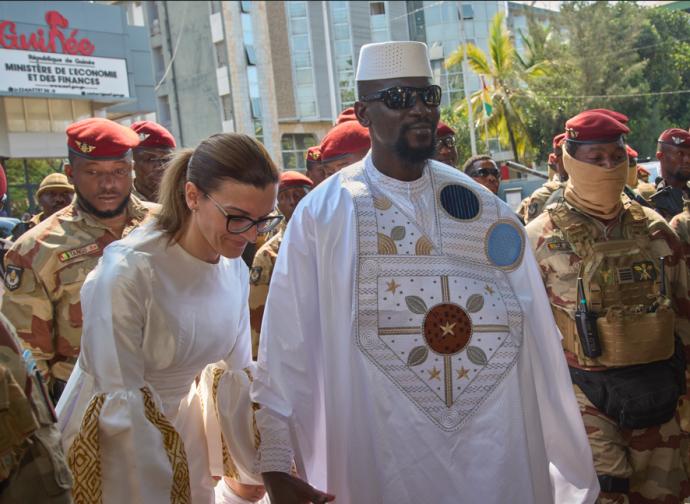
Within the space of a month, two African countries, Guinea Conakry and Uganda, held elections to elect their heads of state. These were two particularly important elections.
In Guinea, General Mamady Doumbouya won with an overwhelming 86.72% of the vote. However, the opposition alleged fraud during the vote count and claimed that the exclusion of the general's two main opponents, former President Alpha Condé and former Prime Minister Cellou Dalein Diallo, had influenced the outcome. Both Condé and Diallo have been in exile since the military seized power in a coup in 2021. Doumbouya himself led the coup and then assumed the role of interim president. The general had promised a rapid transition to democracy. He also assured voters that he would not run for office in order to make way for civilians. However, the elections were postponed several times for unspecified technical reasons, and Doumbouya eventually decided to run "for the good of the country".
In Uganda, the incumbent president, Yoweri Museveni, won with 71.6% of the vote. Like Doumbouya, Museveni is a military man who took power in a coup in 1986, defeating the dictator Tito Okello, who had deposed the previous year the dictator Milton Obote. Addressing the crowd after taking office, Museveni said, 'The people of Uganda, the African people, have a right to democratic government. It is not a concession from a regime. The people must be sovereign, not the government.” On that day, he also said that 'the problem with Africa, and Uganda in particular, is not the population, but leaders who want to stay in power for too long.' Since then, Museveni has ruled uninterruptedly for 40 years. In 1996, at the end of a ten-year democratic transition, the first elections were held, which Museveni won with 75.5% of the vote. Since then, he has won six more elections, all of which have been contested by the opposition on the grounds of intimidation, violence and fraud.
This is a truly unique democratic transition that has transformed a dictator into a head of state under questionable voting conditions. However, Doumbouya and Museveni are not the only ones to have interpreted it this way. Seven other coup leaders currently hold the office of president after running for election, almost all of them having given assurances that they would step down and allow others to govern their respective countries. These countries are Chad, Togo, Equatorial Guinea, Cameroon, the Republic of Congo, Gabon and Zimbabwe (the only country where the coup was led by a politician rather than a military figure).
In some of these countries, the leader who carried out the coup has been in power for decades. Paul Biya has been president of Cameroon since 1982, and on 12 October last year, he won the highly contested elections for the eighth time, securing another seven-year term. Denis Sassou Nguesso became president of the Republic of Congo (then the People's Republic of Congo) when he succeeded President Yhomby-Opango as vice-president after the latter was forced to resign. He held office until 1992, when Pascal Lissouba was elected president. Sassou Nguesso returned to power by fighting against Lissouba in 1997 and still holds office today. Teodoro Obiang Nguema Mbasogo has been president of Equatorial Guinea since 1979. Notably, Equatorial Guinea, along with Angola, will be the first African country to be visited by Pope Leo XIV. Since becoming president, he has seen five popes ascend to the papal throne.
In six other African countries, the democratic transition following a coup has yet to begin, and it will only be known then whether it will truly be democratic. These countries are Mali, Burkina Faso, Niger, Sudan, Madagascar and Guinea-Bissau. The leaders of the first three countries have announced their intention to remain president until at least 2030.
A total of 15 countries deserve the euphemistic label of 'imperfect democracies'. Others must be added to the list. Eritrea has never held an election since gaining independence from Ethiopia in 1993 after 30 years of war, and South Sudan has never held an election since gaining independence from Sudan in 2011 after decades of persecution and violence at the hands of the Sudanese government. In Somalia, which has been at war since 1987, there has been no election for over half a century. Since 2004, the election of the head of state has been entrusted to unelected parliamentarians. The inhabitants of Mogadishu, the capital, were the only ones to vote in municipal elections at the end of 2025.
"Without peace, security, and the rule of law, it is impossible to capitalise on the continent's enormous resources, and it is impossible to encourage more private capital investment in Africa. Democracy and good governance are the foundations on which Africa's progress must be based; without them, development is inevitably doomed to collapse under the weight of corruption and repression". This is the view of the Mo Ibrahim Foundation, which publishes the Ibrahim Index of African Governance every two years. The foundation was created by the eponymous billionaire, originally from Sudan, to promote good governance and democracy on the continent. The latest report, released in 2024, documented an increase in the persecution of opposition parties, the manipulation of electoral commissions, and the use of force to consolidate power. For the first time in ten years, it recorded a general decline in governance.
