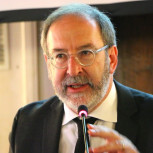
The death of Vittorio Messori, the greatest apologist of our times
The journalist and writer who, with millions of books sold in every language, nurtured generations of Catholics in the faith, died last night at his home in Desenzano sul Garda. However, his enduring legacy is the small church he built piece by piece on the grounds of Maguzzano Abbey. He was a great friend and inspiration to the La Bussola/Daily Compass.


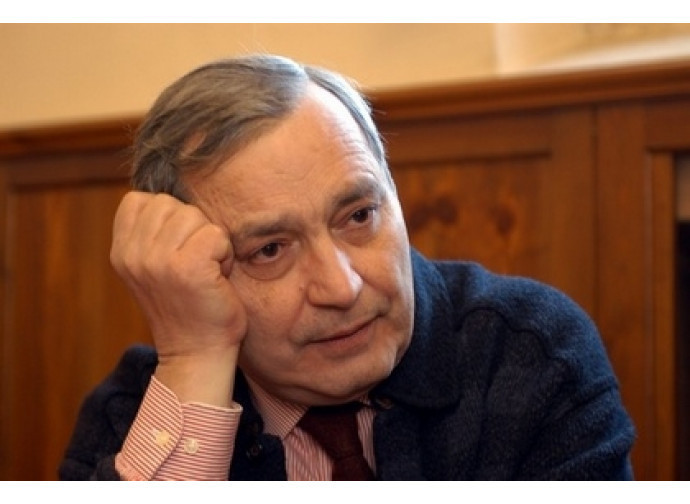
In a few days' time, he would have turned 85. Instead, last night at 9:10 pm, at sunset on Good Friday, Vittorio Messori's heart stopped beating. It is impossible to sum up in a few words what Messori meant to Catholic culture, not just in Italy. It is no coincidence that images of the covers of his books, translated into dozens of languages, adorn several walls in his home in Desenzano sul Garda.
Since publishing Hypotheses about Jesus in 1976 — the culmination of twelve years of investigative work following his sudden conversion to Catholicism — Messori had become a global reference point for the rebirth of apologetics. This was not a routine defence of the Church, but rather a serious and well-documented exploration of the reasons for faith. Reading even a single one of his books is enough to understand the seriousness and love for the truth that drove him. It is no coincidence that his personal research has brought many people back to the faith and helped them to grow in it.
Without him, La Bussola/Daily Compass would not exist today. His style served as an example and inspiration for Catholic journalists of the next generation. I was also fortunate enough to enjoy his friendship for several years, dating back to the days of the monthly magazine Il Timone, edited by Gianpaolo Barra, of which Messori was the founding father. He strongly encouraged the venture of La Bussola and even offered his collaboration during the early years, carving out precious time from his final works, which focused above all on the figure of Mary, and from what he perceived as the most important work of the final stretch of his earthly life: preparing for death and the encounter with Christ, who had fascinated him so much.
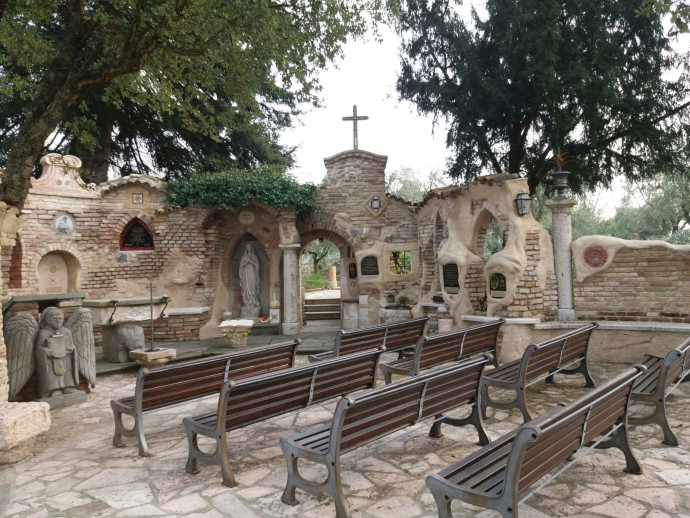
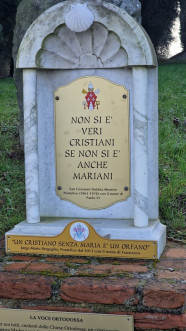 This included the significant effort he devoted to constructing the Chapel of Our Lady of the Olive Tree (Madonna dell’Ulivo) amidst the olive groves surrounding the Benedictine Abbey of Maguzzano, overlooking Lake Garda, which is now managed by the Poor Servants of Divine Providence, a priestly community founded by St. John Calabria.
Messori also had a room in the abbey that served as his personal office, where he went every day to work and pray.
Madonna dell’Ulivo is a small open-air chapel with walls reminiscent of the architecture of Antoni Gaudí. It was built piece by piece according to a design he had in mind, blending ancient and modern sacred objects into a harmonious whole that expresses the creator's love for Christ and the Virgin Mary. Every time we went to see him, it was a must-visit, and it was irresistibly fascinating to hear him explain every detail of the structure, as well as the origin and reason behind the latest additions.
My greatest regret is that I did not manage to make a video of Vittorio explaining the little church of Our Lady of the Olive Tree himself, so that everyone could share in the profound meaning of this work. His wife Rosanna Brichetti would have wanted this too, but unfortunately health problems and the difficulties linked to the pandemic made the project impossible. Evidently, God had other plans.
However, the fact remains that while his books bear witness to the rationality of faith and his intellectual quest, the little church of Madonna dell'Ulivo represents the culmination of his spiritual experience: a tangible expression of profound love and his living testament.
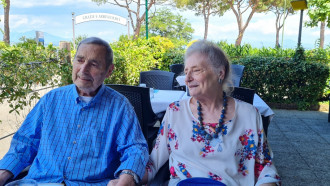 I have mentioned Rosanna, his wife, and not by chance. On 16 April, which is also Vittorio’s birthday and the day that Bernadette Soubirous, the visionary of Lourdes and a figure much beloved by Messori, was taken to heaven, it will be four years since her death. She was Messori's other great love, and their marriage was born of a unique story forged through a journey of suffering and itself a testament of faith. Rosanna herself chose to recount this story in a book published in 2018: Una Fede in Due – La Mia Vita con Vittorio (A Faith for Two: My Life with Vittorio). However, it was when meeting them together in the simplicity of a chat that one could sense that their deep bond with God was the source of the freedom they experienced and conveyed.
The lunches we shared were unforgettable – after visiting Maguzzano, the two of them, together with my wife and I, would sit on the shores of Lake Garda and speak simply about the life of the Church, our work, and the small and great things of our daily lives. These moments were so desirable and enjoyable not so much for what one could learn intellectually, but for the atmosphere we experienced, which brought St Paul’s exhortation to the Corinthians to life: ‘Whether you eat or drink, or whatever you do, do all for the glory of God’. It should also be noted for future reference that it was precisely around those tables that Rosanna’s collaboration with La Bussola—dedicated to Our Lady, with articles later collected in La Bussola’s book De Maria numquam satis—came into being, as well as the inspiration for La Bussola monthly apologetic magazine.
It is obvious to say that the passing of Vittorio Messori, following that of his wife Rosanna Brichetti, leaves a great void in Catholic culture. In reality, his death calls on us all to continue the work he carried out in his passionate, day-by-day exploration of the reasons for the faith, each in our own place.