
Pope in Africa: Echoes of Bergoglio and minor corrections
Ten days across four countries, marked by a sense of normality, with no major upheavals and no reduction of the Church to a social welfare agency. Uplifting yet predictable, Pope Leo XIV’s numerous addresses strike a balance between continuity with Pope Francis’s approach and a few ‘out-of-the-box’ observations on faith and reason, migration and the Church’s social doctrine.

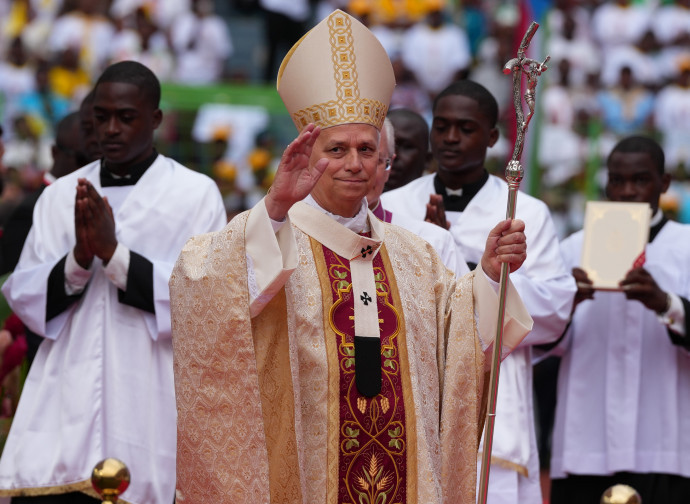
Pope Leo returned on 23 Aprile from his trip to Africa. He visited four countries – Algeria, Cameroon, Angola and Equatorial Guinea – and delivered many speeches. He presided over liturgical celebrations, met with various groups of people and won the affection of many crowds. He visited multiple aspects of the social and ecclesial life of those countries, too. He also found time to speak about the Church’s social teaching, both directly by explaining what it is and by addressing many social problems present in the countries visited in its light.
Now that he has returned home, it is possible to take stock of all his remarks and form an overview of his comments on issues dear to the Church’s social teaching, even if not of the entire trip.
The media took an interest in the Pope’s trip, mainly during the early days when the Trump issue flared up and was immediately defused by Pope Leo. For the rest of the trip, things proceeded fairly smoothly and predictably amidst the general enthusiasm of the African peoples hosting him and the routine newspaper reports.
Some were looking for hints of novelty compared to Francis, but none were found. Pope Leo XIV repeatedly quoted Pope Francis, even referring to his addresses to the Popular Movements, which had raised some concerns at the time. This can be explained in three ways. Firstly, the first anniversary of Francis's death coincided with the trip to Africa, making him 'present'. Secondly, it seems that the staff who drafted the speeches remained largely the same as during the previous pontificate. Thirdly, Leo himself was not keen to introduce anything new, both for reasons of institutional continuity and out of personal conviction.
Speeches at events of this kind always have a 'diplomatic' dimension and cannot offer disruptive diagnoses. In all his addresses in Africa, the Pope emphasised the continent’s potential, as well as the importance of civil society taking the lead in development. He also condemned deep-seated forms of exclusion that are still experienced there. In Angola, he denounced the ‘logic of extractivism’ of exploiting the country’s mineral resources. Given the current state of war in the world, he also condemned the use of God’s name to justify war. He affirmed the need to guarantee the rule of law and to overcome corruption. Naturally, he also repeatedly quoted Augustine on the proper meaning of power.
While these speeches were uplifting and hopeful, they were also predictable and expected. This approach has fostered an interpretation of this trip as normal and proceeding without upheaval. This is despite Africa offering various grounds for a fresh start.
Many African governments, for example, oppose Western (and ‘democratic’) pseudo-values regarding life and the family. The strongest opposition to Cardinal Fernández’s Fiducia Supplicans note, for instance, came from the African episcopate. The rhetoric of interreligious dialogue is being called into question in Africa itself due to religiously motivated violence against Christians.
While navigating such difficulties, Leo XIV has occasionally expressed views that are out of line, suggesting that he has more than one ghostwriter, each with a different theological and pastoral orientation. Let us give three examples.
On 21 April, when addressing the cultural community at the University Campus of the National University of Equatorial Guinea in Malabo, he discussed the tree of knowledge in relation to the trees of Eden and the Cross. 'The problem,' he said, 'therefore, does not rest with knowledge but in its deviation towards an intelligence that no longer seeks to correspond to reality, but rather to twist it to its own purposes.' The tree of the Cross helps to remedy this dysfunction 'not as a denial of human intelligence, but as a sign of its redemption'. This was a true expression of the intelligence of faith. 'Christ does not appear as a religious escape in the face of intellectual endeavors, as if faith began where reason ended. On the contrary, in Him the profound harmony between truth, reason, and freedom are manifested.' This is a discourse with far-reaching consequences, not only in Africa, if it is read and lived out.
On 17 April, during the meeting with the academic community at the Catholic University of Central Africa in Yaoundé (Cameroon), he told the young students: “In the face of the understandable tendency to migrate, which can lead one to believe that a better future can easily be found elsewhere, I first and foremost invite you to respond with an ardent desire to serve your country and put the knowledge you are acquiring here to the benefit of your fellow citizens. This is the raison d'être of your university, which was founded thirty-five years ago to train pastors and laypeople committed to society. These are the witnesses of wisdom and justice that the African continent needs.’ This remark implies a complete shift in perspective regarding the entire migration landscape.
Finally, let us recall the direct reference to the Church's social teaching made in Malabo on 21 April during the meeting with the authorities. Here, the Pope said: “Today, the Church’s social teaching offers guidance to all who seek to address the “new things” that destabilize our planet and human coexistence, while prioritizing, above all else, the Kingdom of God and his justice. This is a fundamental dimension of the Church’s mission: to contribute to the formation of consciences through the proclamation of the Gospel, the provision of moral criteria and authentic ethical principles — all while respecting individual freedom and the autonomy of nations and their governments”.
This is an important statement because it does not forget the proclamation of the Gospel or the search for the Kingdom of God; it does not reduce the Church to a social ethics agency.
