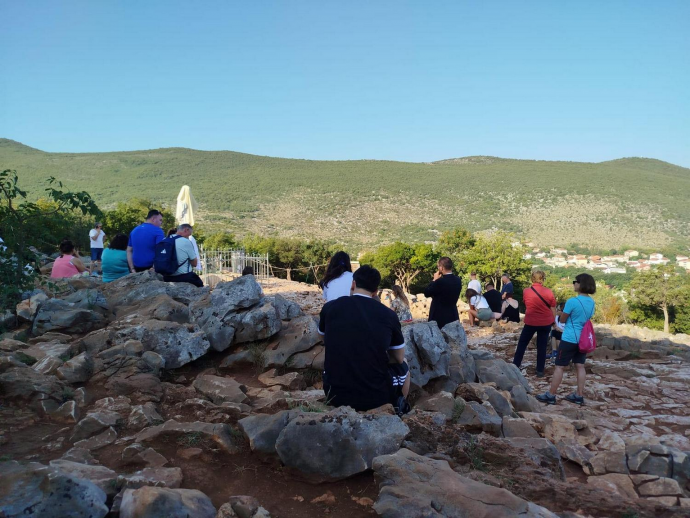
Medjugorje: parish responds with prayer after affront to Our Lady
During the night of 27–28 July, the statues of Our Lady on the Hill of Apparitions in Medjugorje were defaced with blasphemous graffiti; they have since been cleaned. A fire was also set at the outdoor altar of St James’s Church. These sacrilegious acts took place just a few days before Mladifest. The parish has responded by following the example of the Virgin Mary, through prayer, fasting and forgiveness.

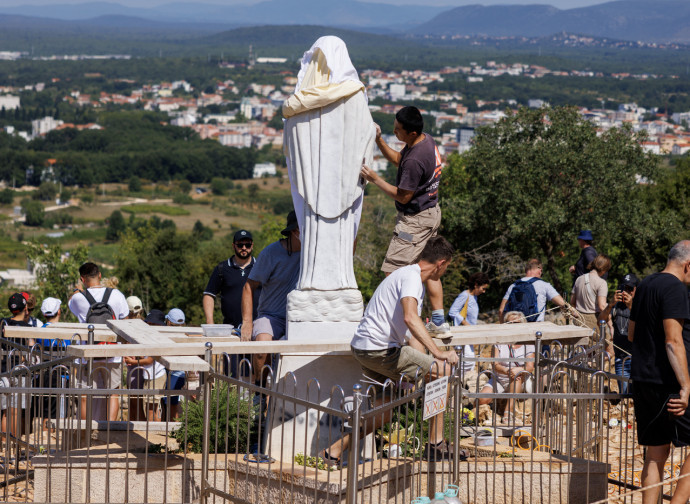
Disbelief, dismay and anger. These are the feelings sweeping through Medjugorje following the desecration on Podbrdo, the hill of the apparitions, where unknown individuals daubed black paint on three statues of the Virgin, defacing her face, torso, and part of her robe. In a place that attracts thousands of pilgrims from all over the world every day seeking prayer, silence and hope, this act is perceived as much more than mere vandalism. For millions of the faithful, it is a desecration and an offence against one of the most recognisable symbols of Marian devotion. The news, accompanied by images of the defaced statues, quickly spread around the world, fuelling a wave of outrage.
The symbolic significance of the act is all the more evident given the timing of the incident. It took place just a few days before the 37th International Youth Festival (Mladifest), which was due to take place in Medjugorje from 1 to 6 August. This is one of the most important events of the year, attracting tens of thousands of young people from every continent. The small village in Herzegovina is currently home to numerous pilgrims and volunteers busy with preparations. One of the most eagerly awaited events on the programme is the Rosary recitation on the morning of 2 August, right in front of the statue of Our Lady on the Hill of Apparitions – the very spot that was desecrated yesterday. It was precisely in this atmosphere of anticipation that the desecration took place.
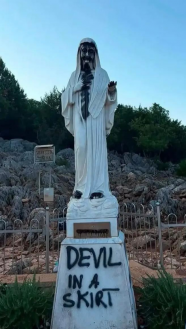 On the plinth of the famous statue, situated high on the hill, a message was scrawled in English: 'Devil in a skirt'. This offensive message sparked outrage amongst the pilgrims present. The use of such contemptuous language is striking. The intent to provoke is clear, and this appears to be a deliberate attack on what represents a sign of consolation and hope for millions of the faithful. The central issue concerns not only faith, but also the relationship between a society that considers itself free and democratic, and its symbols. Attacking them undermines the community and the identity of millions of people.
The act of vandalism, which has been attributed to a young man of Polish origin who has since been arrested, also affected another site of spiritual significance in Medjugorje: the Blue Cross at the foot of Podbrdo. Black paint appears to have been used again here, and the word 'devil' was scrawled on a nearby plaque.
The investigation will clarify the sequence of events and the perpetrator’s motives, but the evidence left at the scene suggests a clear intent to provoke.
Meanwhile, the statues have been cleaned and the graffiti removed. One question remains, however: what drives someone to turn religious symbols into a target? Violence often stems from the idea that that which represents the 'other' must be denied or humiliated. This dangerous dynamic can lead to different beliefs being confused with enemies to be fought. When anger is directed at religious symbols, it is not an isolated incident, but a sign of a deeper rift that could affect the whole fabric of civil society.
This incident also brings to mind a similar one from 2008, when the statue of Our Lady on the Hill of Apparitions was damaged by unknown perpetrators. On that occasion, the Medjugorje community reacted decisively, refusing to allow the act to undermine the serenity and peace of the place. Once again, the parish of Medjugorje has opted for a firm yet measured response. In a statement issued after the desecration, the parish expressed sadness at what had happened and called on the faithful and pilgrims to practise forgiveness and prayer. This stance does not downplay the seriousness of the incident, but rather refuses to fuel a spiral of confrontation.
Restoration work began immediately. The statues on Podbrdo and the outdoor altar at St James’s Church, which is situated beneath a large white awning near where a fire was set with the intention of damaging the recently replaced fire-resistant awning, have been cleaned and repaired. This allows those present to continue their pilgrimages in peace. The message from the parish community is clear: the response to this desecration will be care, not hatred. Father Filippo Romagnoli of the 'Totus Tuus' Centre of the Maria Regina dei Cuori Association (the Montfortian Spirituality Centre in Medjugorje) also echoes this call. In line with the parish's message, the priest invites the faithful to respond to the incident 'in the way Our Lady has been teaching for over forty years in Medjugorje: through prayer, fasting and forgiveness'. He therefore urges us to pray 'for the conversion of the hearts of those who committed this act, so that the Lord may touch them with his grace and guide them along the path of goodness', as well as 'for peace in the hearts of all'. The appeal concludes with a call not to be swept away by the search for culprits or by emotional reactions, but rather to bear witness 'through one's own life to love, forgiveness and hope', responding to evil without fuelling further division. The Interfaith Council of Bosnia and Herzegovina has also strongly condemned the incident, describing it as an offence not only against the Catholic faithful, but also against coexistence, mutual respect, and dialogue between the country's religious communities.
While continuing to welcome pilgrims from all over the world, Medjugorje wishes to respond to this wound with the message that has always characterised this place: peace, hope and reconciliation. However, in the coming days, thousands of young people will make their way up the hill of the apparitions, where they will recite the Rosary during Mladifest before the very statue that was desecrated. This simple gesture carries great symbolic significance: a determination to let prayer, not anger and the desire for revenge, prevail; and to let the meaning of a place that has drawn people seeking faith, consolation and peace for forty-five years not be overshadowed by provocation. This is probably the strongest response that Medjugorje can offer in the face of an act of hatred: continuing to welcome people, praying and building bridges of dialogue without losing hope.