
France: Bishop officiates at funeral of Macron’s Freemason friend
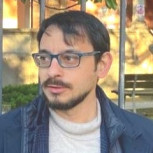
A church funeral was held for François Patriat, a prominent figure in Freemasonry, Macron’s party and an advocate of abortion and euthanasia. The president himself also delivered a speech in his memory from the pulpit, while the bishop of Dijon officiated at the service. He paid no heed to the deceased’s membership of the Freemasons and his views on abortion and euthanasia, which the deceased had never publicly renounced.


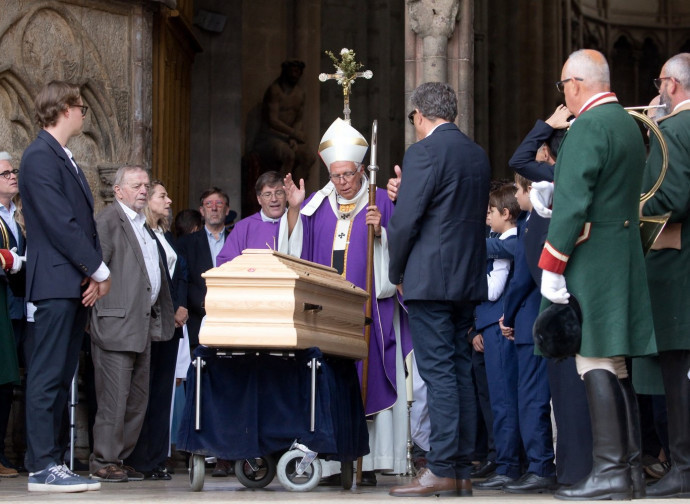
A Freemason and supporter of euthanasia was buried with a church funeral conducted by the bishop himself. This took place in the French diocese of Dijon, where news of the double ban issued by Rome and San Remo on the funerals of two Freemasons must not have reached. The deceased, Senator François Patriat, was a distinguished and affiliated figure who passed away at the age of 83 on 19 August following a cycling accident. On 25 August, the funeral service was celebrated at the collegiate church of Notre-Dame in Semur-en-Auxois, the birthplace of the late politician, by Monsignor Antoine Hérouard, the Bishop of Dijon. A large number of politicians ranging from the Élysée Palace downwards were in attendance. Patriat was by no means an unknown figure. As well as being well known for his Masonic affiliation, he was also renowned for his career in local and national politics: He was Minister for Agriculture under the Jospin government, President of the Regional Council of his native Burgundy and a senator from 2008 until his death. He began his long career in the Socialist Party and, from its foundation, went on to become a leading figure in Emmanuel Macron’s Renaissance party.
The President of the Élysée Palace delivered a long and moving tribute to 'François the Invincible', known to his friends as 'Fanfan', to those present from the pulpit. For a full 13 minutes, Macron delivered a speech more suited to a campaign rally than a place of worship, celebrating both the deceased and himself. He recalled 6 April 2016, the date the party was founded, and how Fanfan was present (‘il était là!’). On the way, he stopped at Amiens Cathedral to light a candle because ‘he was a socialist who believed in providence’ – words reminiscent of ancient ‘panegyrics’ in honour of the saints. The bishop described Patriat’s relationship with Catholicism as 'evolving' and centred his homily on the journey, expressed in terms of 'commitment', 'hope' and 'covenant', since 'for Christians, truth is not a philosophical or political system; truth is, first and foremost, someone in whom we place our trust and who invites us to walk with Him', specifying that 'we believe that Jesus opens up the path of life for us'.
However, the meaning of this 'evolving' relationship remains a mystery that might have remained within the personal sphere of the deceased, were it not for the fact that there is a public — and, more specifically, political — sphere at odds with the Church on ethical issues, at least.
On the very day of the funeral, the Catholic website Tribune Chrétienne raised the issue, noting that 'François Patriat was also known for his membership of Freemasonry, a membership he openly acknowledged throughout his career'. The pro-Masonic French publication 450.fm refers specifically to the 'passing to the Eternal East' of 'Brother François Patriat' and complains that, upon the death of public figures affiliated with Masonic lodges, their membership is generally overlooked by the media and only highlighted by outlets hostile to Freemasonry. The article directly and explicitly references the Tribune Chrétienne piece.
Let us return to the party founded on 6 April 2016 with the indispensable support of Fanfan, who served as its Senate leader until his death. The party strongly championed the inclusion of abortion in the constitution, and more recently the euthanasia law, enacted in August. This was a law to which Patriat was by no means opposed. In fact, on 28 May 2025, he welcomed its progress through Parliament, hoping that the 'response from public opinion' would also make inroads in the Senate. 'Given that 85 per cent of the French population is in favour,' he commented, 'it is clear that this movement is reaching elected representatives, including senators, who can sometimes be a little more reactionary.'
As for abortion, one need only revisit Patriat’s jubilant post on X dated 4 March 2024, the day abortion became a constitutional right: 'It is up to France, which remains the symbol of liberty and equality in the eyes of the world,' commented the senator, 'to solemnly reaffirm these principles and guarantee fundamental freedom of women to choose their own motherhood in the sacred text of the Constitution.'
Should this not be enough to advise Monsignor Hérouard not to attend, or indeed to grant a church funeral (in accordance with canon law) to a prominent Freemason who has translated its agenda into political action? The prelate’s presence is all the more surprising given that the French bishops have generally taken a firm stance on end-of-life issues, helping to secure conscientious objection for private institutions, including Catholic ones, which Macron’s bill had otherwise excluded. What took place in Patriat’s soul right up to the very last moment is his own affair (and God’s), but the same cannot be said of the external 'fact', the celebration of the funeral – a funeral that amounted to a celebration of a Freemason and an advocate of abortion and euthanasia. However 'evolving' he may have been, he does not appear to have publicly renounced certain positions.
